Europe’s Unlikely Architect: How Trump’s Influence is Forging a New Era of Strategic Tech Autonomy
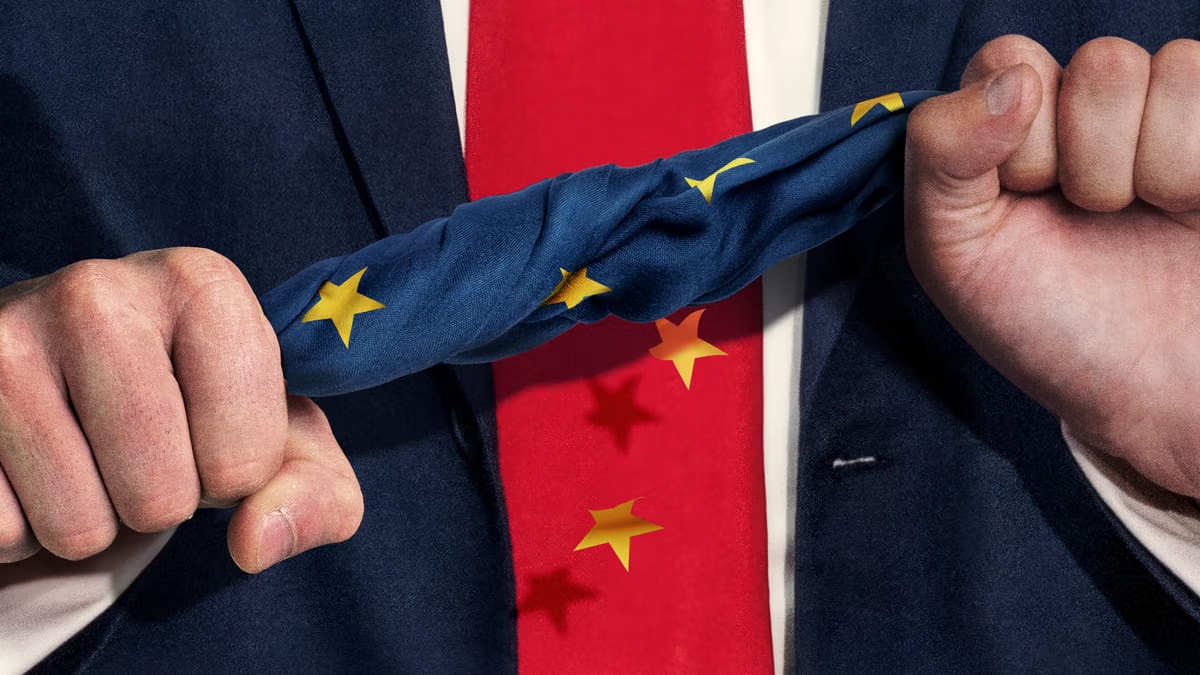
In the intricate dance of global geopolitics, it’s rare for a leader to exert profound, lasting influence far beyond their own borders and even after leaving office. Yet, an intriguing argument posits that Donald Trump, despite never holding a European post, has become a de facto “President of Europe” – not through direct election, but through a catalytic, transformative impact on the continent’s strategic direction. This isn’t just about ephemeral politics; it’s a seismic shift with profound implications for Europe’s technological future and its global standing.
For decades, the prevailing narrative of Europe’s defense and foreign policy was largely one of reliance, particularly on the unwavering commitment and military might of the United States. NATO, while fundamentally a collective security alliance, often saw Washington as its unequivocal anchor, providing the lion’s share of military capabilities and strategic guidance. European nations, comfortable under this security umbrella, often underinvested in their own defense infrastructure and neglected to develop a truly cohesive, independent foreign policy apparatus. This era of comfortable dependency, however, was dramatically disrupted by the arrival of Donald Trump on the global stage.

Enter Donald Trump, whose “America First” doctrine and overt skepticism towards traditional alliances sent shockwaves reverberating across European capitals. His relentless pressure on NATO allies to significantly increase defense spending, coupled with a perceived wavering commitment to the alliance’s sacred Article 5 – the cornerstone of collective security – ignited a crucial, long-overdue reckoning. This wasn’t merely a request for higher contributions; it was an existential challenge to the very foundation of Europe’s post-war security architecture, forcing European leaders to confront a potential future where American support could no longer be taken for granted.
The key takeaway from this turbulent period isn’t just about budget lines or the percentage of GDP allocated to defense; it’s about a fundamental reorientation of the European mindset. Trump inadvertently forced Europe to stare down its vulnerabilities and confront the absolute necessity of “strategic autonomy.” This isn’t just a fancy diplomatic term; it’s the profound realization that Europe needs to be able to act, defend itself, and project its interests independently when necessary, rather than solely relying on external powers, however benevolent or historically aligned. The subsequent unprovoked war in Ukraine, a horrific tragedy unfolding on Europe’s doorstep, only accelerated this awakening, solidifying the understanding that the continent’s security and prosperity could no longer be taken for granted, and that a robust, self-reliant defense posture was not a luxury, but an imperative for survival in a volatile world.
Beyond the Barracks: The Dawn of Technological Sovereignty
While the immediate conversations sparked by Trump’s tenure centered on tanks, troop numbers, and traditional military capabilities, the concept of strategic autonomy ripples far beyond conventional defense. For a continent as technologically advanced, economically sophisticated, and interconnected as Europe, true independence and resilience must extend deeply into the digital realm. This is precisely where the “Trump Effect” takes on a distinctly tech-centric dimension, propelling Europe towards a future defined by technological sovereignty as a cornerstone of its strategic independence.
A Europe committed to genuine strategic autonomy is, by definition, a Europe that must also aggressively pursue and secure its **technological sovereignty**. This means meticulously building the capacity to control its own digital destiny, reducing critical dependencies, and ensuring that its core technological infrastructure and innovation capabilities reside firmly within its borders and under its regulatory control. This shift is not just about protection; it’s about empowerment and becoming a global leader in shaping the future of technology.
Investing in Indigenous Tech: Fostering European Innovation
The drive for technological sovereignty necessitates a significant and sustained investment in indigenous European technology. This means less reliance on foreign giants for critical digital infrastructure, cloud computing services, artificial intelligence development, and cutting-edge cybersecurity solutions. Historically, Europe has often been a market for tech innovations developed elsewhere, particularly in the United States and, increasingly, China. The new imperative is to foster homegrown European champions in these crucial sectors, not just to consume technology, but to create it, own it, and control its evolution. Initiatives like Gaia-X, a European project to develop a secure, federated data infrastructure, and increased funding for AI research under the European AI Act, are clear indicators of this strategic pivot. The goal is to ensure that European values and regulatory standards, such as privacy and data protection, are baked into the fundamental architecture of future digital systems, rather than being retrofitted onto foreign platforms.
Securing Supply Chains: Building Resilience and Diversification
The global pandemic, coupled with geopolitical tensions, starkly exposed the profound fragility of global supply chains. Europe, like many regions, found itself vulnerable to disruptions in the availability of vital components, from medical supplies to critical semiconductors. A Europe truly seeking strategic autonomy will, therefore, prioritize the diversification and “friend-shoring” of its supply chains for semiconductors, rare earth minerals, advanced materials, and other vital components. This strategy aims to reduce dependence on single, potentially volatile, or geopolitically sensitive sources, thereby safeguarding its industrial base and technological independence. The European Chips Act, for example, is a testament to this commitment, aiming to bolster domestic semiconductor manufacturing capacity and secure Europe’s position in this foundational technology. This isn’t about isolation, but about building robust resilience and ensuring uninterrupted access to the building blocks of the digital economy.
Data Governance and Privacy: A Distinct European Digital Model
Europe has already distinguished itself as a global leader in data governance and privacy with the implementation of the General Data Protection Regulation (GDPR). The intensified drive for strategic autonomy will likely strengthen Europe’s resolve to protect its citizens’ data within its borders, further fostering a more secure and trustworthy digital ecosystem that operates distinctly from American or Chinese data models. This commitment extends beyond mere regulation; it involves developing the technical infrastructure and legal frameworks necessary to create sovereign data spaces, where data flow is controlled, transparent, and aligned with European values. The aim is to ensure that European data, which is increasingly valuable, remains under European control, preventing its exploitation by foreign entities and safeguarding fundamental rights in the digital age. This distinct approach positions Europe as a potential standard-setter for ethical and human-centric technology development globally.
Dual-Use Technologies: Bridging Military and Civilian Innovation
Increased defense spending in Europe isn’t just about purchasing existing arms or replenishing stockpiles; it’s about making substantial investments in cutting-edge research and development for “dual-use technologies.” These are innovations that serve both military and civilian applications, creating a powerful synergy between defense and commercial sectors. From advanced robotics and autonomous systems to quantum computing, secure communications (including quantum-resistant cryptography), and next-generation materials, these technologies are crucial for both national security and economic competitiveness. By fostering innovation in these areas, Europe aims to create a virtuous cycle where defense R&D fuels civilian technological advancement, and vice-versa. This not only bolsters military capabilities but also stimulates economic growth, creates high-tech jobs, and ensures that Europe remains at the forefront of global technological development, reducing its reliance on foreign suppliers for critical strategic capabilities.
The Road Ahead: A More Independent, Tech-Savvy Europe?
The path to full strategic autonomy, particularly in the complex and rapidly evolving technological landscape, is undoubtedly fraught with significant challenges. It requires immense and sustained political will across the diverse tapestry of 27 nations, each with its own national interests and priorities. It demands significant financial investment, not just in defense budgets, but also in foundational research, infrastructure, and talent development. Furthermore, it necessitates a willingness to overcome internal disagreements, harmonize regulatory frameworks, and foster greater integration and cooperation among member states on a scale perhaps unprecedented since the founding of the European Union.
However, despite these formidable hurdles, the trajectory is clear. Even if future US administrations revert to more traditional, alliance-based approaches, the genie of European strategic thinking is irrevocably out of the bottle. The profound shift in mindset catalyzed by the “America First” era and accelerated by geopolitical realities means that Europe will continue to prioritize self-reliance and the development of its own capabilities. Trump’s presidency, intentionally or not, provided the undeniable impetus for Europe to forge a new, more self-assured identity – one more self-reliant, more unified in its strategic thinking, and crucially, more determined than ever to control its own technological destiny. This isn’t just a political narrative; it’s an economic and technological imperative that will reshape global power dynamics and accelerate Europe’s pursuit of digital leadership on the world stage. The unintended legacy of an “America First” foreign policy might just be a more formidable, tech-independent Europe, poised to exert its influence and values more decisively in the 21st century.
Read the original story at Politico Europe.
What do you think will be the most significant challenge for Europe in achieving full technological sovereignty, and how might it impact global tech competition?