Europe’s Enduring Challenge: Sustaining Support for Ukraine in a Marathon War
The initial, adrenaline-fueled sprint of European support for Ukraine is undeniably over. The vivid blue and yellow flags that once fluttered from nearly every window, symbolizing a continent united in shock and defiance, have now been weathered by the relentless sun and rain. This fading imagery serves as a potent metaphor for the new, grinding phase of the conflict: a long, arduous marathon that demands endurance and sustained resolve, not just immediate passion. As the war settles into this drawn-out struggle, a different and arguably more complex battle is unfolding—one fought not on the devastated fields of the Donbas, but within the intimate confines of living rooms and the echoing halls of power across Europe.
The central challenge facing European leaders and policymakers today transcends the immediate logistics of mustering advanced weaponry or implementing further rounds of punitive sanctions. Instead, it pivots fundamentally on the ability to sustain the essential public will to see Ukraine’s fight for freedom through to a just and lasting conclusion. This is a critical pivot, shifting from crisis management to a long-term strategy built on the foundation of public understanding and continuous support.

When Russia launched its full-scale invasion in February 2022, a profound wave of shock, indignation, and absolute solidarity galvanized the continent. The moral clarity of the situation was absolute, and the unity displayed by European nations was unprecedented. This initial, robust response provided a critical lifeline to Ukraine and sent an unequivocal message to Moscow. However, the staying power of that unity, forged in the heat of immediate crisis, is now facing its sternest and most persistent test.
The Creeping Shadow of Ukraine Fatigue: A Tangible Threat to European Unity
The creeping shadow of “Ukraine fatigue,” once a distant concern discussed only in analytical circles, has now emerged as a tangible and potent political reality. This fatigue is not merely indifference; it is a complex interplay of competing priorities, economic pressures, and the sheer mental exhaustion of prolonged conflict. Kitchen-table issues—the relentless bite of inflation, the soaring costs of energy bills threatening to cripple household budgets, and the pervasive, looming economic anxieties of what promises to be a long and challenging winter—are increasingly beginning to compete with, and in some cases even eclipse, the existential struggle happening on Europe’s eastern flank. For many citizens, the immediate pressures on their personal finances and daily lives take precedence over geopolitical concerns, however vital they may be.
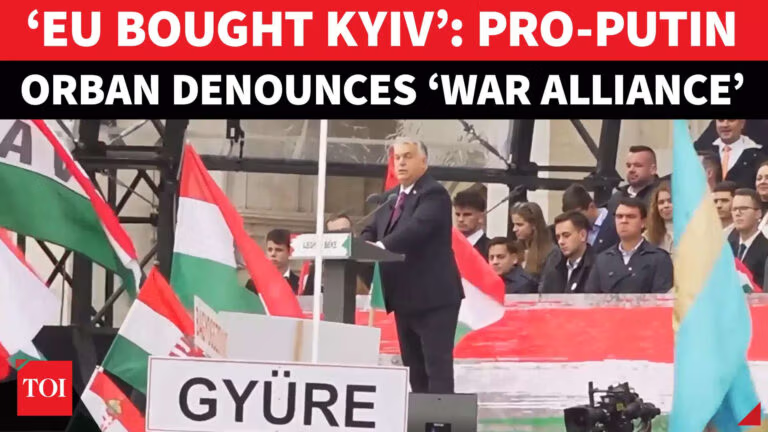
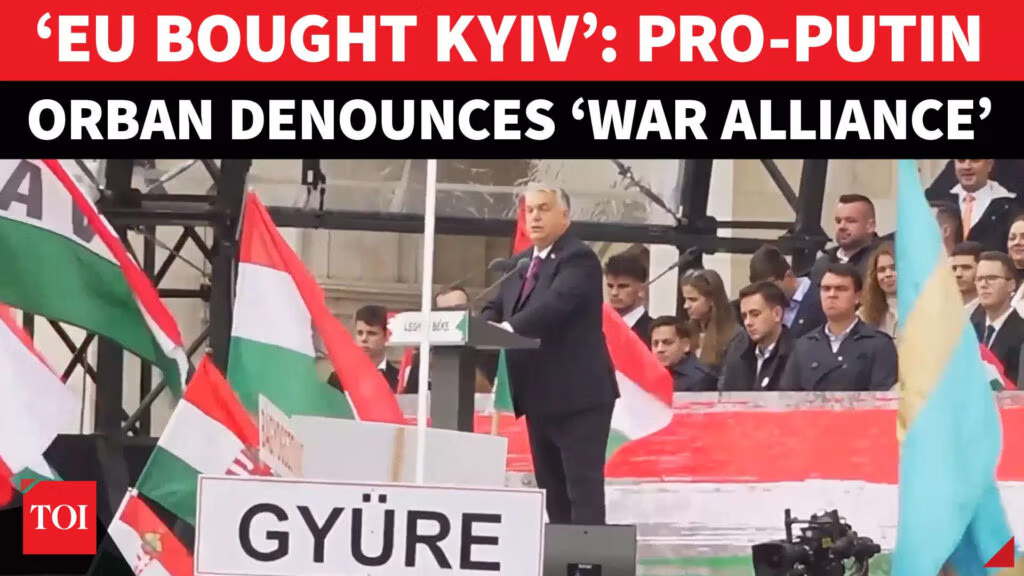
This stark reality is what policy experts across the continent are now urgently highlighting, warning that neglecting this shift in public sentiment could have profound consequences. The conversation among strategists is visibly shifting from the immediate crisis response, focused on urgent aid and sanctions, to the more profound and long-term strategic necessity of keeping European populaces deeply invested and engaged in Ukraine’s fight. This represents a delicate and often precarious balancing act for national leaders, who must skillfully justify vast expenditures on military and financial aid to electorates who are feeling an ever-tightening pinch at home. The populist sirens, ever-present in European politics, who argue vehemently for prioritizing purely domestic problems over what they often dismiss as costly and distant foreign entanglements, are finding an increasingly receptive and anxious audience. Their narrative, often simplified and emotionally charged, resonates strongly with those struggling economically.
Beyond Aid Packages: The New Imperative of Strategic Communication
So, what does this evolving landscape mean for the future trajectory of European support for Ukraine? Fundamentally, it means that the next phase of European leadership will be defined as much by astute and consistent communication as it will by sound policy. It is no longer sufficient for leaders to simply approve the next substantial aid package or attend another high-level summit to reaffirm their commitment. They must now consistently, persuasively, and transparently articulate the profound stakes involved to their people. This is a critical distinction: the argument must be made, and crucially, remade repeatedly, that support for Ukraine is not about charity or altruism alone; it is fundamentally about Europe’s own security and long-term stability.
The core message must be crystal clear: a stable, sovereign, and democratic Ukraine represents a direct and essential investment in a stable, secure, and democratic Europe. Ukraine, in this framing, is not just a recipient of aid; it is the vital buffer, the frontline defender against a revanchist and increasingly aggressive Russia whose imperial ambitions demonstrably do not end at Ukraine’s internationally recognized borders. History, after all, offers numerous cautionary tales of aggressors emboldened by appeasement or indifference. European leaders must articulate the grim potential consequences of a Russian victory, detailing how it could destabilize the entire continent, embolden authoritarian regimes globally, and fundamentally undermine the international rules-based order that underpins European prosperity and peace.
Framing the Costs: An Insurance Policy for Europe’s Democratic Future
The challenge for European leadership, therefore, is to reframe the significant costs associated with supporting Ukraine—both financial and economic—not as an onerous burden to be resented, but as a necessary and indeed vital premium on an indispensable insurance policy for the entire continent’s democratic future. This reframing requires courage, intellectual honesty, and a profound commitment to public education. It means drawing clear, compelling connections between the struggles in Ukraine and the daily lives of citizens in Berlin, Paris, Rome, and Warsaw. It means demonstrating how a stronger, more resilient Ukraine directly contributes to lower geopolitical risks, more stable energy markets in the long run, and the preservation of fundamental freedoms that Europeans often take for granted.
Without this sustained public buy-in—this continuous, active consent from the citizenry—political resolve among leaders can, and most assuredly will, fray under pressure. Upcoming elections across Europe will inevitably be fought and won primarily on domestic platforms, with candidates focusing on local economic woes, social issues, and national interests. In such an environment, the pressure to divert resources, attention, and political capital inward, away from what might be perceived as external conflicts, will become immense and potentially overwhelming. The siren calls of isolationism and protectionism, often cloaked in arguments of pragmatic self-interest, will grow louder, challenging the unity and shared purpose that defined the early days of the conflict.
Countering Populist Narratives and Economic Headwinds
To effectively counter these powerful centrifugal forces, European leaders must employ a multi-faceted approach. Firstly, they must be rigorously transparent about the costs and benefits of their policies towards Ukraine. Obfuscation or downplaying the economic impact will only fuel distrust. Secondly, they need to proactively address domestic economic challenges with robust policies, demonstrating that they are not ignoring their citizens’ immediate concerns while also supporting Ukraine. This includes targeted relief for vulnerable households, investment in renewable energy to reduce dependence on volatile fossil fuel markets, and measures to combat inflation.
Thirdly, and critically, they must empower and leverage civil society organizations, think tanks, and media outlets to help articulate the long-term strategic importance of Ukraine’s fight. This isn’t about propaganda, but about fostering an informed public discourse. Regular, accessible briefings from experts on the geopolitical implications, the nature of Russia’s aggression, and the humanitarian crisis can help maintain empathy and understanding. Leaders must connect with ordinary people, visiting communities, engaging in town hall meetings, and using all available communication channels to explain why this matters, not just what is being done.
Furthermore, demonstrating tangible successes and progress, however incremental, in Ukraine’s defense and resilience can also serve to invigorate public support. Highlighting the effective use of aid, the bravery of the Ukrainian people, and the strategic setbacks for Russia can remind citizens of the impact of their collective effort. It reinforces the notion that their contributions are making a difference and are part of a winning strategy for European security.
The Geopolitical Stakes: A Revanchist Russia and the Future of Europe
The argument for continued solidarity with Ukraine extends far beyond mere humanitarian concern; it is anchored in a sober assessment of European security architecture and geopolitical stability. A victorious Russia, having successfully annexed or subjugated Ukraine, would fundamentally alter the balance of power in Europe, potentially ushering in an era of heightened instability and renewed Cold War-style tensions. This is not merely a hypothetical scenario; Russia’s historical aggression, its disregard for international law, and its stated ambitions to restore a sphere of influence indicate a clear and present danger to neighboring European nations and, by extension, the entire continent.
Moscow’s revanchist tendencies, its willingness to use force to redraw borders, and its weaponization of energy and information represent a direct challenge to the very principles upon which the modern European Union was built: peace, cooperation, and respect for national sovereignty. Allowing Russia to succeed in Ukraine would send a chilling message globally, signaling that aggression can pay off, and that the international community lacks the resolve to defend democratic values and territorial integrity. This would have profound implications for global security, potentially emboldening other authoritarian regimes and leading to a more volatile and dangerous world.
Therefore, supporting Ukraine is not just about defending Ukraine; it is about defending the foundational principles of European security and global order. It is about ensuring that the cost of aggression remains prohibitively high, thereby deterring future adventurism. It is about safeguarding the democratic future of Europe itself, ensuring that decisions are made by free and sovereign nations, not dictated by an expansionist power.
Securing the Lifeline: Unwavering Public Will
For European leaders, the new imperative is unequivocally clear: the most critical supply line to Ukraine may not be one laden with tanks, artillery shells, or financial aid, but rather one composed of unwavering public will and sustained political resolve. Securing and maintaining this intangible but incredibly powerful line will necessitate a relentless campaign of political courage, strategic communication, and an honest, transparent conversation about the true price of freedom—not only for Ukraine, but, perhaps more poignantly, for Europe itself.
This means moving beyond platitudes and delving into the uncomfortable truths about the long-term commitment required. It means acknowledging the sacrifices, both economic and social, that European citizens are being asked to make. But it also means reiterating the profound value proposition of these sacrifices: a more secure, stable, and democratic continent for future generations. The battle for hearts and minds is now paramount, and its outcome will determine the future course of the war and, indeed, the future of Europe. It demands leadership that can inspire, educate, and unify, ensuring that the initial burst of solidarity transforms into an enduring commitment.
What do you believe are the most effective strategies European leaders can employ to combat “Ukraine fatigue” and maintain strong public support for the long haul?
Read the original story at France 24.