The Unthinkable Alliance: Eric Adams Endorses Andrew Cuomo for a Comeback, Reshaping New York Politics
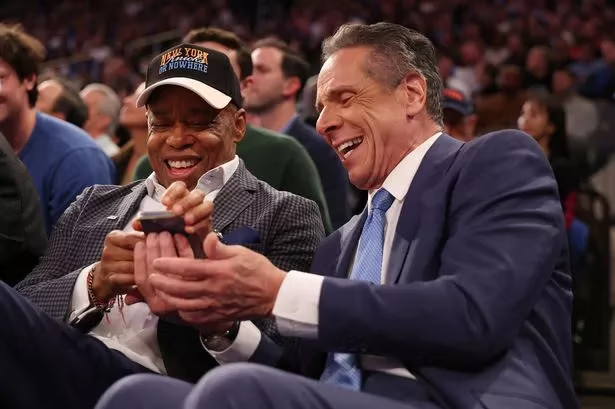
In a seismic shift that has sent shockwaves through the very bedrock of New York’s political establishment, Mayor Eric Adams delivered an endorsement that was nothing short of a political resurrection for a former rival and a direct challenge to the state’s current leadership. Standing before a captivated audience, the Mayor of New York City didn’t just offer a polite nod to a former governor; he issued a clarion call for his return to power, unequivocally stating, “I’m a Cuomo fan. I told him, I said ‘Andrew, you should come back.'” This wasn’t merely a friendly gesture between former colleagues; it was a strategically calculated political bombshell designed to redraw the battle lines within the state’s already fractious Democratic Party.
The audacity of Adams’ move cannot be overstated. Andrew Cuomo, a figure who departed Albany under a cloud of scandal involving allegations of sexual harassment and a contentious investigation into nursing home deaths during the pandemic, has been a pariah to many within the party. For Adams, himself no stranger to political machinations and currently navigating a federal investigation into his campaign finances, to openly champion Cuomo’s comeback signals a profound realignment of power and a bold gamble on the political appetites of New Yorkers. This endorsement immediately thrusts the possibility of “Cuomo 2.0” from the realm of speculative whispers into the very heart of public political discourse, forcing a reevaluation of who holds sway in the Empire State.

Unpacking Adams’ Rhetoric: “America, Not Europe” and the Quest for Strong Leadership
Mayor Adams’ praise for Andrew Cuomo was meticulously crafted, centering on the narrative of a strong, decisive leader who possessed an unparalleled ability to “get stuff done.” Adams deliberately evoked powerful memories of Cuomo’s command during moments of extreme crisis, particularly his highly visible and often praised leadership during the aftermath of Superstorm Sandy and the turbulent, early days of the COVID-19 pandemic. In Adams’ recounting, Cuomo emerges not just as a formidable political operator, but as an indispensable figure capable of steering New York through its darkest hours, painting a picture of competence that Adams clearly believes is lacking elsewhere.
However, the most revealing and arguably most potent part of Adams’ remarks was a peculiar, almost cryptic, piece of rhetorical flourish. “We can’t be this city, this state, that we can’t be Europe,” Adams declared. “We have to be America. We have to be New York.” This was far from a throwaway line; it was the ideological core of his message, a carefully coded statement loaded with political meaning within the context of New York’s dynamic political landscape. In the nuanced vernacular of New York politics, Adams was drawing a stark line in the sand, advocating for a specific brand of governance that stands in direct opposition to what he perceives as a more progressive, consensus-driven, or overly bureaucratic approach.
When Adams states “We can’t be Europe,” he is not referring to geography. Instead, he is tacitly critiquing what he and others on the more centrist or conservative wing of the Democratic Party often perceive as a tendency towards European-style social democracy – characterized by extensive social safety nets, perceived bureaucratic inertia, and perhaps a less aggressive stance on issues like public order or business regulation. This “European” model, in his view, might be seen as antithetical to the more rugged, individualistic, and results-oriented ethos he believes defines “America” and, more specifically, “New York.”
Conversely, his call to “be America, be New York” champions a brand of tough, centralized, and unapologetically pro-business governance. This ethos aligns perfectly with the Cuomo model – a style of leadership known for its focus on infrastructure projects, fiscal pragmatism (often at odds with progressive spending priorities), and a forceful, often confrontational, approach to problem-solving. It’s a vision that prioritizes visible action, economic growth, and a strong hand in public safety, even if it means clashing with legislative bodies or progressive advocacy groups. This was, unmistakably, a thinly veiled critique of the current political climate in Albany and, by direct extension, a potent broadside aimed squarely at Governor Kathy Hochul, Cuomo’s successor, with whom Adams has cultivated a publicly tense and often fractious relationship over policy, funding, and ideological direction.
The Profound Implications: Reshaping New York’s Political Landscape
The reverberations of this seemingly casual endorsement are profound and promise to reshape the future trajectory of New York State politics for years to come. Adams’ declaration is not merely a gesture of goodwill; it is a strategic political move with far-reaching consequences that touch upon fundraising, party dynamics, and the very perception of leadership.
1. A Massive Boost for Andrew Cuomo’s Rehabilitation Tour
Perhaps the most immediate and tangible effect of Adams’ endorsement is the monumental boost it provides to Andrew Cuomo’s long-simmering and often-criticized rehabilitation tour. Since his dramatic resignation, Cuomo has engaged in a calculated effort to re-enter public life, primarily through a podcast, carefully selected media appearances, and op-eds designed to reframe his narrative and highlight his perceived successes. An endorsement from the mayor of the nation’s largest and most influential city, particularly one with Adams’ public persona and electoral mandate, lends an undeniable degree of legitimacy to the audacious idea of a “Cuomo 2.0.”
This public backing signals to a crucial array of political actors – potential donors, influential power brokers, and the broader voting public – that a return to political power for Cuomo is no longer merely the fantasy of a disgraced politician. Instead, it is a tangible possibility actively being discussed, deliberated, and, more importantly, publicly supported in the highest echelons of city government. Such an endorsement helps to chip away at the narrative of disgrace, replacing it with one of potential redemption or, at the very least, renewed relevance. It encourages those on the fence to reconsider Cuomo as a viable force, potentially opening doors to funding, media opportunities, and renewed public interest that his solo efforts have largely struggled to achieve. The Adams endorsement transforms Cuomo from an outcast seeking validation into a contender with significant political backing, fundamentally altering the calculus for any future political endeavors.
2. Igniting a Shadow War for the Future of the New York Democratic Party
Beyond bolstering Cuomo, Adams’ endorsement formally ignites what can only be described as a shadow war for the ideological and leadership future of the New York Democratic Party. By championing her predecessor, Adams is openly challenging Governor Kathy Hochul’s authority, her legitimacy as the state’s leader, and her chosen direction for New York. He is not merely disagreeing with her; he is positioning himself as a kingmaker, or at the very least, a significant counterweight to gubernatorial power, capable of influencing the party’s direction from his perch in City Hall.
This move creates a powerful counter-narrative to Hochul’s leadership, suggesting that her tenure, while stable, lacks the decisive force and “get stuff done” mentality that Adams—and by extension, Cuomo—represents. It sets the stage for a potentially brutal primary showdown in 2026, where the factions within the Democratic Party could coalesce around different visions for the state. This is a profound realignment of power dynamics within New York, where former rivals like Adams and Cuomo are finding common cause and forging an alliance against a new political order, personified by Governor Hochul. It forces other Democratic leaders to choose sides, subtly or overtly, and could fragment the party’s unity at a critical juncture, leading to internal struggles that could have electoral consequences for years to come.
3. The Irony and Shared Vulnerability: An Alliance Forged Under Siege
Finally, there is an undeniable, almost poetic, irony woven into the fabric of this alliance. Eric Adams, who is currently navigating the treacherous waters of a federal investigation into his campaign finances and facing intense scrutiny over his administration’s practices, is throwing his considerable political weight behind a man who left office under a severe cloud of sexual harassment allegations and nursing home fatality scandals. This is not an alliance forged purely in shared ideology or long-standing friendship; it is, perhaps, an alliance born out of a shared sense of being under siege, of being targets of political and legal scrutiny.
Both men have cultivated an image of tough, pragmatic leaders who prioritize results over political correctness, often viewing criticism as an impediment to progress. This shared mindset, combined with their respective experiences of intense public and governmental pressure, could form a powerful, albeit controversial, bond. For Adams, aligning with Cuomo might be a calculated risk, a bet that the public’s yearning for a strong, decisive leader will outweigh the lingering memories of scandal. For Cuomo, an endorsement from a sitting mayor, particularly one battling his own controversies, offers a sense of solidarity and a narrative of resilience against what both might perceive as politically motivated attacks. This confluence of challenges suggests a mutual benefit: Adams gains an experienced, formidable ally with a proven record of command, and Cuomo gains a crucial platform and a measure of legitimacy that could propel his comeback efforts. The optics, however, are undeniable, and time will tell if New Yorkers are willing to overlook past transgressions for the promise of perceived competence.
The Big Bet: Strongman Politics Over Scandal?
Ultimately, this is more than just an endorsement; it is a potent political statement. Eric Adams is making a profound bet that New Yorkers, weary of perceived indecision, bureaucratic sluggishness, or overly progressive policies, are genuinely hungry for the kind of strongman politics that Andrew Cuomo famously represented, even with all the considerable baggage it carries. He is gambling that a widespread yearning for perceived competence, a return to “getting things done,” will ultimately outweigh the indelible memory of scandal and ethical breaches that forced Cuomo from office. The implications of this gamble are monumental, not just for Andrew Cuomo’s personal political future, but for the very direction and ideological alignment of the New York State Democratic Party and the broader political landscape for years to come.
Read the original story at The Mirror Us.
Given Mayor Adams’ bold endorsement, do you believe New Yorkers are ready to prioritize perceived “strong leadership” and a “get things done” mentality over past controversies, potentially paving the way for Andrew Cuomo’s political comeback?