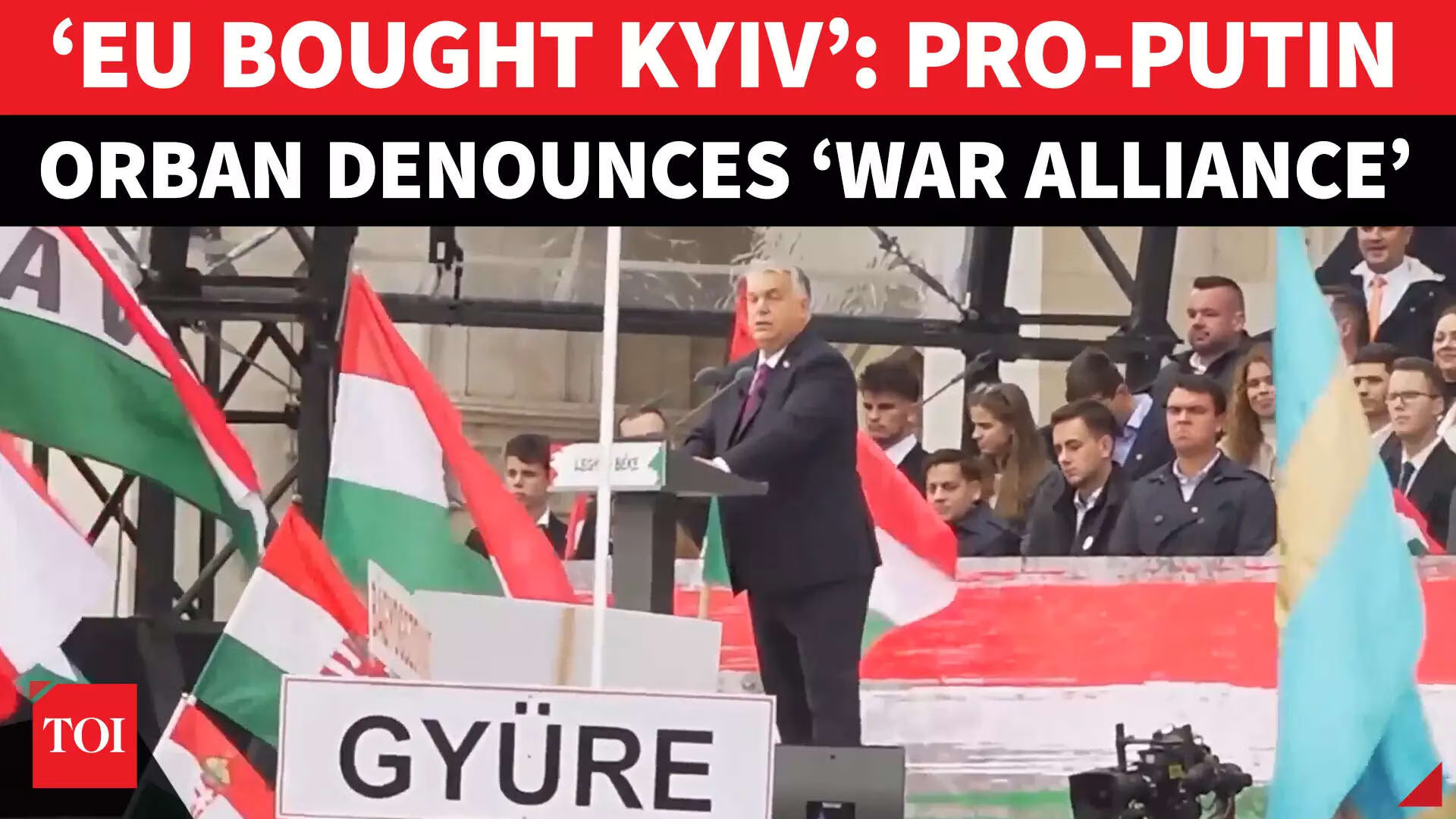
Orbán’s Unilateral Declaration: A Profound Challenge to Western Unity
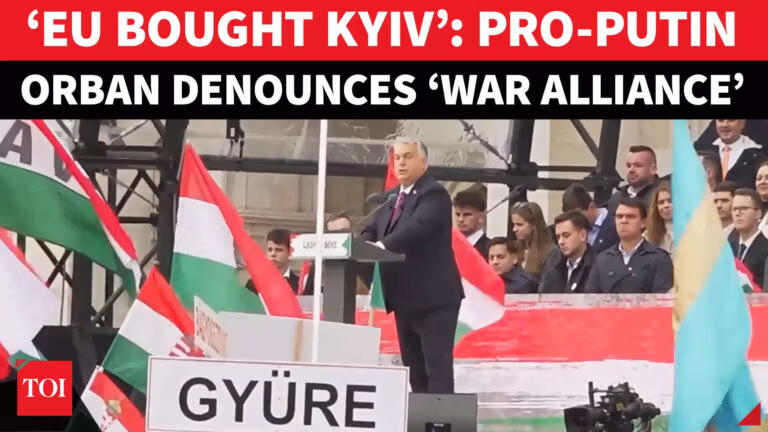
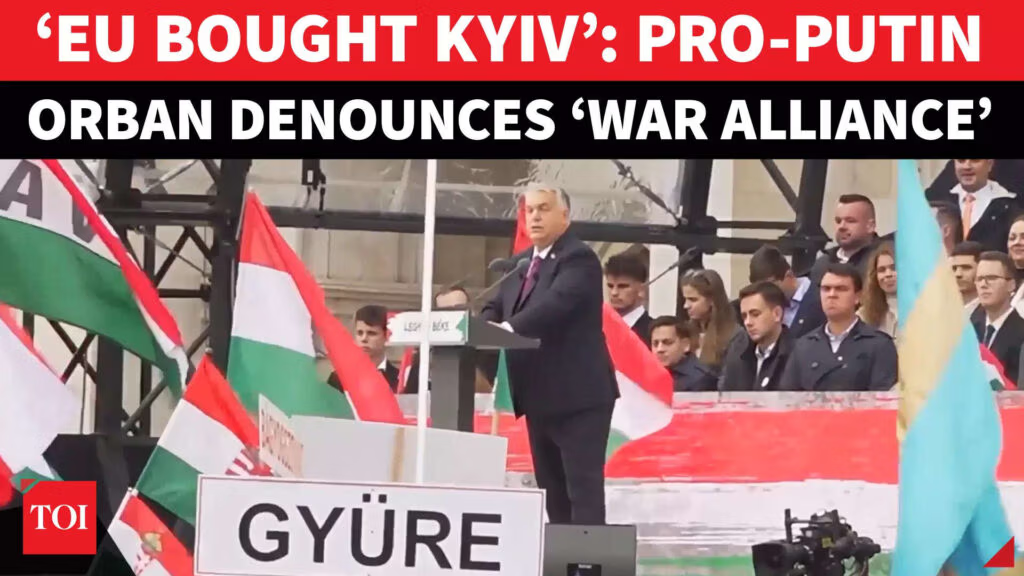
In a political landscape predominantly defined by unwavering Western support for Ukraine, Hungarian Prime Minister Viktor Orbán has once again emphatically charted his own distinct course. His recent declaration—a rhetorical bombshell reverberating far beyond the confines of Budapest—states unequivocally that “Europe has decided on war.” This pronouncement draws a stark and uncompromising line in the sand, with Orbán vowing that Hungary will not be unilaterally dragged into a conflict he pointedly portrays as a reckless and perilous march toward World War III.
More than a mere statement of national policy, Orbán’s audacious assertion that “we will not die for Ukraine” represents a direct, potent, and existential challenge to the very foundation of Western unity and its collective resolve. For years, Orbán has cultivated an image as a maverick within the European Union, frequently clashing with Brussels over issues ranging from democratic backsliding to immigration. However, his stance on the Ukraine war elevates his dissent to an entirely new and critical level, directly questioning the strategic coherence and moral compass of the continent’s most powerful alliances.

His rhetoric is not merely a critique; it is an active subversion of the prevailing narrative, designed to resonate with deep-seated anxieties across the continent and beyond. By framing Hungary as a steadfast ‘island of peace’ amidst what he depicts as an escalating tide of hostility, Orbán aims to position himself as a voice of reason against what he terms “Brussels war-mongers.”
Crafting the ‘Island of Peace’ Narrative: A Fundamental Ideological Break
At its core, Orbán’s incendiary speech masterfully reframes the entire narrative of the war, presenting a stark alternative to the mainstream Western perspective. Where Brussels, Washington, and other European capitals consistently articulate the conflict as a necessary defense of a sovereign nation against unprovoked Russian aggression, Orbán deliberately paints a picture of “Brussels war-mongers” actively and deliberately escalating a regional conflict into a potentially catastrophic continental one. This is not simply a disagreement over the efficacy of sending arms or the allocation of financial aid; it represents a fundamental ideological break from the consensus that has largely unified the EU and NATO since early 2022.
The “island of peace” concept is a cornerstone of Orbán’s domestic and foreign policy messaging. Domestically, it serves to consolidate his power by appealing to a constituency that prioritizes national sovereignty, economic stability, and insulation from perceived external threats. Internationally, it allows him to project an image of an independent nation charting its own course, unswayed by what he often characterizes as the dictates of globalist elites. This narrative taps into a potent vein of war-weariness and economic anxiety that exists, often quietly but palpably, across various segments of European societies. Citizens grappling with persistent inflation, rising energy costs, and the societal impact of large-scale refugee movements may find Orbán’s anti-war stance appealing, particularly if they feel their own governments are not adequately addressing these domestic pressures.
Orbán skillfully leverages these anxieties, framing his stance as a pragmatic pursuit of peace rather than ideological alignment with Russia. He suggests that the ongoing conflict, and Europe’s involvement in it, diverts critical resources and attention from the everyday struggles of ordinary citizens. This populist critique resonates with those who view international engagements as costly distractions from national welfare, and it empowers Orbán to cast himself as the protector of Hungarian interests against a perceived, abstract, and often hostile “globalist” agenda.
A Calculated Gamble: Elections, Populism, and the Search for Allies
The Strategic Timing of Orbán’s Declaration
The timing of Orbán’s latest declaration is far from coincidental; it is a meticulously calculated move designed to maximize its impact on the forthcoming political landscape. With European Parliament elections prominently on the horizon and a pivotal U.S. presidential election looming large, Orbán is strategically transforming Hungary’s foreign policy into a rallying cry for a broader populist, nationalist-driven “peace” movement. He is gambling on the premise that voters across Europe and America are more fundamentally concerned with avoiding a wider, potentially catastrophic war than with ensuring a decisive Ukrainian victory or upholding abstract principles of international law.
Orbán’s strategy explicitly calls for a significant political sea change across the Western world. He openly pins his hopes on the election of leaders—most notably a potential return of Donald Trump to the White House—who demonstrably share his non-interventionist and often transactional stance on international relations. This goes beyond mere political preference; it is an active effort to cultivate a transnational network of like-minded populist leaders who can collectively challenge the prevailing liberal international order. He is not merely speaking to his Hungarian constituents; he is speaking to a global audience of skeptics, anti-establishment voters, and those disillusioned with conventional foreign policy approaches, aiming to galvanize a movement that could fundamentally alter the geopolitical alignment of the West.
The Rise of a Transnational “Peace” Movement
Orbán’s vision extends to fostering a pan-European “peace” movement, distinct from traditional pacifist movements. This new iteration is often characterized by its nationalist undertones, skepticism towards supranational institutions like the EU, and a focus on national interests above collective security. He seeks to align with other populist and far-right leaders across the continent, such as Marine Le Pen in France, Geert Wilders in the Netherlands, or figures within Germany’s AfD, who share a similar aversion to perceived EU overreach and a desire for more nationalistic foreign policies. These leaders often echo sentiments about avoiding entanglement in foreign conflicts and prioritizing domestic issues, thereby creating a fertile ground for Orbán’s narrative of an “island of peace.” The European Parliament elections, in particular, serve as a critical testbed for this movement, offering an opportunity for these parties to gain significant influence and potentially disrupt the EU’s established policy-making consensus.
The Trump Factor: A Pivotal Alliance
The prospect of Donald Trump’s return to the U.S. presidency is central to Orbán’s strategic calculations. Trump’s “America First” doctrine, his questioning of NATO’s utility, and his historical interactions with figures like Vladimir Putin resonate deeply with Orbán’s worldview. A Trump victory would not only validate Orbán’s long-standing critique of liberal interventionism but could also fundamentally alter the transatlantic security architecture. It would provide Orbán with a powerful ally on the global stage, potentially weakening the Western coalition’s resolve and creating greater diplomatic space for Hungary’s divergent foreign policy. This potential alliance underscores the significant geopolitical stakes tied to the upcoming elections and Orbán’s audacious political maneuvering.
Fracturing Alliances: The Geopolitical Repercussions
Testing the Limits of Unity: EU and NATO Consensus
Orbán’s explicit defiance exposes the deepening fractures within both the European Union and NATO, two bedrock alliances that have been tested significantly since Russia’s full-scale invasion of Ukraine. While these organizations have indeed shown remarkable, albeit sometimes strained, resolve since 2022—implementing unprecedented sanctions, providing substantial aid to Kyiv, and bolstering collective defense—Orbán’s open dissent provides a concerning blueprint for other nations that may be wavering in their commitment or growing increasingly weary of the conflict’s costs. His rhetoric directly tests the very limits of consensus-based decision-making within the EU, where unanimity is often required for critical foreign policy and security decisions, and it amplifies a powerful internal voice to arguments that, until now, have been largely relegated to the political fringe. Hungary’s persistent obstruction on issues like financial aid packages for Ukraine or sanctions on Russian individuals further highlights these internal tensions.
For an alliance like NATO, built fundamentally on the bedrock of collective defense enshrined in Article 5, a member state’s leader openly accusing its partners of instigating war is a profound and inherently dangerous challenge. It undermines the trust essential for mutual security and military cooperation. Such statements sow discord, create ambiguity about shared objectives, and could potentially weaken the alliance’s ability to act decisively in a crisis. While Hungary has not withdrawn from NATO, its leader’s rhetorical alignment with Russian narratives poses a significant challenge to the alliance’s political cohesion and its unified front against external threats. This also raises questions about the long-term viability of an alliance where a member state actively campaigns against the common strategic direction.
Moscow’s Propaganda Victory: Eroding Moral Clarity
Second, and equally critically, Orbán’s rhetoric provides an undeniable strategic windfall for the Kremlin. Moscow has long and consistently pushed the narrative that it is not engaged in a war against Ukraine alone, but rather that it is defending itself against a hostile, expansionist NATO aiming to encircle and undermine Russia. To have the leader of an EU and NATO member state not only echo but publicly amplify that exact sentiment is an invaluable and almost irreplaceably potent propaganda victory for Russia. It lends a veneer of legitimacy to Russia’s often specious claims on the world stage, suggesting that even within the Western bloc, there are voices that confirm Moscow’s version of events.
This internal dissent actively seeks to erode the moral clarity that has been instrumental in galvanizing Western support for Kyiv. By portraying the conflict as a ‘European war’ driven by ‘war-mongers’ rather than a defensive struggle against an aggressor, Orbán complicates the public’s understanding and undermines the moral high ground the West has largely held. This narrative fragmentation can weaken public resolve, make it harder for governments to justify continued aid and sanctions, and ultimately play into Russia’s long-term strategy of dividing and conquering its adversaries. The Kremlin will undoubtedly seize upon Orbán’s statements, broadcasting them widely to bolster its own claims of victimhood and to portray Western unity as a fragile facade.
The Future of Western Resolve: Outlier or Omen?
Ultimately, Viktor Orbán’s audacious stand forces a critical and urgent question upon the Western world: is he merely an isolated outlier, a maverick whose consistent defiance will ultimately be contained and marginalized by the larger collective? Or, more ominously, is he the proverbial canary in the coal mine, giving resonant voice to a growing, silent constituency across Europe and beyond that is rapidly losing its appetite for a prolonged, economically burdensome, and potentially escalatory conflict? The answer to this pivotal question will likely not be found in abstract diplomatic pronouncements, but rather revealed with stark clarity in the ballot boxes later this year, particularly in the crucial European Parliament and U.S. presidential elections.
For now, Hungary’s self-proclaimed “island of peace” stands as a stark, unsettling reminder that while the physical front lines of this devastating conflict may be undeniably located within Ukraine, the equally crucial and perhaps more insidious battle for the West’s collective heart and mind is being fought far and wide, within its own borders, its own institutions, and its own democratic processes. The outcome of this internal struggle will profoundly shape the future trajectory of the war and the geopolitical order for decades to come.
Read the original story at The Times Of India.
Given the deepening divisions Orbán’s statements highlight, do you believe European unity can withstand such internal challenges in the long run, or is this the beginning of a significant shift in the continent’s geopolitical alignment?