Forging Europe’s Tech Independence: The ASML-Mistral AI Vision
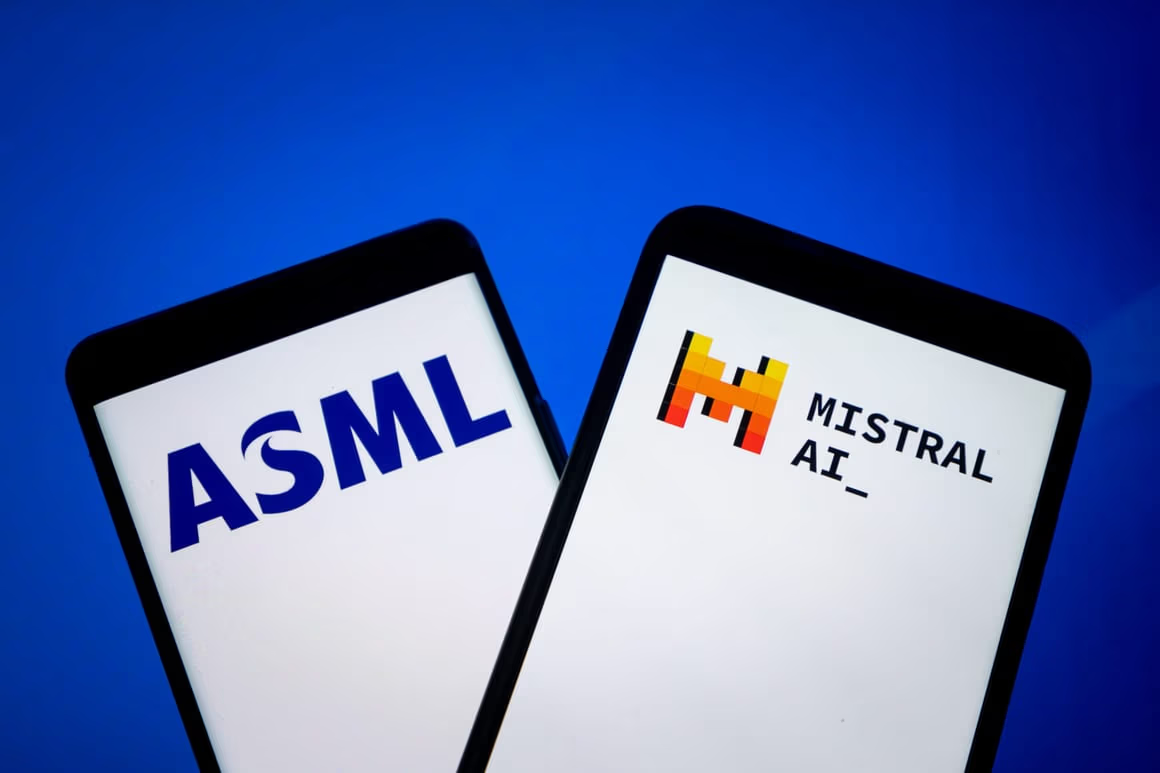
In the high-stakes global race for AI dominance, Europe has often been characterized as a cautious regulator, a step behind the American giants and Chinese behemoths. But a bold new vision is quietly taking shape, one that seeks to forge a uniquely European path to power by linking the continent’s established industrial might with its burgeoning software talent. The potential partnership between Dutch semiconductor king ASML and French AI darling Mistral isn’t just a business deal; it’s the blueprint for Europe’s technological declaration of independence.
At the heart of this push is a simple, yet powerful, idea: what if Europe could build a complete, homegrown technology stack? What if the continent’s undisputed leader in the deep, foundational hardware that powers the entire digital world could join forces with its most promising challenger to OpenAI?

The Unlikely Duo: ASML, the Hardware Bedrock, and Mistral AI, the Software Vanguard
On one side, you have ASML. They are the silent giants of the tech world, the company whose complex lithography machines are the essential, irreplaceable tool used to manufacture the world’s most advanced microchips. Without ASML, there is no TSMC, no Nvidia, no cutting-edge silicon. They are the bedrock of the global semiconductor industry.
On the other, you have Mistral AI, the Parisian startup that has electrified the tech scene with its open-source approach and models that rival those from Silicon Valley’s biggest names. They represent Europe’s agility, its software prowess, and its best hope for creating a homegrown AI champion.
A Symbiotic Loop: Innovation, Growth, and Geopolitical Strategy
The French government, spearheaded by digital affairs minister Clara Chappaz, is playing matchmaker, envisioning a “Batman and Robin” duo for European tech. The logic is compelling. To design its next generation of impossibly complex machines, ASML needs staggering amounts of AI-driven computational power. Mistral, to train its ever-larger models, needs access to optimized, state-of-the-art hardware. It’s a perfect symbiotic loop, a closed circuit of European innovation.
But this isn’t merely a commercial synergy. It’s a strategic masterstroke born from geopolitical necessity. As the U.S. restricts ASML’s access to the Chinese market, the Dutch giant must find new avenues for growth and application. Partnering with a European AI leader offers a hedge against geopolitical winds and a chance to build an ecosystem closer to home. For Europe, it’s a golden opportunity to stop relying on American cloud platforms and hardware to power its own AI ambitions.
Shifting European Strategy: From Regulation to Innovation
The key takeaway is that this initiative represents a fundamental shift in European strategy. For years, the continent has struggled to create its own “Big Tech” champions. This alliance suggests a new approach: instead of trying to replicate Silicon Valley, Europe can leverage its unique industrial strengths—the deep-tech, hard-to-replicate manufacturing prowess of companies like ASML—as the foundation for a new kind of tech superpower.
The Road Ahead: Challenges and the Test of European Ambition
Of course, the path from a government-backed dream to a corporate reality is fraught with challenges. The talks are still in their early days. The corporate cultures of a decades-old industrial behemoth and a nimble, fast-moving startup could hardly be more different. Furthermore, the immediate needs of AI companies are for massive farms of GPUs, a market dominated by Nvidia. The ASML-Mistral partnership is a long-term play, focused on co-designing the chips and systems of tomorrow, not just powering the models of today.
Ultimately, the success or failure of this venture will be a litmus test for Europe’s future. It will reveal whether the continent can successfully bridge the gap between its industrial heritage and its digital future. If this “dream team” can deliver, it could create a powerful new gravitational center in the global tech landscape. If it falters, it may reinforce the narrative of a continent unable to convert its strengths into a cohesive, world-beating strategy. The blueprint for a European tech fortress is on the table; the world is now watching to see if they can build it.
Read the original story at Politico Europe.
What are your thoughts on Europe’s strategy to combine industrial hardware leadership with cutting-edge AI software? Can this “dream team” truly reshape the global tech landscape?