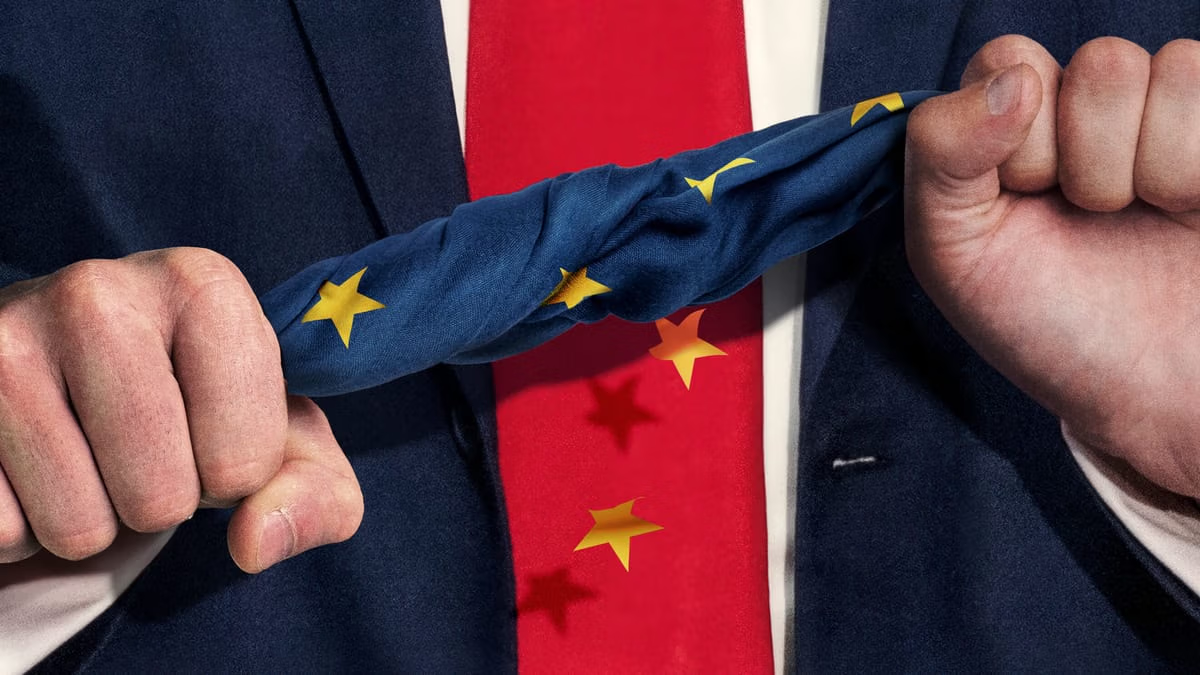
The Unseen President: How Donald Trump’s Shadow Governs Europe
There’s a ghost at the banquet of European politics, an invisible head of state whose pronouncements from across the Atlantic dictate the continent’s most urgent conversations. He holds no office in Brussels or Berlin, yet his influence is the single most powerful force shaping European policy today. That man, of course, is Donald Trump. His specter looms large over every strategic discussion, every defense budget allocation, and every diplomatic overture across the continent, an omnipresent yet physically absent figure whose potential return to power is reshaping the very foundations of European security and identity.
In a profound and deeply ironic twist, the former U.S. President has achieved what decades of his predecessors could not: he has jolted a complacent Europe into getting serious about its own security. For generations, European leaders often paid lip service to defense spending targets, secure in the knowledge that the ultimate guarantor of their peace was just an ocean away. Now, that comfort has been shattered. The nervous whispers at high-level summits like the Munich Security Conference, once hushed anxieties about burden-sharing, have transformed into a unified, urgent chorus of concern. The central question is no longer if Europe must stand on its own, but how—and how quickly—it can achieve genuine strategic autonomy in an increasingly perilous world.

This unprecedented situation underscores a fundamental re-evaluation of the transatlantic alliance. While previous U.S. administrations, Republican and Democrat alike, encouraged greater European self-reliance, Trump’s approach has been uniquely confrontational, accelerating a shift that many thought would take decades. His rhetoric has forced Europe to confront its vulnerabilities with an immediacy that no other political figure has managed to inspire, effectively making him the reluctant architect of a continent’s awakening, challenging its long-held assumptions about global order and its place within it.
The End of the American Umbrella: A Reckoning for European Security
For generations, Europe nestled comfortably under the American security umbrella, a geopolitical reality established in the aftermath of World War II and solidified during the Cold War. This arrangement, epitomized by NATO, allowed European nations to channel significant portions of their national budgets into social programs, infrastructure, and economic growth, confident that the immense military might of the United States would deter any major aggressor. This era of relative ease, however, is definitively over. Donald Trump’s transactional view of alliances, particularly his recent remarks suggesting he would “encourage” Russia to attack NATO members who don’t meet defense spending targets, was not just a diplomatic shockwave; it was the final, deafening alarm bell that reverberated from Lisbon to Tallinn.
Trump’s “America First” doctrine, first articulated during his 2016 campaign and put into practice during his presidency, systematically challenged the bedrock assumptions of the transatlantic partnership. He frequently labeled European allies as “delinquent” for not meeting the 2% of GDP defense spending target, openly questioned the validity of NATO’s Article 5 collective defense clause, and hinted at a potential U.S. withdrawal from the alliance. While his previous actions were unsettling, his February 2024 statement regarding Russia and “delinquent” NATO members crossed a new threshold. It wasn’t merely a threat to reduce U.S. commitment; it was an unprecedented invitation for aggression, shattering any remaining illusions about the unconditional nature of American protection and prompting a profound reassessment of European security architecture.
The result is a continental scramble to re-arm and re-strategize with an urgency not seen since the Cold War. The long-debated 2% of GDP defense spending target, once an aspirational goal or a point of contention in diplomatic communiques, is now universally seen across Europe as the bare minimum for survival. Nations like Poland and the Baltic states, acutely aware of the Russian threat on their borders, have already surpassed this target or are rapidly moving towards it, investing heavily in modernizing their armed forces and air defenses. Even historically cautious nations such as Germany, which for decades kept its defense spending well below the threshold due to post-war pacifist sentiment and economic priorities, has committed to significant increases, including a €100 billion special fund for its armed forces, marking a historic Zeitenwende or “turning point.”
This isn’t just about appeasing a potential U.S. president; it’s a fundamental psychological and strategic shift. Europe’s leaders are being forced to confront the once-unthinkable prospect of defending their eastern flank, protecting vital trade routes, and ensuring their energy security without the certainty of the U.S. cavalry arriving over the hill. The ongoing war in Ukraine has already highlighted the vulnerabilities of European defense supply chains, the critical need to replenish arsenals, and the importance of interoperability. Trump’s rhetoric has simply underscored the fragility of relying on a single, potentially unreliable, external guarantor. In this sense, whether willingly or not, Trump is the unintentional architect of a more militarized, self-aware, and self-reliant Europe, forcing it to mature beyond its long-held dependencies and forge its own destiny in a volatile geopolitical landscape.
A French Idea Finds its German Moment: The Ascent of Strategic Autonomy
This new and harsh reality has pulled a once-niche concept from the fringes of Parisian think tanks into the mainstream of European governance: “strategic autonomy.” For years, French President Emmanuel Macron’s passionate calls for a sovereign Europe, capable of acting independently on the world stage—militarily, industrially, and diplomatically—were often dismissed by allies as Gallic grandstanding, a thinly veiled attempt to assert French leadership or undermine transatlantic ties. Macron envisioned a Europe that could not only defend itself but also project its values and interests globally, without always needing to align with Washington. Now, with the shadow of American abandonment looming large, Macron’s ambitious vision looks less like national ambition and more like prescient prophecy.
Strategic autonomy, in its broadest sense, means Europe’s capacity to define and pursue its own interests and to make its own choices, particularly in foreign policy and defense, without being unduly dependent on or constrained by external powers. This encompasses not only robust military capabilities but also industrial independence in key sectors, technological sovereignty in critical areas like AI and semiconductors, and resilience in crucial supply chains. For decades, many European nations, especially Germany, viewed such concepts with skepticism, fearing they would weaken NATO or be perceived as anti-American. The perceived cost of building a truly autonomous defense capability, both financially and politically, seemed too high when the American umbrella was reliably open.
The “Trump effect,” combined with Russia’s full-scale invasion of Ukraine, has forced a pragmatic reckoning across the continent, particularly in Germany. As the continent’s economic powerhouse, Germany has historically been hesitant to lead on defense and foreign policy, burdened by its 20th-century history and a strong post-war pacifist movement. Its foreign policy, for decades, was characterized by a reliance on multilateralism, economic engagement, and a reluctance to project military power. However, Chancellor Olaf Scholz’s declaration of a Zeitenwende (turning point) in the wake of the Ukraine war marked a dramatic shift, committing Germany to re-invest in its Bundeswehr and take on a greater security role commensurate with its economic might. This shift is not just about spending more, but about fundamentally re-thinking Germany’s strategic posture in Europe.
The new urgency is forging an unexpected and unprecedented consensus. Across Europe, leaders are realizing that building robust, independent European industrial and military capacity is not an act of defiance against the U.S., but a necessary insurance policy against its potential absence or unreliability. This means greater collaboration on defense procurement, joint research and development into next-generation military hardware (like the Franco-German Future Combat Air System and Main Ground Combat System), and harmonizing military standards and doctrines. The goal is to move beyond disparate national defense industries towards a truly integrated European defense market and capability, reducing reliance on non-European suppliers for critical components and systems and bolstering Europe’s capacity to act independently.
The continent is realizing that true sovereignty isn’t just about currency and trade—it’s about the fundamental capacity for self-defense and the ability to project power and protect its values when called upon. This shift fundamentally alters the strategic calculus for the EU, transforming it from a purely economic and political union into a security actor with growing capabilities and responsibilities, pushing it towards a more unified and formidable presence on the global stage.
The Future: A Union Forged by Fear or Fractured by Division?
What does this phantom presidency, this shadow governance from across the Atlantic, mean for the future of the European Union? The irony is palpable. A figure who has often expressed disdain for multilateral institutions and has been openly hostile to the European Union project may, in fact, be the unwitting catalyst for its deepest integration yet. The existential threat of American abandonment and the tangible, brutal reality of Russian aggression on Europe’s doorstep are proving to be powerful unifying forces, pushing member states toward unprecedented collaboration on defense procurement, industrial policy, energy security, and strategic planning in ways that were previously deemed impossible or too politically sensitive due to national interests or ideological divides.
This moment of crisis could accelerate the creation of a genuine European defense union, a concept long debated but never fully realized. We are already seeing increased investment in joint European projects, enhanced intelligence sharing, and a greater willingness to pool resources for common security challenges, from cyber defense to maritime surveillance in the Mediterranean. The recognition that individual nations, even large ones, cannot effectively counter these multifaceted threats alone is driving a pragmatism that is overcoming historical rivalries and nationalistic tendencies. The collective realization is that a strong, united Europe, speaking with a more coherent voice, is the only viable path to resilience and influence in a fragmented global order marked by great power competition.
However, this unity, while powerful, is also inherently fragile. The same political winds that carried Donald Trump to power in the United States are blowing with increasing force across Europe. Nationalist leaders and populist movements, often sharing Trump’s “my-nation-first” worldview, are gaining traction and openly hostile to the EU project, viewing Brussels as an overreaching bureaucratic entity that erodes national sovereignty. Parties such as Geert Wilders’ PVV in the Netherlands, Marine Le Pen’s National Rally in France, the AfD in Germany, and Giorgia Meloni’s Brothers of Italy, while varied in their specific platforms, all represent a significant challenge to the vision of a more deeply integrated Europe.
The specter of Trump, therefore, presents Europe with a dual and complex challenge: it must unite against the external threat he represents (the potential for a weakened NATO and an emboldened Russia) while simultaneously fighting the internal divisions his brand of politics fuels. How can the EU foster deeper integration, particularly in sensitive areas like defense and foreign policy, when powerful factions within its own member states advocate for less integration, more national control, and sometimes, even withdrawal from the Union? This internal tension threatens to pull Europe in contradictory directions, potentially undermining the very unity that the external pressures are trying to forge, creating a dangerous vulnerability at a critical juncture in history.
Europe is at a crossroads, its path forward dictated by a leader an ocean away whose policies and pronouncements have inadvertently ignited a profound continental shift. The choices made by European leaders and citizens in the coming months and years will determine whether this moment of acute crisis forges a stronger, more resilient Union, capable of standing on its own feet and defending its values, or whether the immense pressure will cause it to fracture, leaving individual nations vulnerable and isolated. The era of assumed transatlantic certainty is definitively over; the age of European self-reliance has begun, reluctantly and urgently, with Donald Trump as its unseen, and unwilling, president, pushing it towards a destiny it once hesitated to embrace.
***
Read the original story at Politico Europe.
What are your thoughts on Europe’s path to strategic autonomy? Do you believe it will lead to a stronger, more unified EU, or are the internal divisions too great to overcome?