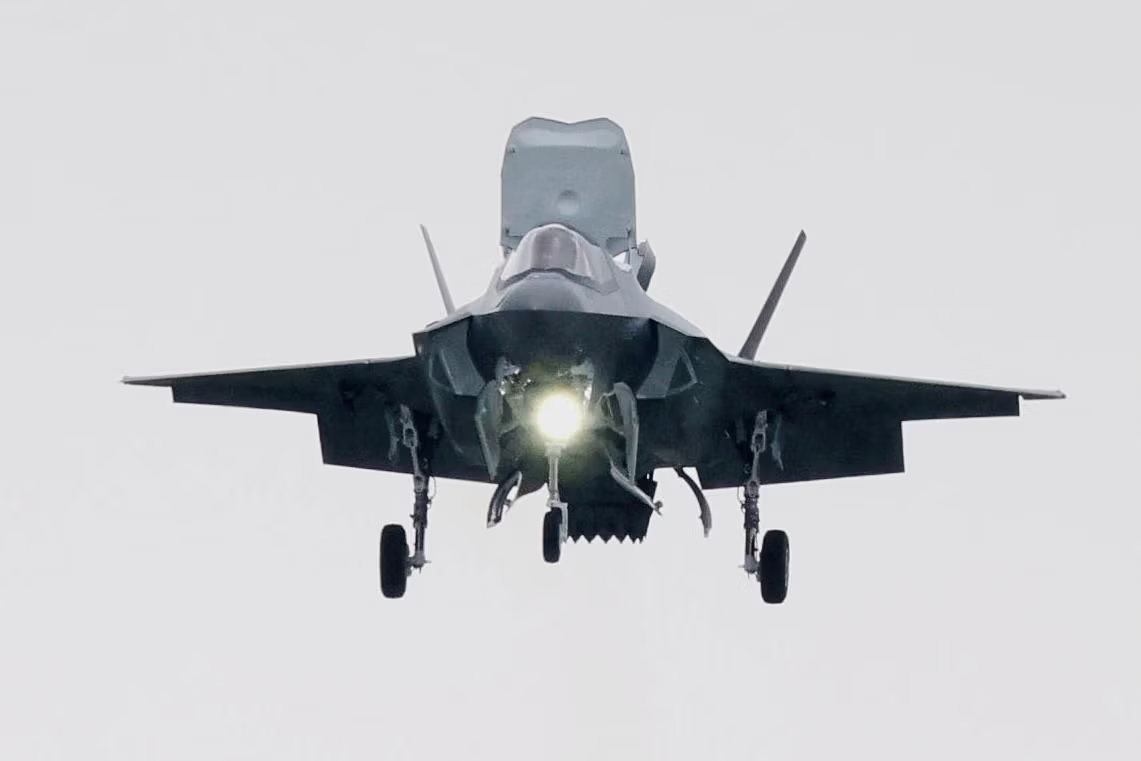
In the quiet corridors of international diplomacy and military strategy, some moves are more like tremors—subtle shifts that signal a much larger, tectonic change is underway. Japan’s decision to deploy fighter jets to Europe for the first time since the end of World War II is not a tremor; it is the earthquake itself. This historic deployment is more than a joint military exercise; it’s the loudest declaration yet that the post-war chapter of Japanese pacifism is decisively over, and a new era of proactive global security has begun. For nearly 80 years, Japan’s military identity has been defined by its “pacifist” constitution, which famously renounces war. Its Self-Defense Forces (SDF) were meticulously curated for one purpose: the defense of the Japanese homeland. The sight of Japanese F-35s or F-15s on a European tarmac would have been unthinkable just a decade ago, confined to fiction or speculative strategy games. Today, it’s a tangible reality, and it speaks volumes about the rapidly changing global landscape and Japan’s evolving role within it.
This unprecedented move by Tokyo signifies a profound re-evaluation of its strategic responsibilities and capabilities. It underscores a fundamental shift in perception, moving away from a purely insular defense posture towards an understanding that national security is intricately linked with global stability. The symbolism of Japanese advanced fighter jets, flying alongside European allies, is immense, not just for the participating nations but for the entire international community. It announces to the world that Japan is ready, willing, and able to contribute actively to maintaining the rules-based international order, far beyond its immediate geographic confines. This is not merely an act of military cooperation; it is a powerful diplomatic statement, reshaping alliances and redefining what it means to be a responsible global power in the 21st century.

So, what catalyzed this dramatic shift? In short, the world has changed fundamentally. The key takeaway from this historic deployment is that Tokyo now views global security as indivisible. The threats posed by an expansionist Russia in Europe and an increasingly assertive China in the Indo-Pacific are no longer compartmentalized as separate regional problems. Instead, they are recognized as two interconnected fronts in a single, overarching challenge to the very principles that underpin international peace and stability. By sending its advanced military assets to train with European allies, Japan is sending an unequivocal message: a threat to the stability of Europe is intrinsically a threat to the stability of Asia, and vice-versa. This recognition of interconnectedness forms the bedrock of Japan’s new, proactive security stance, fundamentally altering its approach to defense and diplomacy.
The End of an Era: Japan’s Post-War Pacifism
For nearly eight decades following the devastation of World War II, Japan’s national identity and foreign policy have been meticulously shaped by its “pacifist” constitution. Article 9, famously stipulating the renunciation of war as a sovereign right and the prohibition of maintaining land, sea, and air forces, has been the cornerstone of this unique stance. This constitutional constraint meant that Japan’s military, known as the Self-Defense Forces (SDF), was strictly designed and equipped for defensive purposes—specifically, the protection of the Japanese homeland and its immediate surrounding territories. Any suggestion of deploying Japanese military assets, especially advanced fighter jets, to distant theaters like Europe would have been met with constitutional questions, domestic political opposition, and international skepticism, cementing Japan’s image as a security beneficiary rather than a contributor. This era, characterized by a deep aversion to military adventurism and a focus on economic prosperity, shaped a generation’s understanding of Japan’s place in the world.
Article 9: A Legacy Redefined
The interpretation of Article 9 has, however, not remained static. Over the years, successive Japanese governments have incrementally reinterpreted its provisions, particularly concerning the concept of “collective self-defense.” Initially, this was understood to mean that Japan could only defend itself directly. Yet, faced with evolving regional threats and growing calls for greater burden-sharing within its alliance with the United States, interpretations began to expand. Landmark policy shifts, particularly under former Prime Minister Shinzo Abe, led to legislative changes in 2015 that allowed the SDF to exercise collective self-defense under certain conditions, even if Japan itself was not directly attacked. These changes, though controversial domestically, laid the legal and political groundwork for Japan to participate more broadly in international security operations. The deployment to Europe is the most striking practical manifestation of this redefinition, showcasing a Japan that is now legally and politically capable of exercising its right to collective self-defense and contributing to international peace and security beyond its borders.
The Evolution of the Self-Defense Forces (SDF)
Parallel to the constitutional reinterpretation, the capabilities of the Self-Defense Forces themselves have undergone a significant transformation. Far from being a ceremonial force, the SDF has developed into a highly advanced, professional military, equipped with state-of-the-art technology. Japan operates a formidable fleet of fighter jets, including advanced F-15J Eagles and, increasingly, fifth-generation F-35A Lightning II stealth fighters. Its naval forces are among the most capable in the Indo-Pacific, featuring Aegis destroyers and potent submarines. This modernization was driven not by expansionist ambitions, but by the necessity of deterring growing threats in its immediate region, particularly from North Korea and China. However, this robust capability, coupled with enhanced logistical and interoperability training with allies like the United States, has now positioned the SDF to contribute meaningfully to broader global security initiatives. The European deployment leverages these advanced capabilities, demonstrating that the SDF is not merely a homeland defense force but a mature, expeditionary-capable military asset ready to engage in complex, long-range international operations.
A World Interconnected: Why Global Security is Indivisible
The core impetus behind Japan’s historic deployment is a stark realization that global security challenges are no longer confined to distinct geographical theaters. The traditional notion of separate regional problems, solvable in isolation, has dissolved in the face of interconnected geopolitical realities. Tokyo now firmly believes that the stability of the Indo-Pacific is inextricably linked to the stability of Europe, and vice-versa. This strategic convergence recognizes that disruptions in one part of the world inevitably create ripples that impact security and economic interests globally, demanding a unified and collaborative response from like-minded nations. This paradigm shift marks a departure from a purely defensive, region-centric security doctrine to a comprehensive, globally-integrated approach where threats anywhere are threats everywhere.
The Russian Threat in Europe
Russia’s unprovoked invasion of Ukraine in 2022 served as a brutal awakening for many nations, including Japan. The conflict not only shattered decades of peace in Europe but also highlighted the willingness of an authoritarian power to challenge the foundational principles of the rules-based international order through military aggression and territorial expansion. From Tokyo’s perspective, Moscow’s actions are not merely a European problem; they set a dangerous precedent for revisionist powers elsewhere. The disregard for national sovereignty, the use of force to alter borders, and the destabilization of international norms directly resonate with Japan’s own security concerns regarding its powerful and increasingly assertive neighbor, China. By demonstrating solidarity with European nations, Japan underscores its commitment to deterring such aggression globally and protecting the principles of sovereignty and territorial integrity, wherever they are challenged.
China’s Assertiveness in the Indo-Pacific
Concurrently, the Indo-Pacific region faces its own profound security challenges, primarily driven by China’s growing military might and its assertive actions in the South China Sea, East China Sea, and towards Taiwan. Beijing’s rapid military modernization, its expansive territorial claims, and its increasing pressure on democratic neighbors are viewed with deep concern in Tokyo. The potential for a conflict in the Taiwan Strait, or escalating tensions around the Senkaku Islands (claimed by China as Diaoyu), represents an existential threat to Japan’s security and economic lifelines. The parallel between Russia’s actions in Ukraine and potential future scenarios in the Indo-Pacific is not lost on Japanese strategists. Therefore, strengthening alliances and demonstrating a unified front against challenges to the rules-based order, whether in Europe or Asia, is a critical component of Japan’s strategy to deter aggression closer to home.
Bridging the Geographic Divide
Japan’s fighter jet deployment acts as a tangible bridge across these perceived geographic divides. It’s a strategic demonstration that the challenges posed by authoritarian expansionism are not isolated incidents but rather manifestations of a systemic threat to democratic values and international law. By training with European air forces, Japan not only enhances its own operational capabilities and interoperability but also signals to both adversaries and allies that a coordinated, multi-regional response is possible and indeed underway. This deployment is a practical embodiment of the “free and open Indo-Pacific” concept, extending its principles of security, freedom of navigation, and adherence to international law to a truly global scale. It underscores a strategic pivot where Japan actively participates in shaping a robust, collective defense architecture that transcends traditional regional boundaries.
From Beneficiary to Global Security Provider
For decades, Japan has largely been perceived as a passive beneficiary of the robust U.S. security umbrella, focusing its resources on economic growth while relying on American military might for its strategic defense. While this arrangement provided stability during the Cold War and beyond, the rapidly shifting global security landscape has necessitated a fundamental re-evaluation of this role. Japan is now actively and decisively transitioning from a security consumer to a security provider, evolving into a crucial pillar in the network of global democracies committed to upholding international norms. This transformation signifies a mature and responsible nation stepping up to share the burdens and responsibilities of global security in a world where the United States is increasingly calling on allies to do more.
Shifting Dynamics of the U.S.-Japan Alliance
The U.S.-Japan alliance remains the bedrock of Japan’s security, but its dynamics are evolving. The United States has long encouraged its allies to increase their defense spending and assume greater regional and global security roles. Japan’s commitment to significantly increase its defense budget to 2% of GDP by 2027, along with its proactive international engagements, is a direct response to this call and a testament to its commitment to the alliance. This shift strengthens the alliance not by supplanting U.S. leadership, but by augmenting it with a highly capable and willing partner. By projecting power and influence beyond its immediate region, Japan enhances its strategic value to the U.S. and other allies, moving towards a more symmetrical partnership where responsibilities are more evenly distributed. This deployment is a clear indicator that Japan is no longer content to merely protect its own shores; it is actively contributing to the collective security framework that ultimately safeguards its own interests and those of its partners.
Demonstrating Capability and Political Will
This historic deployment isn’t merely about symbolic gestures; it’s about building tangible capabilities and demonstrating resolute political will. The exercise of sending advanced Japanese fighter jets, along with their support personnel and logistics, thousands of miles to a European theater is a complex undertaking. It demands sophisticated planning, robust logistical chains, and advanced operational readiness. By successfully executing such a deployment, Japan is building the essential coalition muscle memory for coalition operations. These interoperability drills and joint training exercises are crucial for harmonizing tactics, communication protocols, and strategic objectives with allied forces. More importantly, this move demonstrates to both allies and potential adversaries that Japan possesses not only the high-end military capability to project power far from its own shores but also the political conviction and strategic foresight to stand shoulder-to-shoulder with its partners in defending shared values and interests on a global stage. It removes any doubt about Japan’s commitment to active global engagement.
Forging Future Alliances: The Precedent and Long-Term Vision
Japan’s deployment of fighter jets to Europe is far more than a singular event; it establishes a powerful precedent for future international engagements and sets a new trajectory for its foreign and defense policy. This historic move signals a long-term commitment to active participation in global security, promising a more integrated and collaborative approach with allies worldwide. It lays the groundwork for deepening military-to-military ties and fosters an environment ripe for expanded defense cooperation across multiple domains, ultimately strengthening the collective security architecture against emerging and evolving threats.
Accelerated Military-Industrial Cooperation: The GCAP Model
A prime example of this deepening cooperation is the Global Combat Air Programme (GCAP), a groundbreaking joint venture between Japan, the United Kingdom, and Italy. GCAP aims to develop a next-generation stealth fighter jet by 2035, integrating advanced technologies from all three nations. This program is not just about producing a superior aircraft; it represents a profound intertwining of national defense futures. By combining their industrial capabilities, technological expertise, and financial resources, these nations are fostering an unprecedented level of trust and interdependence. The success of GCAP will create a common operational platform, enhance interoperability, and ensure that their respective air forces are equipped with cutting-edge technology tailored to future threat environments. This collaborative model, built on shared strategic vision and mutual technological exchange, transcends simple treaties; it weaves their defense industrial bases and long-term security interests inextricably together, creating a powerful deterrent and a robust foundation for future collective action.
Building Coalition Muscle Memory
Beyond large-scale industrial projects, the recurring nature of international engagements like the fighter jet deployment is critical for building enduring coalition muscle memory. Each joint exercise, each deployment, each exchange of personnel, contributes to a seamless integration of forces, doctrines, and logistical capabilities. This sustained interaction ensures that when a crisis arises, allied forces can operate together effectively and efficiently, without the friction that can arise from unfamiliarity. It means shared understanding of command structures, communication protocols, and tactical approaches. This continuous process of training and interoperability strengthens the bonds between nations at every level, from strategic planners to frontline pilots, fostering a shared sense of purpose and a collective readiness that is vital for deterring aggression and responding decisively to global challenges. These engagements are investments in future stability, ensuring that alliances are not just agreements on paper but living, dynamic partnerships capable of real-world impact.
Navigating Geopolitical Reactions
Predictably, Japan’s bold strategic pivot will not go unnoticed in Beijing and Moscow, two capitals increasingly aligned in their opposition to the U.S.-led liberal international order. Their reactions are not just anticipated; they are an inherent part of the strategic calculus behind this deployment. While their rhetoric will undoubtedly be sharp, Japan and its allies are prepared to articulate their position clearly, emphasizing defense and stability over provocation.
Beijing and Moscow’s Narrative
Both China and Russia are likely to seize upon this deployment as an opportunity to frame it as a resurgence of Japanese militarism, stoked by Western powers. They will undoubtedly point to Japan’s wartime history, attempting to sow discord among Asian nations and cast Japan as an aggressive actor abandoning its pacifist constitution for expansionist aims. This narrative seeks to undermine Japan’s credibility, isolate it from regional partners, and justify their own military build-ups and assertive behaviors. Beijing might interpret the move as further evidence of a U.S.-led encirclement strategy, while Moscow could view it as an extension of NATO’s influence into Asia, reinforcing their perceptions of a hostile, expansionist West. The propaganda machines in both countries will work to portray Japan’s actions not as defensive or stabilizing, but as dangerously provocative.
The Imperative of Proactive Engagement
However, for Japan and its allies, the calculus is clear and compelling: the risk of inaction in a volatile and increasingly dangerous world is far greater than the risk of being perceived as provocative. In an era where authoritarian regimes are openly challenging sovereignty and international law, a passive stance would only embolden aggressive actors and undermine the very principles of peace and stability. Proactive engagement, such as this fighter jet deployment, serves as a powerful deterrent. It demonstrates resolve, capability, and a united front among democracies. It signals that the international community is prepared to defend the rules-based order, not just in rhetoric, but through tangible military cooperation and collective action. By stepping up, Japan is not abandoning peace; it is actively working to secure it in a world where peace cannot be taken for granted, reinforcing the message that collective security is the most effective bulwark against revisionist ambitions.
The Dawn of a New Strategic Reality
Ultimately, the roar of Japanese fighter jets over European skies is the unmistakable sound of a new strategic reality dawning. It signifies a profound metamorphosis for Japan—a nation transforming from a post-war pacifist state into a more confident, capable, and globally-engaged major player on the international stage. This is not a return to a past era, but the forging of a new identity, one that actively embraces its role in defending a free and open international system against multifaceted global threats.
The post-war era, defined by constitutional constraints and a predominantly defensive posture, is definitively over. In its place, the era of the “global partner” has begun—a Japan that recognizes its security is interwoven with global stability, and that its robust capabilities must be deployed proactively and collaboratively to uphold the principles of sovereignty, rule of law, and democratic values. This historic deployment is a beacon of this transformation, demonstrating Japan’s unwavering commitment to contributing to global peace and security as a vital and indispensable member of the international community.
Read the original story at The Washington Times.
What impact do you believe Japan’s new proactive global security stance will have on the geopolitical landscape of the Indo-Pacific and beyond in the coming decade?