In the grand theater of global politics, the European Union has long cast itself in a noble role: the moral compass, the champion of diplomacy, and the global standard-bearer for human rights and democracy. It’s an identity forged in the ashes of conflict, a promise of a better way forward through cooperation and law. Yet, as the geopolitical chessboard becomes increasingly fraught with tension, a stark and uncomfortable question emerges: Does Europe have the nerve to actually play the part it has written for itself?
The gap between Europe’s lofty rhetoric and its real-world actions is becoming a defining feature of its foreign policy. The continent sees itself as a “normative power,” one that shapes the world through its values rather than its military might. But this noble ambition is being tested like never before, and the results reveal a crisis of confidence that threatens to undermine its global standing.
The Geopolitical Chessboard: Russia and Ukraine
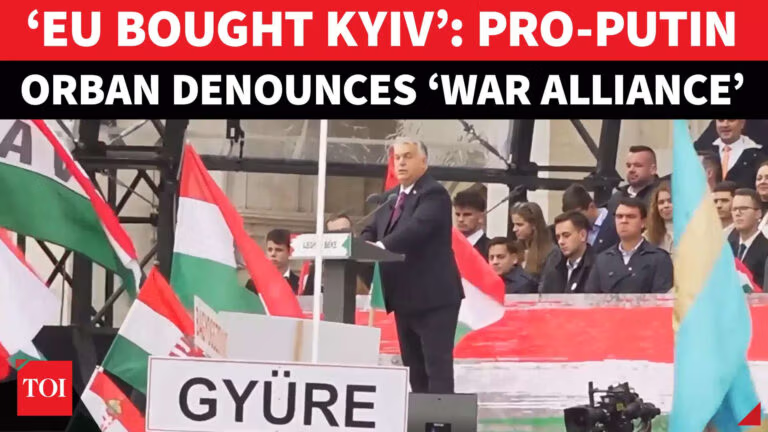
The most glaring test has been Russia’s war in Ukraine. While the EU ultimately rallied with sanctions and support for Kyiv, this unity came only after a painful awakening. For years, the bloc’s approach was a masterclass in cognitive dissonance—condemning Moscow’s aggressions while simultaneously deepening its dependence on Russian energy. The pursuit of economic pragmatism left Europe strategically vulnerable, a weakness Vladimir Putin was all too willing to exploit. The continent talked the talk of sovereignty and international law, but its actions were dictated by the flow of gas.
Strategic Autonomy Tested: The China Conundrum
This dilemma is not an isolated incident. Look east, and the same pattern repeats itself with China. Brussels frequently voices “grave concern” over human rights abuses in Xinjiang and the erosion of freedoms in Hong Kong. Yet, these condemnations are often followed by a swift pivot back to the immense, irresistible pull of the Chinese market. The concept of “strategic autonomy”—Europe’s quest to carve its own path independent of Washington and Beijing—often looks less like a bold strategic vision and more like an attempt to avoid making a difficult choice. It’s an effort to have it both ways: to be a moral arbiter and a chief trading partner to a regime it ostensibly opposes.
The Stakes: Credibility, Influence, and the Path Forward
So, what does this mean for the future?
A Looming Crisis of Credibility
The primary risk for Europe is a catastrophic loss of credibility. In a world increasingly defined by the hard-nosed calculations of great power competition, a foreign policy built on unenforced principles is a house built on sand. Allies may question its reliability, while adversaries see its moral stances as little more than a bluff. If Europe’s red lines are consistently blurred by economic interests, they cease to be red lines at all.
Risk of Relegation to the Sidelines
Furthermore, this inaction threatens to relegate Europe to the sidelines. As the United States and China vie for global influence, a hesitant and internally divided Europe risks becoming a passive economic playing field rather than an active, agenda-setting player. The world is not waiting for the EU to achieve consensus. Decisions are being made in Washington, Beijing, and Moscow that will shape the 21st century, and Europe’s voice, once so resonant, risks becoming background noise.
The challenge ahead is immense. To close the chasm between its values and its actions, Europe must forge a genuine political will that transcends the narrow economic interests of its 27 member states. It requires a fundamental decision: Is the EU willing to bear the economic and political costs that come with being a true geopolitical force? Until it can answer that question with a resounding “yes,” its ambition to be the world’s “good guy” will remain just that—an ambition, not a reality.
Read the original story at Gulf Times.
What do you think? Can the European Union truly become a decisive geopolitical force, or will economic pragmatism always temper its moral ambitions?