Cairo’s Stark Warning: Gaza’s Crisis Could Be Europe’s Next Migration Wave
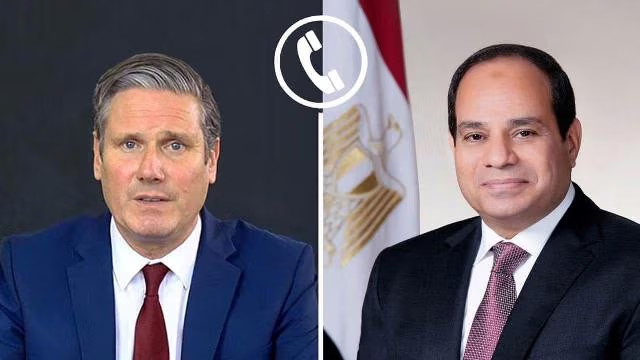
In the quiet, calculated world of international diplomacy, some messages are delivered not as mere suggestions, but as stark, unignorable warnings carrying the weight of geopolitical consequence. Such was precisely the case in Cairo, where a recent high-stakes meeting between Egyptian President Abdel Fattah El-Sisi and UK Labour Leader Keir Starmer peeled back the layers of the escalating Gaza conflict, revealing how its profound shockwaves could soon crash upon distant European shores.
This was more than a routine diplomatic exchange; it was a carefully orchestrated moment designed to deliver a specific, potent message to a prospective future British Prime Minister. The headline takeaway from their frank discussion wasn’t just another reiteration of calls for a ceasefire or a plea for increased humanitarian aid, though both were undeniably central to the agenda. Instead, President El-Sisi delivered a blunt diplomatic ultimatum, one directly targeting one of Europe’s most sensitive and politically charged nerves: the spectre of mass migration.

His warning was unequivocal, direct, and laden with a chilling forecast: if the ongoing Israeli military operation in Gaza culminates in the mass displacement of Palestinians into Egypt’s already volatile Sinai Peninsula, it will not, he argued, remain a contained regional crisis. On the contrary, such an event would inevitably trigger an “unprecedented” wave of human movement, with a destabilized Egypt becoming the launchpad for a significant exodus of people towards Europe. This is not merely a forecast; it’s a strategic reframing of the entire crisis, designed to awaken Western leaders to the direct, tangible domestic consequences of the conflict’s trajectory.
El-Sisi’s Red Line: A Threat to National Security and the Palestinian Cause
For Egypt, the prospect of absorbing potentially millions of displaced Gazans represents an absolute, non-negotiable red line. President El-Sisi articulated this position with uncompromising clarity, framing it not just as a humanitarian catastrophe but as a fundamental national security threat. The Sinai Peninsula, bordering Gaza, is a region with a complex history, already grappling with insurgency and significant security challenges. Introducing a massive, desperate population into this sensitive area would inevitably exacerbate instability, strain Egypt’s already stretched resources, and create a humanitarian crisis of immense proportions within its own borders.
Beyond the immediate logistical and security concerns, El-Sisi’s warning also underscored a deeper, existential fear: that forced displacement into Sinai would effectively constitute a “liquidation of the Palestinian cause.” This refers to the historical aspiration of Palestinians for an independent state and the right of return. Should a mass exodus occur, particularly if it’s perceived as permanent, it would fundamentally alter the demographics and political landscape, potentially undermining any future prospects for a two-state solution and permanently displacing a significant portion of the Palestinian population. Such an outcome would be seen by Egypt and many other Arab states as a betrayal of their long-standing support for Palestinian self-determination and an unacceptable reshaping of the regional order.
Egypt has a long history of mediating in the Israeli-Palestinian conflict and has consistently rejected any scenario that would lead to the permanent displacement of Palestinians from their lands. The memory of the 1948 Nakba, which saw hundreds of thousands of Palestinians displaced, looms large. El-Sisi’s stern words are therefore rooted in decades of regional diplomacy, national interest, and a deep understanding of the historical sensitivities involved. He is not just expressing concern; he is articulating a firm boundary beyond which Egypt will not yield, and whose breach, he warns, will have global repercussions. The current economic fragility of Egypt, already battling inflation and a severe currency crisis, further intensifies its reluctance to shoulder such an immense and unpredictable burden.
The Strategic Reframing: Forcing Europe to Confront its Own Borders
By explicitly linking a potential mass displacement from Gaza to an “unprecedented” migration flow towards Europe, President El-Sisi is deploying a powerful diplomatic lever. He is forcing Western leaders, particularly those in Europe, to confront the tangible, domestic consequences of a conflict they often view as geographically distant. The message is unequivocal: the fallout from Gaza will not stay contained within the Middle East’s geopolitical theatre; it will arrive, unwelcome and destabilizing, at Europe’s borders.
This strategic reframing is astute. European nations, still reeling from the political and social ramifications of the 2015 Syrian refugee crisis, are acutely sensitive to the issue of irregular migration. The rise of far-right nationalist parties across the continent, often campaigning on anti-immigrant platforms, underscores the political fragility of this issue. El-Sisi’s warning taps directly into this anxiety, suggesting that an unchecked Gaza crisis could ignite a similar, if not greater, wave of human movement, potentially overwhelming border controls and further fueling internal political discord within the European Union.
Egypt’s role as a bulwark against migration to Europe is well-established. For years, Cairo has cooperated with European states to curb irregular migration flows across the Mediterranean. This cooperative history adds weight to El-Sisi’s warning; it’s not an idle threat but a statement from a partner who understands the mechanisms and potential vulnerabilities of these migration routes. He is effectively telling a potential future British Prime Minister, and by extension, other European leaders: your policy decisions regarding ceasefires, humanitarian access, and a long-term political solution for Gaza are not just about Middle Eastern stability; they are directly linked to the future stability and political cohesion of your own continent. The message underscores that global stability is profoundly interconnected, and that what happens in one region can swiftly cascade across continents, challenging the very fabric of societies far removed from the initial flashpoint.
Starmer’s Global Audition: Navigating the Middle East Minefield
For Keir Starmer, widely tipped to be the UK’s next leader, this meeting in Cairo was a crucial component of his ongoing audition on the world stage. As Labour prepares for a general election, Starmer has been meticulously working to project an image of competence, gravitas, and international statesmanship. Navigating the historically complex and emotionally charged terrain of the Israeli-Palestinian conflict has been a particularly delicate balancing act for him, as he endeavors to steer the Labour Party away from the controversial and often divisive stances of its recent past under Jeremy Corbyn and toward a more mainstream, internationally aligned foreign policy.
Starmer’s visit to the region, including stops in Israel and the Palestinian territories, was designed to demonstrate Labour’s commitment to balanced engagement and pragmatic diplomacy. His call during the talks for an immediate ceasefire in Gaza, coupled with his reaffirmation of a long-term commitment to a two-state solution, places him firmly in step with a growing international consensus. This strategic positioning serves multiple purposes: it signals to key allies, particularly in the United States and Europe, that a Labour-led Britain would be a reliable, pragmatic, and engaged partner on critical global issues. Domestically, it aims to reassure a wary electorate and a diverse party base that Labour’s foreign policy will be responsible, ethical, and effective.
The Egyptian President’s direct warning to Starmer during this pivotal visit further underscored the immense responsibility that awaits the Labour leader should he enter Downing Street. It highlights that the challenges facing the UK and its allies are not merely economic or domestic; they are deeply intertwined with global geopolitical shifts and humanitarian crises. For Starmer, absorbing El-Sisi’s message means grappling with how a future Labour government would respond to unprecedented migration pressures while simultaneously advocating for a lasting peace in the Middle East—a complex tightrope walk that will define his early premiership.
The Broader Geopolitical Ripple Effect: Gaza’s Uncontained Crisis
This high-stakes conversation in Cairo signifies a critical and alarming shift in the perception of the Gaza war. It emphatically underscores that this is no longer a localized conflict whose devastating consequences can be neatly compartmentalized or contained within the narrow confines of the Palestinian territories and Israel. Regional powers like Egypt, Jordan, and Saudi Arabia are now openly and urgently connecting the ongoing humanitarian catastrophe in Gaza to the core political anxieties and national security interests of the West. Their warnings are not merely expressions of solidarity but strategic appeals to self-interest.
The potential for wider regional destabilization is immense. A mass displacement from Gaza could ignite fresh tensions in the Sinai, impact Jordan (which hosts a large Palestinian population), and further strain relations across the Arab world. This, in turn, could empower extremist groups, intensify regional rivalries, and undermine delicate peace efforts and normalization agreements between Israel and other Arab states. The geopolitical chessboard of the Middle East is inherently volatile, and the Gaza conflict has proven to be a potent accelerant for existing grievances and fault lines.
Furthermore, the crisis has highlighted the perceived limitations and divisions within the global community. The United Nations has struggled to secure widespread humanitarian access and a lasting ceasefire, while differing stances among major global powers (the U.S. vetoing Security Council resolutions, European nations debating their positions) have sometimes hampered a unified, effective response. El-Sisi’s warning serves as a powerful reminder that stability is interconnected, and that the decisions made in Washington, London, and Brussels regarding ceasefires, humanitarian corridors, and a long-term political solution for Gaza now carry the added weight of preventing a domino effect that could reshape migration politics in Europe for years to come, profoundly impacting democratic processes and social cohesion.
Western Stakes and Future Challenges: Preventing a Domino Effect
The message from President El-Sisi to Keir Starmer was not just about the immediate dangers unfolding in Gaza; it was a sobering, if not chilling, preview of the complex, interconnected future challenges that await the next generation of Western leaders. The imperative now is to recognize that the pursuit of peace and stability in the Middle East is inextricably linked to the preservation of stability within European borders. Failing to adequately address the humanitarian and political dimensions of the Gaza crisis risks creating a precedent for mass displacement that could spiral beyond anyone’s control, with far-reaching and unpredictable consequences.
Policymakers in Washington, London, Brussels, and beyond must internalize this warning and adjust their strategies accordingly. This entails a renewed, concerted effort to push for an immediate and sustained ceasefire, ensure unfettered humanitarian access, and, crucially, lay down a credible, irreversible pathway towards a genuine two-state solution. Without a viable political horizon for Palestinians, the underlying causes of conflict and displacement will persist, continuously threatening to boil over into new crises that demand international intervention and carry global repercussions.
The long-term implications are profound. Europe’s capacity to manage migration, its internal political stability, and its commitment to international law are all under scrutiny. The decisions made today regarding Gaza will not only determine the fate of millions of Palestinians but will also cast a long shadow over the future of European societies and their ability to navigate complex global challenges. The warning from Cairo is a call to action, demanding a holistic, forward-thinking approach that recognizes the deep linkages between regional conflicts and global security.
Read the original story at Egypt Daily News.
What are your thoughts on President El-Sisi’s stark warning? Do you believe European leaders are fully grasping the potential for the Gaza conflict to trigger a new migration crisis, and how should they best respond to prevent such an outcome?