The Camera Bar Conquers All: Has Sony’s Xperia Lost Its Edge?
In the ever-churning world of smartphone design, some brands are trendsetters, and others are steadfast holdouts, clinging to a unique design language that sets them apart. For years, Sony has been the latter. Its Xperia line has been a bastion of minimalist, rectangular-slab aesthetics, a consistent and recognizable island in a sea of changing camera bumps and curved edges. This distinct philosophy, often prioritizing functional elegance and a user experience tailored for creative professionals, has cultivated a niche but fiercely loyal following. Sony’s commitment to features like a 3.5mm headphone jack, expandable storage, and dedicated camera buttons in an age where competitors shed them, further cemented its reputation as a brand marching to the beat of its own drum.
Well, it seems the tide has finally come in. The market’s irresistible currents are now pushing even the most resolute individualists towards a common shore, forcing a reevaluation of what it means to be unique in a saturated landscape.

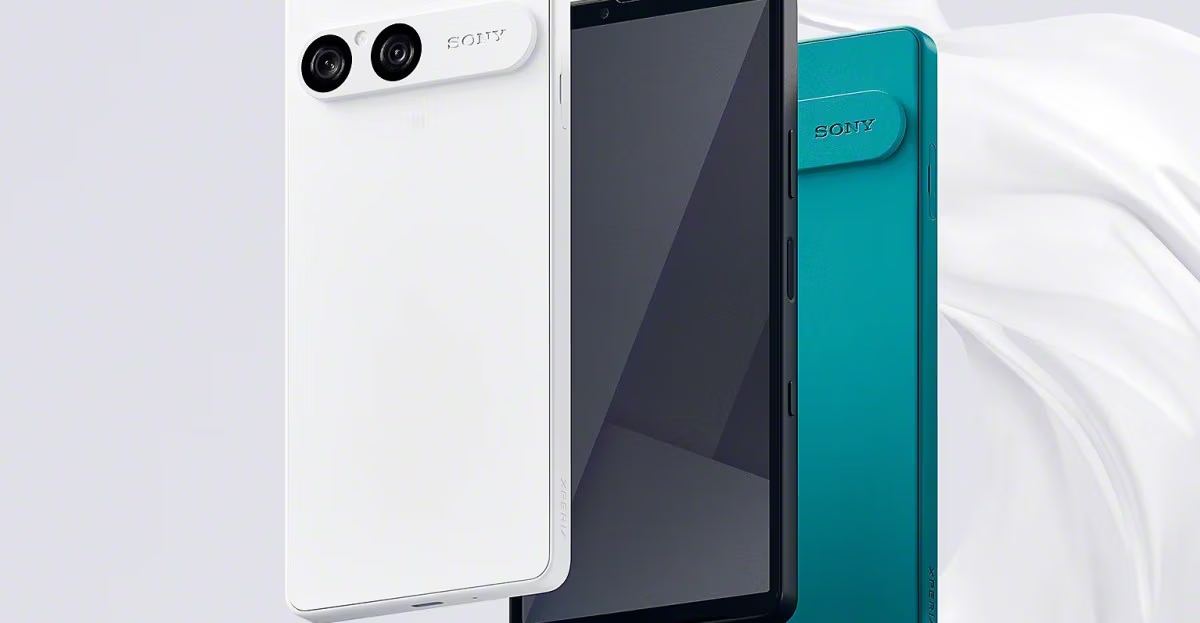
News from The Verge reveals that Sony’s upcoming mid-ranger, the Xperia 10 VII, is ditching its classic corner-mounted vertical camera array. Its replacement? A horizontal camera bar stretching across the phone’s upper back. If that sounds familiar, it’s because you’ve seen it prominently on Google’s Pixel phones for the last few generations, and increasingly on other devices seeking to convey a premium, camera-centric identity.
Let’s be clear: this isn’t just another phone getting another camera layout. This is a signal, a white flag from one of the industry’s most stubborn individualists. For a company renowned for its engineering prowess and its position as a leading supplier of camera sensors to the very competitors it now emulates, this design shift is profound. It tells us a few crucial things about where the smartphone market is heading, and perhaps, about the evolving identity of Sony Mobile itself.
The Unstoppable March of Design Homogeny
First, the camera bar has officially won. What started as a bold, slightly divisive choice on the Google Pixel 6 has now become the new default for signaling “serious camera.” It’s the 2020s equivalent of the notch, a design element that once sparked fervent debate but eventually became an almost universal indicator of a contemporary smartphone. The camera bar’s appeal is multifaceted: it provides a visually balanced look, often spanning the entire width of the phone, which can appear more symmetrical and less obtrusive than a square or vertical corner bump. Functionally, this horizontal strip allows for larger camera sensors, more sophisticated lens arrangements, and better heat dissipation, all critical for advanced mobile photography and video recording.
For Sony, a company whose camera sensor technology is literally inside most of its competitors’ phones – including many iPhones and Pixels – adopting this design feels less like innovation and more like capitulation. It’s a tacit admission that its own subtle design language, which favored a discreet corner placement, wasn’t screaming “great camera” loudly enough to the average shopper browsing the shelves at Best Buy or scrolling through online retailers. Sony’s Xperia line has always prided itself on its photographic capabilities, often featuring advanced manual controls and pro-level applications derived from its Alpha camera division. Yet, without a bold visual cue, that message might have been lost on consumers who make split-second purchasing decisions based on aesthetics. They’ve adopted the uniform to fit in, to visually align themselves with the perceived leaders in mobile imaging design, even as they’ve long been the silent powerhouse behind the scenes.
This widespread adoption of the camera bar underscores a powerful truth about consumer psychology and market trends: sometimes, form dictates perception as much as, if not more than, actual function. Even if Sony’s previous camera setups were technically superior or equally capable, their visual understatedness might have cost them valuable mindshare. The camera bar, therefore, serves as an undeniable visual shorthand, instantly communicating “this phone prioritizes photography” to a broad audience, a message that Sony now feels compelled to echo.
A Shift in Strategy: From Niche to Mainstream?
This move hints at a larger strategic pivot for Sony. The Xperia line has long catered to a niche but loyal fanbase of photographers, videographers, and audiophiles who appreciate the pro-level features, the high-fidelity audio output, and the no-nonsense design. These were the connoisseurs’ choice, users who valued the precise controls, the 21:9 cinema-aspect display, and the dedicated hardware features over flashier, more consumer-oriented gimmicks. They understood the power of the manual controls in the Camera Pro app, the quality of the built-in DAC, and the utility of a physical shutter button. For these users, Xperia wasn’t just a phone; it was a specialized tool, a portable creative studio.
But niche markets, while offering intense loyalty, are tough. They rarely yield the sales volumes necessary for massive profitability and market dominance. Competing against giants like Samsung, Apple, and Google, who command vast marketing budgets and global distribution networks, requires a strategy that resonates with a much broader audience. By adopting a more mainstream, instantly recognizable design feature like the camera bar, Sony might be signaling a renewed push for broader appeal. The message is subtly changing from “a professional tool for creators” to “a great phone for everyone, which also has a fantastic camera.” It’s a pragmatic, understandable business decision, aimed at expanding market share and increasing profitability in a fiercely competitive industry.
However, this shift comes with significant risks. It risks diluting the very identity that made the brand special to its core user base. Will the die-hard Xperia fans, who championed Sony for its distinctiveness, see this as a smart evolution or a betrayal of principle? Will the new, more mainstream design be enough to attract new customers who might still associate the brand with its less prominent market position? Finding the balance between retaining a unique brand identity and achieving broader market appeal is a tightrope walk. Sony must carefully manage this transition to ensure it doesn’t alienate its most dedicated advocates while simultaneously failing to capture significant new segments.
What’s Next When Everyone Looks the Same?
The bigger picture here is the slow, inevitable convergence of smartphone design. When every flagship has a glass back, an aluminum frame, a punch-hole selfie camera, and now, a prominent camera bar, how do you stand out? This homogenization extends beyond just aesthetics, creeping into user interfaces, software features, and even the general performance benchmarks that often feel indistinguishable to the average user. The industry seems to be converging on a “best practice” design language, leaving less room for genuine visual innovation.
Sony’s surrender to this trend is a testament to the immense pressure of the market. It’s incredibly difficult to carve your own path when giants like Google and Samsung define the aesthetic of an entire generation of devices, backed by colossal marketing campaigns. The costs associated with unique design, custom tooling, and independent marketing efforts are simply too high for many players to sustain in the face of mass-market appeal. This leaves us wondering what the next frontier of design differentiation will be, as external hardware elements become increasingly uniform.
Will it be the widespread adoption of truly invisible, under-display cameras that finally deliver an uninterrupted, all-screen experience? Will the refinement of foldable technology mature to a point where it becomes genuinely practical and affordable for the masses, offering entirely new form factors? Or will we see a renaissance of unique materials, sustainable manufacturing processes, and bold color palettes that push the boundaries beyond glass and aluminum? Perhaps the future of differentiation lies not in hardware aesthetics, but in the intelligent integration of AI, hyper-personalized software experiences, or innovative battery technologies. The challenge for brands will be to communicate these internal advancements as compellingly as the camera bar communicates its photographic prowess.
The Sony Xperia 10 VII might not be the most revolutionary phone of the year in terms of raw specifications, but its design choice is a fascinating canary in the coal mine. It tells a story of market forces, brand identity, and the relentless search for a design that is both unique and universally understood. For now, it seems the camera bar is the answer, even for the rebels. It forces us to reconsider what “premium” looks like, and how much individuality brands are willing to sacrifice for mainstream acceptance and market viability.
What are your thoughts on this design shift? Do you believe Sony is making a necessary move for survival, or is it sacrificing the very essence of what made Xperia special?
Read the original story at The Verge.