Ever feel like you’re a digital janitor? Your day isn’t just about doing your work, but managing the work around the work. It’s the endless juggling of windows, the hunt for that one specific file across three different cloud apps, the constant barrage of notifications demanding your attention. You’re not just using your computer; you’re wrestling with it.
It’s a feeling so common we’ve accepted it as the price of admission to the modern world. But a fascinating piece from Ars Technica serves as a powerful reminder that it was never supposed to be this way. The article, “Jef Raskin’s cul-de-sac and the quest for the humane computer,” isn’t just a history lesson; it’s a ghost story about a future we almost had.

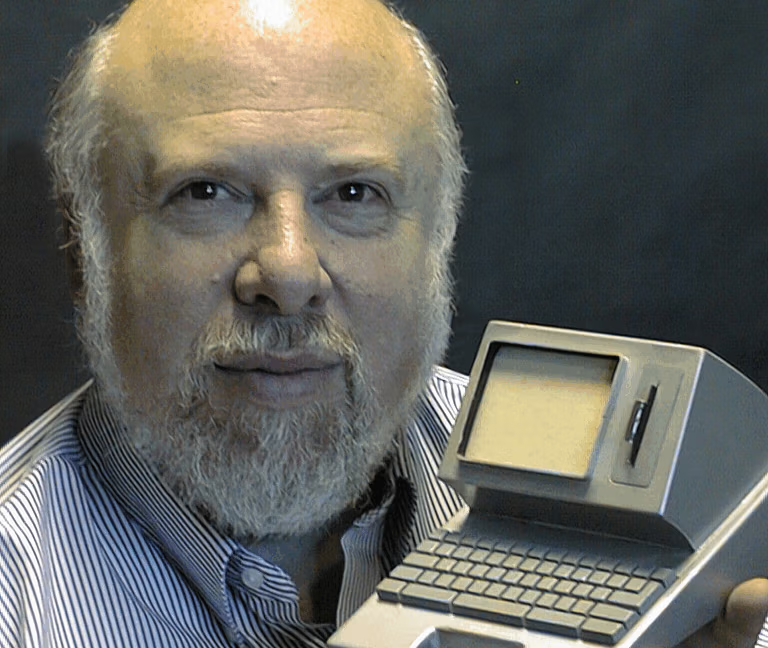
For those who don’t know the name, Jef Raskin was the original visionary behind the Macintosh project at Apple, a man obsessed with a single, radical idea: the “humane interface.” His core belief was that computers should conform to people, not the other way around. They should be extensions of our minds, tools that reduce cognitive load, not multiply it.
The now-ubiquitous desktop metaphor—with its folders, overlapping windows, and icons—was something Raskin fought against. While it was a revolutionary leap from the command line, he saw the seeds of the very chaos we experience today. He foresaw a future where users would spend more time managing their digital workspace than actually thinking and creating within it. Sound familiar?
Ars Technica’s piece brilliantly frames Raskin’s alternative vision as a “cul-de-sac“—a promising road of innovation that the industry explored, then abandoned for the superhighway of the graphical user interface (GUI) we all drive on today. Raskin championed a different model, one centered on a single, zoomable interface or a universal, text-based system. Imagine a computer where you never had to “save” a file because your work was always preserved. A machine where you found information not by navigating a maze of folders, but by simply describing what you were looking for. No windows to manage, no desktops to clean. Just you and your flow.
What Does This ‘What If’ Scenario Mean for Us Now?
The key takeaway is that we’ve spent 40 years optimizing a paradigm that may have hit its ceiling. The WIMP (Windows, Icons, Menus, Pointer) interface was designed to onboard a generation unfamiliar with computing. It succeeded spectacularly. But today, it’s creaking under the weight of our hyper-connected, multi-tasking lives. The very tools designed to make us more productive are now a primary source of distraction and anxiety.
Raskin’s ‘Cul-de-Sac’ Isn’t a Dead End Anymore. It’s the Blueprint for the Future.
Look at the trends emerging in modern software. The rise of command-palette tools like Alfred and Raycast on macOS or the built-in functions in apps like Slack and VS Code are a direct rebellion against menu-hunting. They are a nod to Raskin’s belief in a more direct, language-based interaction. The growing “calm tech” movement, which advocates for technology that respects our attention, is the very definition of a humane interface. Even the push towards single-task, minimalist writing apps is an attempt to escape the prison of the cluttered desktop.
We are, piece by piece, trying to rebuild the humane computer that Jef Raskin envisioned all those years ago.
The Ars Technica article is a crucial look back, not for nostalgia’s sake, but as a map. It shows us where we took a different turn and, more importantly, reminds us that other paths are still there to be explored. The next great leap in personal computing probably won’t be a faster processor or a higher-resolution screen. It will be a fundamental rethinking of how we interact with our machines—a shift from managing the interface to achieving a state of flow.
We may have left Jef Raskin’s ideas in a cul-de-sac four decades ago, but it’s time we sent a search party. The humane computer is a ghost that still haunts the machine, waiting for us to finally let it in.
Read the original story at Ars Technica.
Do you often feel like you’re wrestling with your computer, and what specific interface frustrations do you wish modern tech would solve?