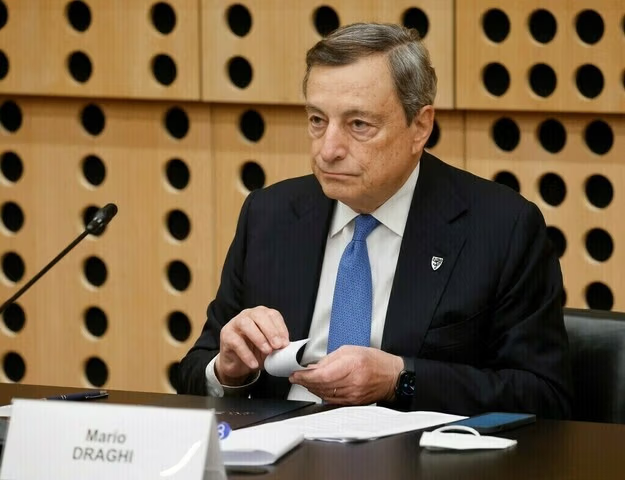
A Radical Change is Needed: Mario Draghi’s Urgent Prescription for an Ailing European Economy
When Mario Draghi speaks, Europe listens intently, remembering the unwavering resolve that salvaged the euro with his iconic “whatever it takes” promise. Now, the former European Central Bank President has once again issued a profound warning, but this time, his focus has shifted from monetary policy to the fundamental health and competitiveness of the European Union’s economy. In a stark and unvarnished assessment, Draghi declared that Europe is not merely falling behind; it is “failing to match the speed” of its principal global rivals, the United States and China. This isn’t just an economic observation; it’s a critical geopolitical statement signaling an existential challenge to the continent’s long-term prosperity and stability.
Draghi’s message, delivered as he meticulously crafts a landmark report for the European Commission, transcends mere criticism; it is a powerful call to arms. He contends that the EU’s prevailing economic model, once lauded for its stability and social cohesion, has become a significant liability in a rapidly evolving global landscape that demands agility, strategic foresight, and monumental action. While Washington swiftly deploys hundreds of billions of dollars through its Inflation Reduction Act, galvanizing green industries and technological innovation, and Beijing relentlessly executes its state-driven industrial strategy with unparalleled efficiency and scale, Europe, in Draghi’s view, remains ensnared in a response characterized by timidity, debilitating fragmentation, and chronically insufficient funding. The chasm between Europe’s approach and that of its competitors is widening, threatening to relegate the continent to a secondary role on the global economic stage.

The Core Diagnosis: Fragmentation and a Failure of Scale
At the very heart of Draghi’s piercing analysis lies a deceptively simple yet profoundly devastating problem: Europe’s crippling lack of scale. This isn’t just about the size of individual companies, but about the systemic inability for economic activity to achieve critical mass across the continent. European enterprises, despite their innovative potential and high-quality products, consistently struggle to transcend national borders and achieve the global footprint necessary to compete effectively with American tech giants or Chinese manufacturing powerhouses. The continent’s much-celebrated single market, intended to foster seamless economic integration, remains, in practice, a labyrinthine patchwork of 27 distinct regulatory frameworks, disparate legal systems, and fragmented capital markets. This bureaucratic and financial balkanization fundamentally impedes the seamless flow of investment, talent, and innovation—precisely the ingredients required to nurture and scale global champions.
Consider the stark contrast: an ambitious entrepreneur in Lisbon, brimming with a groundbreaking idea, faces immense hurdles attempting to tap into diverse venture capital pools or scale across various national markets as effortlessly as a startup in Austin, Texas, can access funding from Silicon Valley. The barriers range from differing insolvency laws and taxation regimes to varied company incorporation rules and investor protections. This pervasive fragmentation is unequivocally Europe’s Achilles’ heel, stifling growth, deterring cross-border investment, and ultimately condemning many promising European ventures to a sub-optimal existence within limited national confines, rather than allowing them to blossom into continent-spanning, world-leading enterprises. This stifling environment drains Europe of its inherent innovative potential and cedes strategic economic ground to more unified and agile rivals.
Unlocking Europe’s Potential: The Imperative of a Capital Markets Union
Draghi’s proposed solution to this existential challenge is nothing short of a “fundamental overhaul,” with the creation of a genuine Capital Markets Union (CMU) at its absolute core. This isn’t merely abstract financial jargon; it is a visionary blueprint for transforming Europe into a dynamic, integrated economic powerhouse. The CMU envisions a continent where the vast pools of private savings—currently estimated in the trillions of euros and often locked away in low-yielding bank deposits or national bonds—can be efficiently and effectively channeled into the monumental, long-term investments that Europe desperately requires. These investments are crucial for driving the ambitious green and digital transitions, which demand unprecedented capital outlays for renewable energy infrastructure, advanced digital networks, and cutting-edge technologies. Moreover, with the escalating geopolitical tensions, a newly urgent priority has emerged: defense. Rebuilding and integrating Europe’s defense industrial base requires a level of investment currently impossible under the fragmented status quo.
Without a truly unified pool of capital, a sophisticated and integrated financial ecosystem, and a standardized regulatory environment, Europe will remain perpetually outspent, out-innovated, and strategically vulnerable. A functioning CMU would enable venture capitalists to easily invest across borders, facilitate cross-listing of shares, harmonize insolvency procedures, and simplify access to funding for businesses of all sizes, from nascent startups to established industrial giants. It would reduce the cost of capital, making European companies more competitive globally, and provide institutional investors with a broader, deeper, and more liquid market for their investments. This radical shift in financial architecture is not just an economic policy; it is a strategic imperative for Europe to secure its future prosperity and exert its influence on the global stage.
Navigating the Geopolitical Storm: Why Europe’s Future is Now
What amplifies the urgency and potency of Draghi’s warning is its fortuitous, yet critical, timing. The comfortable old world order upon which Europe had long structured its peace and prosperity has irrevocably shattered. The bedrock of American security guarantees, the allure of vast Chinese markets for European exports, and the seemingly endless supply of cheap Russian energy—these pillars have all crumbled, leaving the continent exposed and vulnerable. Europe now confronts the monumental, multi-faceted task of concurrently securing its own defense capabilities, reshoring critical supply chains to enhance resilience, and undertaking a comprehensive, costly overhaul of its entire energy infrastructure away from fossil fuels and towards sustainable alternatives.
Each of these challenges individually demands unprecedented levels of investment and coordinated action; tackling all three simultaneously represents an economic and political undertaking of staggering proportions. Draghi’s conviction is clear: the required scale of investment is simply impossible to achieve without a radical, systemic change to Europe’s economic and financial architecture. The current fragmented approach, characterized by national silos and cautious incrementalism, is wholly inadequate to meet the demands of this new geopolitical reality. The continent cannot afford to dither; its very security and economic sovereignty are at stake, compelling it to forge a more unified, resilient, and self-sufficient future.
The Road Ahead: Political Challenges and the Stakes for Europe’s Social Fabric
Mario Draghi’s eagerly anticipated report is poised to become a central political battleground, forcing an inescapable and crucial debate on the very future trajectory of the European project. It will compel national leaders to confront deeply uncomfortable questions that challenge long-held tenets of national sovereignty and fiscal prudence. Are member states truly willing to cede more control and regulatory authority to Brussels and other EU institutions to forge a truly integrated economic powerhouse? Can the European Union, historically characterized by its traditional fiscal caution and often conservative budgetary approaches, overcome these deeply ingrained habits to unlock the “massive” public and private investment needed to compete effectively with global titans like the U.S. and China? These are not mere technical queries; they delve into the core identity and political will of the European Union.
The stakes extend far beyond merely adjusting economic league tables or improving growth statistics. Draghi issues a somber warning that a failure to act decisively jeopardizes Europe’s fundamental “social contract.” A continent that progressively loses its capacity to generate robust prosperity, drive cutting-edge innovation, and create high-quality, secure jobs risks fueling the very political instability and populist backlash it has diligently fought for decades to contain. Economic stagnation begets social unrest, eroding public trust in democratic institutions and emboldening extremist movements. The ability of Europe to deliver a tangible improvement in the lives of its citizens—through jobs, opportunities, and a secure future—is paramount to preserving its unique model of democratic governance and social welfare.
Mario Draghi’s message is a clear-eyed, unsentimental assessment from one of Europe’s most experienced and respected statesmen. It is an unequivocal declaration that the era of incrementalism, of piecemeal reforms and cautious half-measures, is no longer a viable option. The continent now stands at a profound fork in the road, faced with a binary choice: it can either boldly embrace the “radical change” that Draghi so urgently prescribes, undertaking the fundamental transformations necessary to reclaim its competitive edge and secure its future, or it can accept a trajectory of managed decline, inevitably becoming a marginalized player in a rapidly evolving world that simply will not wait for Europe to catch up.
What concrete steps do you believe European leaders must prioritize to implement Draghi’s vision for a more competitive and unified European economy?
What concrete steps do you believe European leaders must prioritize to implement Draghi’s vision for a more competitive and unified European economy?