The Trump Gambit: A Two-Pronged Prescription for Ukraine’s War
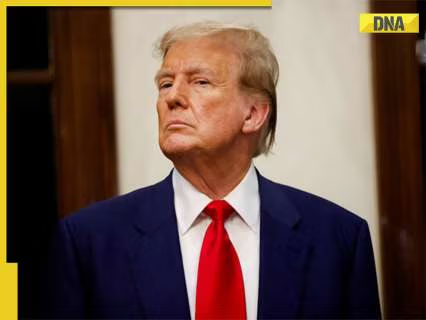
In a move that signals a clear and dramatic departure from current U.S. policy, former President Donald Trump has laid out his own stark vision for ending the war in Ukraine. It’s a two-pronged strategy that simultaneously demands aggressive economic warfare from Europe while pushing for a pragmatic, and likely painful, settlement from Kyiv. This isn’t just campaign rhetoric; it’s a potential blueprint for a second Trump presidency, one that is already sending ripples through the halls of power in Washington, Brussels, and Kyiv.
First, Trump leveled a familiar critique at America’s European allies, reigniting a long-standing argument from his time in office. “Stop buying oil from Russia,” he urged, directly linking Europe’s energy dependence to the Kremlin’s war chest. For Trump, the equation is simple: every barrel of Russian oil purchased by a European nation is another dollar funding the invasion of Ukraine. This “I told you so” moment is a powerful part of his narrative, reminding audiences that he spent years warning Germany and others about the strategic folly of projects like the Nord Stream 2 pipeline. By calling for a complete cutoff, he positions himself as the only leader willing to demand the economic sacrifice necessary to truly cripple Putin’s war machine.

Yet, in the same breath, Trump offered a dramatically different piece of advice to Ukrainian President Volodymyr Zelenskyy. “You have to make a deal,” he stated, pivoting from a hawkish stance on Russia’s finances to a dealmaker’s realpolitik on Ukraine’s future. The unspoken implication of such a “deal” is clear: it would likely involve territorial concessions and a compromise on Ukrainian sovereignty that the current Biden administration and many NATO allies have deemed unacceptable. This is the core of the Trump gambit—a transactional approach that eschews the current policy of unwavering, open-ended support for Ukraine’s goal of total victory.
Trump’s Call for European Economic Warfare: Crippling Russia’s War Chest
Former President Trump’s strategy for the Ukraine conflict is firmly rooted in his long-held belief that Europe must bear a greater economic burden in confronting Russian aggression. He has consistently argued that Europe’s reliance on Russian energy, particularly oil, directly fuels the Kremlin’s war machine. His demand, “Stop buying oil from Russia,” is not merely about sanctions; it’s about forcing a complete economic disengagement he believes is essential to genuinely incapacitate Putin’s military and financial capabilities. This perspective echoes his prior warnings about strategic vulnerabilities like the Nord Stream 2 pipeline, reinforcing his narrative that European energy dependence was a self-inflicted wound.
Implementing such a comprehensive energy embargo, however, presents significant challenges for European leaders. While considerable progress has been made to reduce reliance on Russian energy, a complete and immediate cutoff of all Russian oil, as Trump suggests, would still entail substantial economic repercussions. It would require finding alternative energy sources at scale, potentially at higher costs, impacting inflation, industrial competitiveness, and household budgets. The political will to impose such stringent measures, risking significant economic disruption and potential public dissent, remains a complex calculation across European capitals.
From an economic warfare standpoint, Trump’s proposal targets Russia’s primary source of state revenue. A truly comprehensive European embargo, particularly on oil, combined with existing price cap mechanisms and international pressures, could severely diminish Russia’s capacity to fund its military and maintain domestic stability. This strategy underscores a belief that maximal economic pressure is the most direct path to forcing Moscow to the negotiating table, even if it entails considerable short-term economic pain for Europe.
The Dealmaker’s Realpolitik: Ukraine’s Painful Compromise
In sharp contrast to his aggressive economic demands on Europe, former President Trump’s advice to President Zelenskyy is one of pragmatic, and potentially painful, compromise. His unequivocal statement, “You have to make a deal,” carries the profound implication that Ukraine must be prepared to cede territory and compromise on its sovereignty to achieve a cessation of hostilities. This position directly challenges the stated war aims of Ukraine, which insists on the full restoration of its internationally recognized borders, and contradicts the current policy of the Biden administration and most NATO allies, who uphold Ukraine’s territorial integrity.
The “deal” envisioned by Trump almost certainly involves Ukraine accepting the permanent loss of territories currently occupied by Russia, including Crimea and significant portions of eastern and southern Ukraine. Such an outcome is vehemently opposed by Kyiv, which views any territorial concessions as a betrayal of its people, a legitimization of Russian aggression, and a dangerous precedent for future encroachments. For President Zelenskyy, navigating this pressure would involve an agonizing choice between national aspirations and the pragmatic need to end devastating bloodshed, particularly if U.S. support were to become contingent on such a compromise.
This approach highlights Trump’s transactional foreign policy philosophy, where the primary objective is to stop the fighting and achieve a resolution, even if that resolution is “painful” for one party. It stands in direct opposition to the current Western strategy of supporting Ukraine’s goal of total victory, defined as the expulsion of all Russian forces. Trump’s emphasis on a deal prioritizes an end to bloodshed over the full restoration of Ukraine’s borders, signaling a willingness to accept a compromise that the current international consensus views as rewarding aggression and undermining international law.
Understanding the Trump Gambit: A Transactional Shift in U.S. Policy
The “Trump Gambit” in Ukraine is defined by its profoundly transactional nature, marking a significant departure from traditional U.S. foreign policy. This strategy aims to simultaneously escalate economic pressure on Russia through European action, while de-escalating Ukraine’s territorial demands, pushing Kyiv towards a swift compromise. It is a pragmatic, albeit controversial, synthesis designed to achieve a rapid end to the conflict rather than a definitive victory for either side, reflecting Trump’s “America First” doctrine.
This approach stands in direct opposition to the current Biden administration’s policy of “unwavering, open-ended support” for Ukraine, which is predicated on helping Ukraine achieve its full war aims. Trump’s vision, by contrast, prioritizes a swift resolution to a costly conflict he perceives as a drain on American resources, irrespective of the deeper principles of international law or democratic values. His emphasis on European economic burden-sharing aligns with his long-held belief that U.S. allies should assume greater responsibility for global security, thereby reducing American entanglement and financial commitments abroad.
Critically, the Trump Gambit implies a fundamental shift in the U.S. role from a steadfast supporter of Ukraine’s maximalist goals to a potential mediator or even enforcer of a settlement. Such a change would profoundly alter the geopolitical calculus for all parties, potentially weakening Ukraine’s bargaining position and forcing a re-evaluation of security guarantees across Europe. It highlights a foreign policy vision that prioritizes deal-making and perceived American self-interest above established international norms and the stated objectives of traditional U.S. allies.
Ripples Across the Atlantic: Europe’s Strategic Recalculation
For European leaders, former President Trump’s pronouncements on Ukraine are a sobering preview of a potential future where American leadership undergoes a seismic shift. The mere prospect of a U.S. president conditioning aid on Kyiv’s willingness to negotiate, or even withdrawing support entirely, compels a profound strategic recalculation across the continent. This uncertainty injects an unprecedented urgency into Europe’s ongoing efforts to bolster its own defense capabilities and accelerate its journey towards comprehensive energy independence, preparing for a world where Washington’s steadfast backing may no longer be assured.
The potential for reduced U.S. support strengthens the imperative for a more robust, self-reliant European security architecture. This has already spurred intensified discussions and concrete actions aimed at increasing defense spending, streamlining military procurement, and fostering greater intra-European defense cooperation. The goal is to build capabilities capable of managing regional threats independently, or at least with less reliance on external guarantees. Furthermore, Trump’s insistence on cutting off Russian oil reinforces the strategic urgency for Europe to achieve true energy security, diversifying sources and investing heavily in renewables, mitigating geopolitical leverage Russia once held.
Ultimately, Trump’s stance forces Europe to consider a future where transatlantic relations, particularly concerning security, are more transactional and less guaranteed. While potentially challenging, it could also lead to a more unified and assertive European foreign and defense policy, driven by a renewed sense of urgency and self-preservation. This period of strategic recalculation extends beyond Ukraine, touching upon the very foundations of NATO and the broader future of the liberal international order.
A Chilling Message for Kyiv: Ukraine’s Political Deadline and Battlefield Urgency
For President Volodymyr Zelenskyy and the people of Ukraine, the implications of former President Trump’s proposed strategy are chillingly clear. While currently buoyed by broad Western support, Trump’s rising influence introduces a stark political deadline for Ukraine’s war efforts. The looming possibility of his return to the White House creates immense pressure to achieve maximum gains on the battlefield before a potential shift in American policy could force them into a disadvantageous negotiation, potentially undermining all previous sacrifices.
Ukraine’s government has consistently stated that any peace settlement must be based on the full restoration of its territorial integrity. Trump’s call for a “deal,” implying territorial concessions, presents a profound dilemma. Ukraine would face the impossible choice of either adhering to its maximalist war aims, risking a significant reduction or withdrawal of crucial U.S. military and financial aid, or capitulating to demands that would be perceived as a catastrophic betrayal of its sovereignty. This pressure could profoundly impact battlefield strategy, potentially leading to desperate pushes to reclaim territory before a perceived window of opportunity closes.
The psychological impact on Ukrainian morale cannot be overstated. After years of brutal conflict and immense suffering, the prospect of being compelled to surrender territory by its most powerful ally could severely undermine public support for the war effort and faith in international guarantees. This dynamic places President Zelenskyy in an incredibly precarious political position, having to balance the desperate need for continued Western support with the nationalistic resolve that has defined Ukraine’s struggle.
Beyond Campaign Rhetoric: Trump’s Vision as a 2024 Foreign Policy Debate
Former President Trump’s pronouncements on Ukraine should not be dismissed as mere off-the-cuff remarks; they represent a coherent, albeit highly controversial, foreign policy vision. This vision deeply resonates with a segment of the American electorate weary of foreign entanglements and protracted financial commitments, believing U.S. resources are better spent domestically. As the 2024 election cycle intensifies, this two-pronged demand—that Europe bear a greater economic burden and Ukraine accept a territorial compromise—is poised to become a central and defining foreign policy debate.
This debate directly challenges the bipartisan consensus that has largely guided U.S. foreign policy on Ukraine since the 2022 invasion. Trump’s approach forces a critical examination of the goals, costs, and ultimate sustainability of current U.S. and Western engagement. It compels both his supporters and detractors to articulate their vision for America’s role in global conflicts, inevitably touching upon the nature of alliances, the efficacy of military aid, and the delicate balance between upholding international norms and pursuing perceived national interests.
The strategic decisions of allies and adversaries alike will undoubtedly be shaped by the contours of this unfolding debate, long before any votes are cast. European nations are already contemplating hedging strategies and accelerating self-reliance, while Russia will be keenly observing for any cracks in the Western alliance. For the American public, the debate will force a stark choice between a policy of continued robust support for Ukraine and a more isolationist, transactional approach that seeks a quick, albeit potentially painful, resolution.
Source and Further Reading
For more details on former President Trump’s statements regarding Ukraine and Europe, you can read the original story at Dna India.
How do you foresee this two-pronged approach impacting the geopolitical landscape and the ultimate resolution of the conflict in Ukraine? Share your thoughts in the comments below.