The Polish Airspace Incursion: A New Kind of Provocation
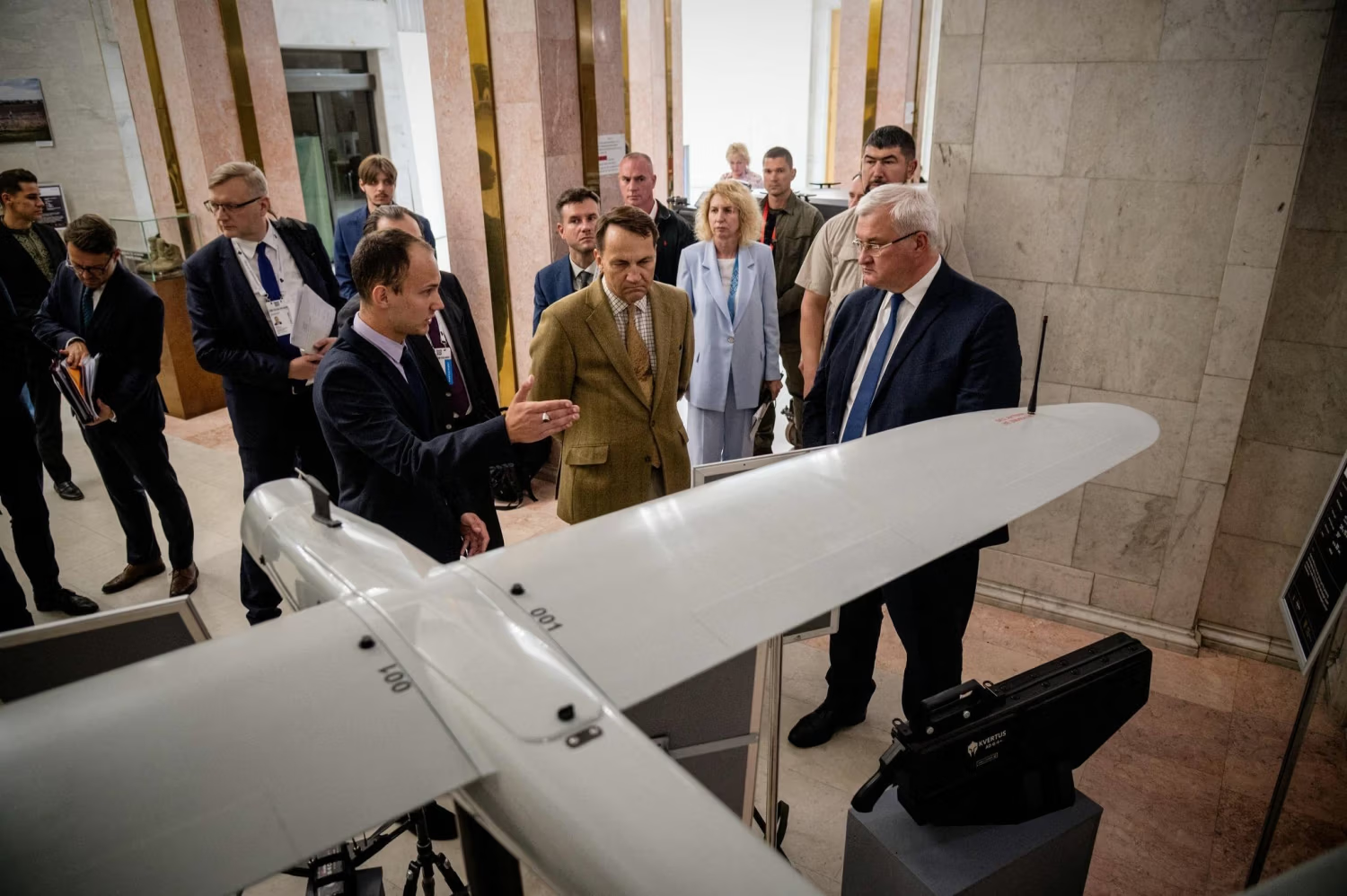
In the high-stakes theater of global politics, it’s often not the initial act of aggression that defines a crisis, but the response that follows. This week, a suspected Russian surveillance drone briefly violated Polish airspace—a serious provocation against a frontline NATO state. But the drone itself is no longer the story. The real tremor shaking the foundations of the transatlantic alliance came from Washington, D.C., in the form of a now-infamous public shrug from President Donald Trump.
The incident, while seemingly minor in isolation, carries significant weight in the current geopolitical climate. Poland, a nation acutely aware of its geographic vulnerability and historical struggles with Russian aggression, views any violation of its sovereignty with extreme seriousness. A surveillance drone, potentially gathering intelligence on NATO defenses or critical infrastructure, represents a direct challenge to its security. Such incursions are not mere technical glitches; they are often calculated tests of resolve, designed to probe defenses, gauge reaction times, and send subtle, yet potent, political messages.

For weeks, intelligence reports had hinted at increased Russian aerial activity near NATO borders, a pattern consistent with Moscow’s strategy of pushing boundaries and testing Western responses. The specific details of the drone’s flight path, its duration in Polish airspace, and the assets deployed for interception remain under wraps, but the diplomatic fallout has been anything but quiet. The expectation within NATO has always been a unified, firm condemnation of such acts, coupled with a reinforcement of collective defense principles. This time, however, the script deviated dramatically.
Trump’s “Casual Dismissal”: Undermining NATO’s Bedrock
His casual dismissal of the incursion, reportedly questioning its significance and suggesting Poland should “handle it,” has sent a jolt of profound unease through European capitals. For decades, the unwavering certainty of the American security guarantee, enshrined in NATO’s Article 5, has been the bedrock of European stability. That guarantee states that an attack on one member is an attack on all. Trump’s comments, however, introduce a terrifying new variable: What if the President of the United States gets to decide what constitutes a “real” attack?
Article 5 of the North Atlantic Treaty is more than just a clause; it is the philosophical and operational core of the entire alliance. It acts as a powerful deterrent, signaling to any potential aggressor that an attack on a small nation like Estonia or a large one like Germany would automatically trigger a collective military response from all 32 members, including the overwhelming might of the United States. This principle of collective defense has ensured peace and stability on the European continent for over 75 years, preventing the escalation of localized conflicts into broader wars by removing any ambiguity about the consequences of aggression.
President Trump’s remarks, whether intentional or not, inject a perilous level of ambiguity into this fundamental commitment. By suggesting that a drone incursion might not be significant enough to warrant a collective response, or implying that Poland should unilaterally manage the situation, he effectively creates a hierarchy of attacks. This could encourage adversaries to engage in “grey-zone” tactics – provocations that fall just short of traditional warfare but are designed to test resolve and exploit divisions, knowing that a full Article 5 response might be withheld or questioned by Washington. The psychological impact on frontline states like Poland, Lithuania, and Latvia, who rely most heavily on the explicit American guarantee, is immense. It forces them to reconsider the absolute reliability of their most powerful ally, potentially leading to dangerous recalculations of their own defensive postures.
Furthermore, this incident highlights a concerning trend of the executive branch circumventing established diplomatic protocols and collective decision-making processes within NATO. The alliance operates on consensus and consultation, with serious security matters typically addressed through established channels involving the North Atlantic Council. A unilateral public statement from the U.S. President that appears to redefine the terms of collective defense undermines these crucial mechanisms and leaves allies scrambling to interpret Washington’s true intent.
The Slippery Slope of “Significance”
The question of “what constitutes a ‘real’ attack” opens a dangerous Pandora’s Box. Is a cyberattack on critical infrastructure less significant than a physical drone incursion? What about economic coercion or information warfare designed to destabilize a government? These are increasingly common threats in the modern geopolitical landscape. If the U.S. President reserves the right to individually assess the “significance” of an attack, it creates a precedent where the threshold for collective action becomes fluid and unpredictable, eroding the very deterrent effect Article 5 is designed to provide. Allies now face the terrifying prospect that, in a moment of crisis, their security might depend not on treaty obligations, but on the subjective judgment or political calculations of a single leader.
America First: From Theory to Real-World Stress Test
This incident is far more than a diplomatic gaffe; it is the practical manifestation of Trump’s “America First” foreign policy doctrine. For years, his transactional view of alliances has been a theoretical concern for European leaders. Now, it’s a real-world stress test. The message being received in Berlin, Paris, and especially Warsaw is that the American commitment is no longer absolute but conditional, subject to the whims and calculations of the White House. The drone incursion was a test of NATO’s resolve, and in the eyes of many, the alliance’s most powerful leader appeared to fail it.
The “America First” doctrine, articulated by President Trump during his previous term and consistently echoed in his current campaign, fundamentally redefines the traditional U.S. approach to international relations. It posits that all foreign policy decisions and alliances must primarily serve the direct economic and security interests of the United States, often at the expense of multilateral cooperation or shared values. Within this framework, alliances are viewed not as permanent partnerships based on mutual defense, but as transactional arrangements where each party must deliver tangible benefits to Washington. If an ally is perceived as not contributing “enough” or if an incident is deemed not directly threatening to U.S. interests, the commitment of American support becomes negotiable.
European leaders have long grappled with the implications of this philosophy. During Trump’s first presidency, concerns mounted over his criticisms of NATO members’ defense spending, his withdrawal from international agreements, and his perceived preference for bilateral dealings over multilateral frameworks. However, these concerns often remained at a rhetorical or policy level. The Polish drone incident, combined with Trump’s reaction, provides a concrete, real-time example of “America First” being applied to a live security crisis involving a NATO ally. It moves the discussion from theoretical apprehension to immediate, practical vulnerability.
In Warsaw, the alarm bells are ringing particularly loudly. Poland has been one of the staunchest U.S. allies, investing heavily in its military, hosting American troops, and consistently meeting or exceeding NATO’s 2% GDP defense spending target. For a nation that has consistently demonstrated its commitment to the alliance and its American partner, to be told, in essence, to “handle it” when facing a Russian provocation is a profound betrayal. It suggests that even the most loyal allies are not immune to the transactional calculus, and that their security is now intrinsically linked to the current occupant of the Oval Office, rather than the enduring principles of a collective defense treaty.
This incident transforms the transatlantic relationship into a constant stress test. Every future provocation, every border incident, every cyberattack will now be viewed through the lens of potential American disengagement. This uncertainty not only emboldens adversaries but also fosters an environment of distrust and anxiety among allies, forcing them to re-evaluate their long-term strategic dependencies on the United States. The perceived failure of leadership in this critical moment sends a chilling message: the era of unquestioning American protection, a cornerstone of post-Cold War European security, may be drawing to a close.
Europe’s Imperative: The Accelerated Drive for Strategic Autonomy
The long-term implications are seismic. This single event is likely to become a powerful catalyst for Europe’s push toward “strategic autonomy.” Leaders who once paid lip service to the idea of a unified European defense capability are now facing the stark reality that they may have no other choice. The conversation is no longer about supplementing NATO, but about creating a viable Plan B for a future where Washington’s reliability cannot be taken for granted.
For decades, the concept of “European strategic autonomy” has been a topic of intermittent discussion within the European Union, often gaining traction after perceived U.S. unilateralism or shifts in American foreign policy. Initially, it was conceived as a way for Europe to develop its own capacity to act militarily and diplomatically when U.S. interests diverged or when Washington chose not to intervene. It aimed to complement NATO, not replace it, ensuring Europe could contribute more effectively to its own security and global stability. However, President Trump’s repeated questioning of NATO’s value, coupled with this latest dismissal of a direct threat to an ally, has fundamentally shifted the debate.
Suddenly, strategic autonomy is no longer a long-term aspiration or a philosophical ideal; it is an urgent, existential necessity. European leaders, particularly in France and Germany, who have been vocal proponents of greater European defense capabilities, now have undeniable evidence that relying solely on the American security umbrella is a precarious gamble. The focus has rapidly transitioned from simply enhancing Europe’s ability to participate in international missions to developing a genuine capacity for self-defense, independent of—or at least substantially less reliant on—U.S. leadership and military assets.
Achieving true strategic autonomy presents monumental challenges. It requires massive, coordinated investment in defense spending across member states, overcoming national industrial interests to foster common procurement and research, and developing a coherent military command structure. Political will, often fragmented by national priorities, must be galvanized. Furthermore, it necessitates difficult decisions about nuclear deterrence, advanced air and missile defense systems, and expeditionary capabilities, areas where European nations have historically depended on the U.S.
Towards a Viable Plan B
The immediate aftermath of Trump’s comments saw a flurry of high-level meetings in Brussels, Paris, and Berlin. Discussions are reportedly focusing on accelerating existing initiatives like the Permanent Structured Cooperation (PESCO) and the European Defence Fund. There is also renewed impetus behind French President Macron’s vision for a European strategic culture and defense architecture, and German Chancellor Scholz’s Zeitenwende (turning point) initiatives to dramatically increase German military spending. The ambition now is not merely to build a robust European pillar within NATO, but to construct a credible “Plan B” – a contingency plan for a scenario where the U.S. commitment to Article 5 is either explicitly withdrawn or rendered effectively meaningless through repeated equivocation.
This Plan B would involve a more robust and integrated European rapid reaction force, independent intelligence gathering capabilities, and potentially, a reconsideration of the role of existing European nuclear powers within a broader continental defense framework. The road ahead is fraught with political and financial hurdles, but the recent incident has provided an undeniable, stark motivation: Europe’s security can no longer be outsourced or taken for granted. The continent must forge its own robust and reliable security architecture, and the timeline for doing so has dramatically shortened.
Shifting Fault Lines: A Post-War Order in Flux
While the drone has long since left Polish airspace, the questions it raised will linger for years. President Trump’s remarks have exposed the deep anxieties underpinning the Western alliance. It is a moment of chilling clarity for Europe: the old certainties are gone. The debate is no longer *if* the continent must forge its own security path, but how quickly it can be done. The fault lines of the post-war order are shifting, and a single, dismissive gesture may have just accelerated the quake.
The post-World War II order, largely shaped by American leadership and underpinned by institutions like NATO, the UN, and the Bretton Woods system, is undeniably under unprecedented strain. The rise of revisionist powers, global economic shifts, and internal political polarization within Western democracies have all contributed to its erosion. However, the perceived withdrawal of American security guarantees, particularly regarding its most vital alliance, represents a fundamental tectonic shift within this order. It’s not just a crack; it’s a widening chasm.
For European nations, particularly those on the eastern flank, the sense of “chilling clarity” is palpable. The decades-long assumption of a unified Western response to aggression, guided by steadfast American commitment, has been shattered. This forces a rapid and painful reassessment of national defense strategies, diplomatic alignments, and economic partnerships. Nations that once relied on a clear division of labor within NATO – with the U.S. providing the ultimate deterrent – must now contemplate a future where they are more individually accountable for their own territorial integrity and deterrence capabilities.
This re-evaluation extends beyond military readiness. It impacts foreign policy dialogues with Russia, China, and other global actors. If Europe cannot rely on absolute American backing, its diplomatic leverage diminishes, potentially forcing more conciliatory approaches or, conversely, prompting a more aggressive self-assertion that could escalate regional tensions. The unity of the European Union itself will also be tested, as member states navigate differing interpretations of the threat and preferred responses to American unreliability.
The ripple effects will be felt globally. The credibility of other U.S. alliances, from Asia to the Middle East, will undoubtedly come under scrutiny. Allies in regions facing similar great power competition will ponder whether their security guarantees are also subject to the transactional whim of a future White House. This could lead to a fragmentation of the global security architecture, encouraging more nations to pursue independent and potentially destabilizing defense policies, including the acquisition of advanced weaponry or even nuclear capabilities.
Ultimately, the Polish drone incident and the subsequent American reaction have become a watershed moment. It has not merely exposed anxieties; it has crystallized them into an urgent imperative for action. The question for Europe is no longer academic or hypothetical. It is about practical timelines, concrete investments, and political courage to build a future where its security is truly in its own hands. The geopolitical landscape is being reshaped at an alarming pace, and the casual remark from Washington may well be remembered as the tremor that definitively accelerated the collapse of old certainties and ushered in a new, uncertain era for global security.
Read the original story at The Japan Times.
What specific actions do you believe European leaders should prioritize to rapidly enhance their strategic autonomy in the wake of such a pivotal moment?