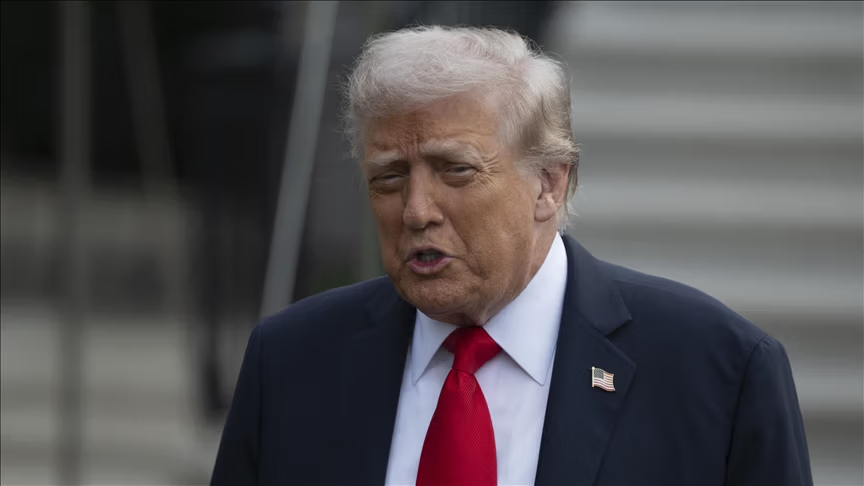
While the world’s focus remains fixed on the grinding frontlines in eastern Ukraine, former President Donald Trump has unveiled a startlingly different vision for ending the conflict—one that shifts the battlefield from the trenches of the Donbas to the global economic arena. In a recent interview, Trump sketched out a strategy that doesn’t involve more missiles for Kyiv, but rather a high-stakes ultimatum aimed squarely at Beijing, with European allies caught directly in the crossfire.
Speaking with British broadcaster Nigel Farage, Trump laid out a transactional and audacious plan: If elected, he would pressure China to help halt Russia’s war effort by threatening to sanction not just Beijing, but America’s own European partners if they refuse to join in. “I would say to Europe, ‘If you don’t sanction China… we’re going to sanction you,'” Trump stated, framing the threat as a powerful tool of economic leverage.

This is more than just another off-the-cuff remark; it’s a revealing look into the potential foreign policy doctrine of a second Trump administration. His proposed Trump Ukraine peace plan, while seemingly simplistic, carries profound implications for global trade, alliances, and the future of international diplomacy. It signals a readiness to employ unconventional means and raw economic power to achieve foreign policy objectives, setting the stage for a new and unpredictable era of superpower confrontation.
The Core Strategy: China as Russia’s Indispensable Lifeline
At its core, Trump’s strategy for ending the Ukraine conflict explicitly pinpoints China as the critical enabler of Russia’s ongoing military campaign. This approach fundamentally reframes the war not as solely a direct confrontation between Ukraine and Russia, but as a broader geopolitical struggle where Beijing holds a decisive key. The underlying assumption is that without China’s robust economic support—encompassing vital trade lifelines, crucial technology transfers, and financial mechanisms that effectively circumvent Western sanctions—Moscow’s war machine would inevitably sputter, stall, and ultimately be forced to retreat. This perspective views China not merely as a neutral party or a passive observer, but as an active participant whose economic policies sustain Russia’s ability to wage war.
Trump’s thinking posits that the existing strategy of directly arming Ukraine and imposing sanctions primarily on Russia, while necessary, is insufficient to force a rapid cessation of hostilities. Instead, by targeting the perceived economic powerhouse that underpins Russia’s resilience, he believes he can apply overwhelming leverage. This involves threatening to cut off China’s access to the vast and lucrative U.S. and European markets – a move that would represent an existential threat to China’s export-driven economy. The goal is to compel Beijing’s hand, forcing it to withdraw its extensive economic and technological support for Vladimir Putin’s regime. Such a move would aim to dry up the financial and material resources flowing to Moscow, effectively starving the Russian military of the components, capital, and markets it needs to continue its aggression. It is a quintessential Trumpian maneuver: identify a single point of maximum leverage, in this case, China’s economic vulnerability, and apply overwhelming pressure, regardless of the potential diplomatic fallout or the broader implications for global trade relations.
Unpacking China’s Role in Sustaining Russia
To understand the premise of Trump’s strategy, it’s crucial to examine how China has, in fact, served as Russia’s economic lifeline since the full-scale invasion of Ukraine in February 2022. While outwardly maintaining a stance of neutrality, Beijing has significantly bolstered its trade with Moscow, compensating for the decline in Russia’s commerce with Western nations. China has become Russia’s largest trading partner, importing vast quantities of Russian oil and gas, often at discounted prices, and exporting a wide array of goods, including dual-use technologies that have direct military applications.
These dual-use goods, ranging from microelectronics and drones to heavy machinery and components, are vital for Russia’s defense industrial base. Western intelligence agencies have repeatedly flagged concerns over Chinese companies supplying Russia with items critical for weapons production, circumventing existing sanctions regimes. Furthermore, China’s financial systems have provided Russia with alternative avenues for international transactions, insulating it from some of the severest impacts of Western banking restrictions. By offering these economic and technological arteries, China has inadvertently, or perhaps intentionally, enabled Moscow to absorb Western sanctions and continue its war efforts for far longer than many initially anticipated. Trump’s proposal seeks to sever these arteries, shifting the economic battlefield to Beijing’s doorstep.
A Transatlantic Ultimatum: The Future of Alliances and the Brussels’ Dilemma
Perhaps the most disruptive and contentious element of Trump’s ambitious peace plan is the explicit threat of imposing secondary sanctions against America’s own European allies. This is not merely a call for cooperation or a diplomatic request; it is an unequivocal demand for compliance. By threatening to penalize nations that have been traditional partners and pillars of the Western alliance if they don’t fall in line with his coercive strategy against China, Trump is signaling a decisive return to an unadulterated “America First” foreign policy. This doctrine, unlike traditional diplomacy, treats long-standing partnerships as fundamentally transactional rather than sacred bonds built on shared values and mutual security.
For European leaders, this presents an unprecedented nightmare scenario. Their economies are deeply and intricately intertwined with China’s, far more so than with Russia’s. China is the EU’s largest trading partner, a crucial market for European exports—from luxury goods to high-tech machinery—and an indispensable source for essential imports, including raw materials and manufactured components. Being forced to choose between the immense economic magnet of Beijing and a punitive Washington would trigger immense economic and political turmoil across the continent. Such a directive would compel European nations to unravel decades of integrated trade relationships, disrupt global supply chains, and potentially plunge several key sectors into crisis, leading to job losses and significant economic downturns.
Testing NATO Solidarity and European Strategic Autonomy
The ramifications for the NATO alliance would be equally, if not more, profound. The threat of secondary sanctions would test the alliance’s unity in an unprecedented way, potentially fracturing the very Western solidarity that has been painstakingly cultivated and maintained in confronting Russian aggression thus far. NATO, founded on the principle of collective defense and shared values, relies heavily on political cohesion. A unilateral American demand backed by economic threats would breed resentment, undermine trust, and could lead to a significant divergence in foreign policy priorities among member states.
Moreover, this pressure tactic would directly clash with Europe’s nascent ambitions for strategic autonomy. For years, European leaders have sought to diversify their economic and security partnerships, reducing over-reliance on any single power. Being strong-armed into an economic confrontation with China by the United States would be seen by many as a direct infringement on their sovereignty and their ability to chart an independent foreign policy course. The message from a second Trump term is stark and unambiguous: allegiance to Washington’s priorities would not be requested through diplomatic channels or multilateral consensus, but rather required through the potent threat of economic retribution, fundamentally altering the dynamics of transatlantic relations.
Implications for 2024 and the Global Economic Arena
As the U.S. presidential election nears, Trump’s bold proposal serves as a stark preview of how he would attempt to deliver on his signature promise to end the war in Ukraine “in 24 hours.” It’s a strategy built not on delicate diplomacy, multilateral consensus, or humanitarian considerations, but on raw economic power and an audacious willingness to upend the existing global order. This approach signals a significant departure from the Biden administration’s emphasis on coalition-building, steady support for Ukraine through conventional military aid, and coordinated sanctions against Russia rather than its enablers.
Both Beijing and Brussels are now explicitly on notice. They must begin to calculate the profound risks associated with a potential U.S. president who views allies and adversaries alike as interchangeable pieces on a complex geopolitical chessboard, to be moved, leveraged, and even penalized in pursuit of a singular, overriding goal: ending the Ukraine war on American terms. This could necessitate a dramatic reassessment of their own national interests and strategic partnerships. For voters globally, it draws a sharp contrast with traditional foreign policy approaches, offering a glimpse into a potentially far more confrontational and unpredictable global landscape.
The High-Stakes Gamble and Its Unintended Consequences
Trump’s gambit is undeniably a high-risk, high-reward proposition. Whether such a strategy could truly force an end to Europe’s largest land war since 1945 is an open question, fraught with unprecedented challenges. The success of this Trump Ukraine peace strategy hinges on several critical assumptions: that China’s economic dependency on the West is paramount, that Beijing would capitulate to such pressure, and that European allies would comply despite immense economic self-interest and potential domestic backlash. There is a very real possibility that China might retaliate with its own economic countermeasures, impacting American businesses and consumers. Furthermore, European nations might resist, creating an unprecedented rift within Western alliances and potentially leading to a fragmentation of the global sanctions regime.
What is certain, however, is that his vision for peace would fundamentally reshape global alliances, dismantle decades of established diplomatic norms, and set the stage for a new and profoundly unpredictable era of superpower confrontation. The global economic arena would become a primary battleground, and the established rules of international trade and cooperation would be severely tested. The long-term effects on institutions like the World Trade Organization, the stability of the dollar as a global reserve currency, and the very concept of international collaboration remain to be seen.
Read the original story at Anadolu Agency.
Considering the immense economic entanglement between China and both the U.S. and Europe, do you believe Trump’s proposed threat of sanctioning European allies to force action against China is a viable path to peace, or would it lead to greater global instability and fracturing of key alliances?