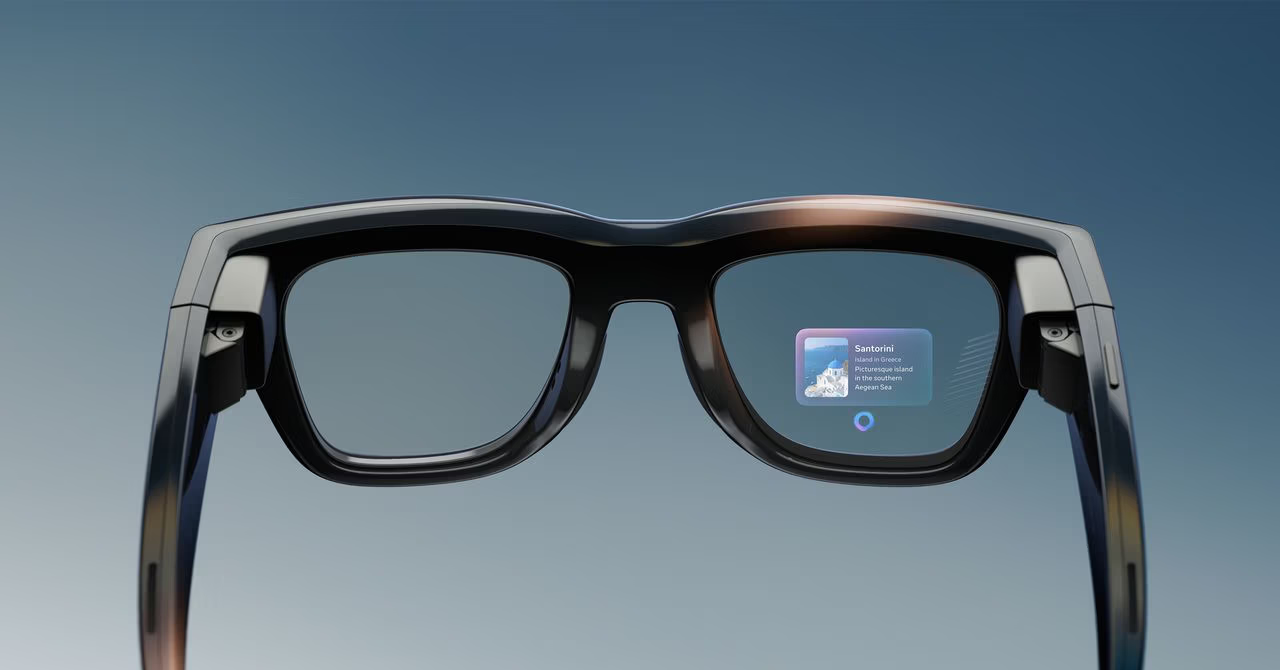
Imagine never forgetting a name again. Picture yourself on a first date, with subtle prompts reminding you of your companion’s hobbies. Envision a business meeting where you have instant access to key data points without ever breaking eye contact. This is the seductive promise of augmented reality smart glasses from companies like Meta—a future where a digital overlay gives us a social and intellectual edge. It’s a superpower, right in front of our eyes.
But as a fascinating new study from Stanford’s Virtual Human Interaction Lab reveals, this superpower comes with a hefty, hidden tax—and it’s paid by the person you’re talking to.

The Stanford researchers staged a simple but brilliant experiment, detailed in a recent WIRED article. They had pairs of people engage in conversation. One person wore a pair of AR glasses that fed them information: conversation starters, facts about the other person, and even reminders to ask questions or nod. The other person had no idea.
From the wearer’s perspective, the technology was a resounding success. They felt the conversation went better, that they were more engaged, and that they learned more about their partner. They were, in a word, smarter. They had a secret assistant whispering the right things to say at the right time.
But here’s the twist.
The person on the other side of the conversation felt the exact opposite.
To them, the “smarter” person just seemed… off. Distracted. Their gaze lingered a fraction too long, their responses slightly out of sync. They were talking to someone who was simultaneously in two places at once, and the delicate dance of human conversation stumbled. While the AR user felt like a social dynamo, their partner perceived them as awkward and less present.
Welcome to the Interaction Tax
This is more than just a teething problem for new tech; it exposes a fundamental challenge for the entire future of augmented reality. The issue isn’t the hardware, but the human brain’s limited bandwidth.
When you’re processing both a real-life human and a digital stream of information, you’re paying a “cognitive tax.” That tax manifests in micro-expressions, delayed reactions, and unnatural pauses that we, as social creatures, are exquisitely tuned to detect. Even if you think you’re being smooth, the other person can sense that something is amiss. You’re creating an asymmetrical social experience: one person is enhanced, while the other is left feeling disconnected.
This Stanford study throws a bucket of cold, human reality on the hot hype of AR. It suggests we’re heading toward a “social uncanny valley”—a state where technology is close enough to augmenting reality to be useful, but not seamless enough to be invisible, leaving a trail of awkwardness in its wake.
The Future is Asymmetrical
So, what does this mean for the future that Meta, and likely Apple and Google, are building?
It means the biggest hurdle for smart glasses isn’t shrinking the projectors or extending the battery life. It’s solving the human-to-human interface. How can a device provide you with useful information without severing the very connection it’s supposed to enhance?
We may be looking at a future with a new kind of social divide. Not between the haves and have-nots, but between the “augmented” and the “unaugmented” in any given conversation. Will we need to develop a new social etiquette? A verbal disclaimer before a meeting: “Just so you know, I’m running a few apps on my glasses”?
The dream of AR has always been about technology that seamlessly integrates into our world. But this study is a critical reminder that the most important part of our world is each other. If our smart glasses make us feel smarter at the expense of making others feel heard, then we haven’t gained a superpower—we’ve just invented a new, sophisticated way to be alone, together.
Read the original story at Wired.
What are your thoughts on this “interaction tax”? Would you wear smart glasses if it meant others might perceive you as less present?