Beyond the Turning Point: Why a German Leader’s Words Signal a Permanently Fractured Europe
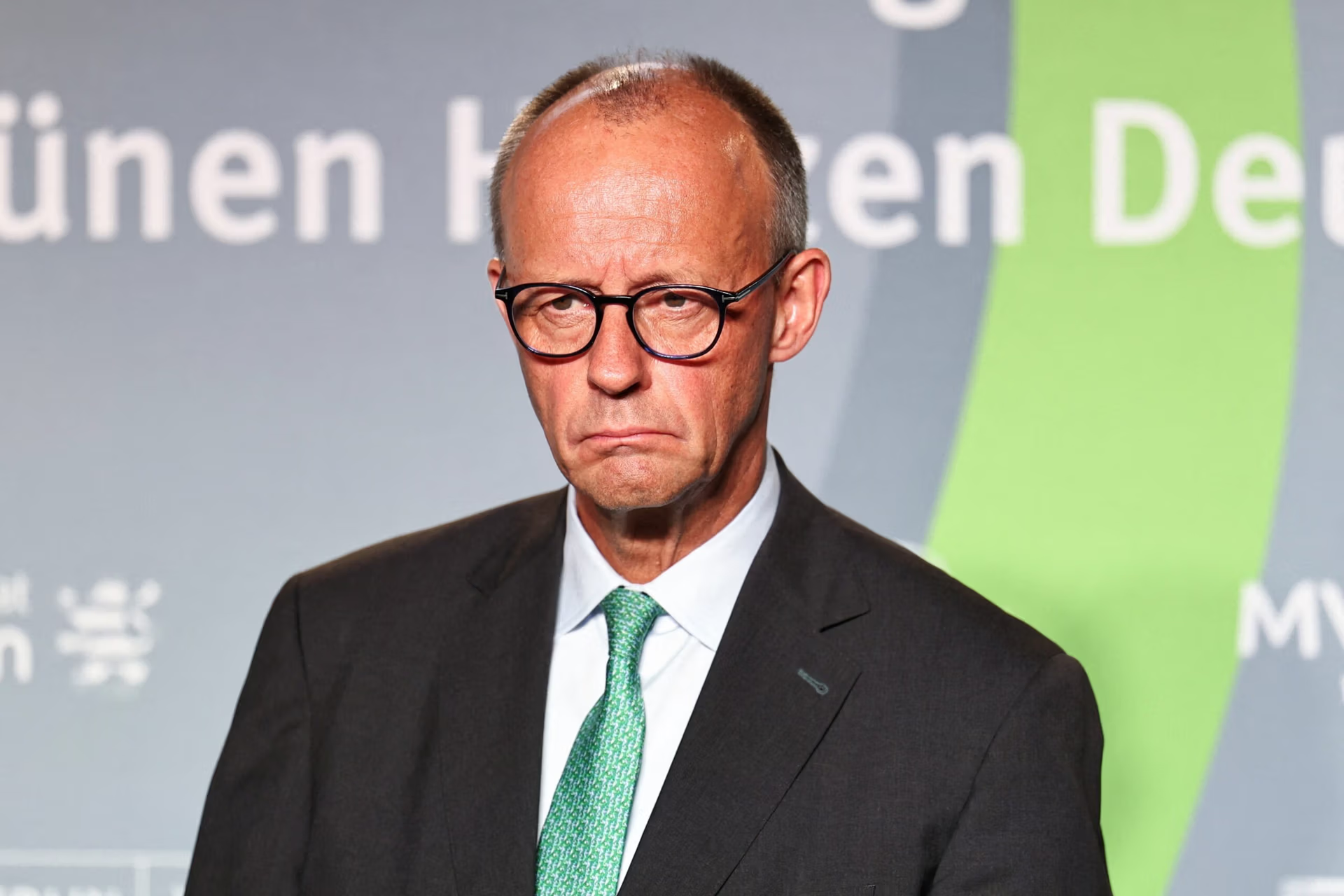
In the hushed halls of European diplomacy, some truths are felt long before they are spoken aloud. Friedrich Merz, Germany’s opposition leader, just gave voice to one of them, and the echo will be felt for years to come. His recent declaration that Europe is “no longer at peace with Russia” is far more than a simple statement of fact; it’s the final, declarative obituary for the post-Cold War era, solidifying a new reality for continental security and international relations.
For decades, and especially within Germany, the prevailing belief was that peace and stability could be achieved through economic partnership and diplomatic engagement—a strategy famously dubbed Wandel durch Handel (change through trade). This doctrine, deeply embedded in German foreign policy, posited that robust economic ties would foster mutual dependence and democratic transformation, ultimately making conflict unthinkable. German industry thrived on affordable Russian energy, while proponents argued that this interdependence was a bulwark against aggression. This illusion, however, was violently shattered by the full-scale invasion of Ukraine in 2022, prompting Chancellor Olaf Scholz’s historic Zeitenwende, or “turning point,” speech. Scholz’s declaration marked an initial seismic shift, acknowledging the collapse of the previous paradigm.

But what Merz’s statement signifies, coming years into this new, stark reality, is the hardening of that initial turning point into a permanent state of being. The initial shock of the invasion has matured into a somber acceptance. This is no longer a temporary crisis to be managed, nor a phase from which Europe expects to “return to normal.” Instead, Merz’s words delineate the new, unalterable foundation of European security, suggesting that the continent must now fundamentally restructure its foreign policy, defense capabilities, and economic strategies around this enduring geopolitical cleavage.
The Critical Shift: From Crisis Management to a State of Permanent Confrontation
The critical shift articulated by Merz is profoundly in the framing of Europe’s relationship with its eastern neighbor. To be “not at peace” is distinctly different from being “at war.” It describes a prolonged, indefinite state of managed hostility, a cold peace fraught with tension rather than overt, widespread military conflict. This chilling assessment implies that the traditional diplomatic off-ramps have been sealed shut, that trust is virtually nonexistent, and that the continent must now organize itself around a paradigm of perpetual confrontation, albeit one that seeks to prevent direct military escalation.
This “managed hostility” manifests in numerous ways: persistent cyber warfare, relentless information campaigns and disinformation, proxy conflicts, and the continuous application of economic sanctions designed to weaken Russia’s ability to wage war. It suggests a future where interactions with Moscow are defined by strategic caution and a deep-seated distrust, rather than any genuine hope for renewed partnership. The very notion of returning to a pre-2022 status quo, where dialogue and cooperation were seen as viable paths to stability, has been decisively rejected. Europe is adapting to a world where Russia is a permanent antagonist, not a potential partner.
Consequently, the emergency measures adopted in the early 2020s—including surging defense budgets, rapid deployments to NATO’s eastern flank, and a frantic scramble to decouple from Russian energy sources—are no longer considered temporary fixes. Merz’s words act as a political permission slip, elevating these reactive measures to the status of a “new normal.” For Germany, a nation long defined by its post-war pacifism, its Kultur der Zurückhaltung (culture of restraint), and a strong economic focus that historically favored engagement over confrontation, this represents a profound and deeply uncomfortable evolution. The country that once sought to build bridges, pipelines, and trade routes with Moscow is now being explicitly urged, at least by its opposition, to accept the necessity of building bulwarks and fortifying defenses instead. This transformation signals a fundamental reorientation of Germany’s national identity and strategic posture, away from its decades-long post-war consensus towards a more assertive, defense-oriented role in European security.
What This New Reality Means for Europe’s Future
Friedrich Merz’s stark assessment, echoing sentiments increasingly shared across European capitals, has three clear and profound implications for the continent’s future trajectory. These implications will reshape political discourse, economic priorities, and international relations for decades to come, defining Europe’s strategic posture in a permanently fractured world.
1. A Permanent Rearmament and the End of the Peace Dividend
The first undeniable consequence is a permanent rearmament of European nations. The debate will no longer center on *if* Europe should spend more on defense, but rather how much more, how quickly, and on what specific capabilities. The notion of a “peace dividend”—the economic benefit derived from reduced military spending after the Cold War, which funded social programs and infrastructure for over 30 years—is definitively dead. This era, where defense budgets were often seen as discretionary spending, is over. In its place is a new “security tax,” a baseline cost of doing business on a continent confronted by a hostile, revisionist power on its immediate border.
This rearmament will be multifaceted. It involves not just increasing the percentage of GDP spent on defense, moving beyond NATO’s 2% target which many are now meeting or exceeding, but also a strategic modernization across all domains. This includes investing heavily in conventional forces, replenishing critically depleted ammunition stockpiles, enhancing sophisticated air and missile defense systems, strengthening cyber warfare capabilities, and rebuilding logistics chains to support rapid deployments. Furthermore, the focus will extend to improving military interoperability within NATO and the European Union, fostering a more integrated and resilient collective defense posture. The financial implications are enormous, requiring difficult trade-offs against other public spending priorities and forcing a deeper societal discussion about national security as a primary public good, rather than a luxury.
2. The End of Strategic Ambiguity and the Rise of Hard-Nosed Containment
For decades, European foreign policy towards Russia was characterized by a delicate, often ambiguous, balance between deterrence and dialogue. The hope was that engagement, cultural exchanges, and economic ties could eventually foster a more democratic and peaceful Russia, while maintaining a strong defensive alliance. This era, exemplified by mechanisms like the NATO-Russia Council and Russia’s temporary inclusion in the G8, is now unequivocally over. Merz’s statement signals a decisive push to drop the pretense of dialogue and partnership in favor of a clear-eyed, singular focus on deterrence and hard-nosed containment.
Future interactions with Russia will be stripped of any pretense of partnership or “resetting relations.” Instead, they will concentrate solely on de-confliction—establishing clear lines of communication and protocols to prevent accidental escalation—and firm containment. This means robust sanctions regimes, strict export controls on dual-use technologies, and sustained diplomatic isolation aimed at limiting Russia’s geopolitical influence. The emphasis will shift from seeking areas of cooperation to managing inevitable friction and preventing the spread of Russian aggression. The era of optimistic summits aimed at finding common ground is definitively over, replaced by a strategic imperative to protect European values and interests through unwavering strength and resilience against a consistently adversarial actor. This paradigm shift also implies a significant investment in counter-hybrid warfare capabilities, including robust defenses against disinformation campaigns and economic coercion.
3. A New Political Fault Line Across Europe
By making this definitive declaration, Friedrich Merz is not only reflecting a growing consensus but also actively drawing a sharp line in the sand for domestic politics, particularly within Germany and, by extension, across the continent. He is positioning his Christian Democrats (CDU) as the party of unvarnished realism and robust security, implicitly painting the current Social Democrat-led government as potentially too slow, too hopeful, or insufficiently decisive in confronting the new geopolitical landscape. This creates a powerful narrative for the CDU, framing national security as a central pillar of their electoral platform.
This new political fault line will increasingly define electoral contests across Europe. Elections, including the next German federal election, will be fought not just on economic or social issues, but critically on who has the most credible, pragmatic, and robust plan for managing this permanent state of confrontation with Russia. Parties will be judged on their commitment to defense spending, their stance on sanctions, their support for Ukraine, and their vision for European strategic autonomy. This will likely lead to heightened debates between those advocating for maximalist deterrence and those who might still seek avenues for limited, pragmatic engagement, albeit without any illusion of trust. Furthermore, this dynamic could exacerbate existing divisions within the European Union, as member states with differing threat perceptions or historical relationships with Russia navigate this new consensus, potentially creating new alliances and tensions within the bloc’s foreign policy framework.
The Long Vigil Has Begun
Friedrich Merz did not reveal a new secret to Europe. He simply held up a stark mirror to the grim reality that the continent has been quietly, and often painfully, adjusting to for years. The optimistic dream of a continent “whole and free,” stretching from the Atlantic to the Urals, a vision that fueled post-Cold War diplomacy, has been irrevocably replaced. In its stead is the sober, demanding task of robustly defending the part of Europe that remains whole, free, and democratic.
The peace, as it was understood for three decades, is over. The long, uncertain vigil has begun, demanding not just military readiness but also a profound re-evaluation of European identity, economic models, and political priorities. This is a continental shift, requiring sustained resolve, significant investment, and a unified strategic vision to navigate the permanent geopolitical chasm that has opened. Europe’s future will be defined by its ability to adapt to this enduring challenge, protecting its values and security in a world where conflict is not an anomaly, but a constant, managed reality.
Read the original story at Reuters.
How do you think European nations, particularly Germany, will balance the urgent need for permanent rearmament with the domestic demands for social spending and economic stability?