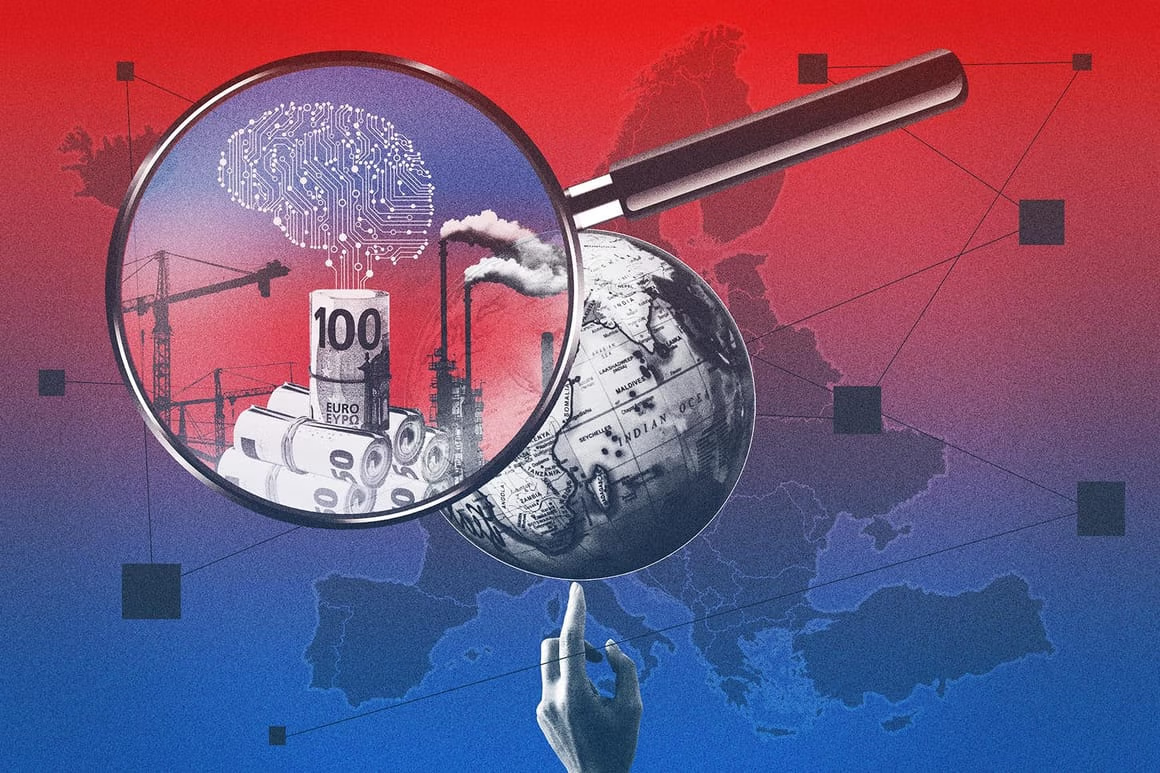
For years, the European Union has been a master of managing crises. From financial meltdowns to a pandemic and a war on its doorstep, Brussels has lurched from one emergency response to the next. But as leaders gathered for the latest high-stakes summit, a different, more profound anxiety filled the air: the fear of being left behind. The central question was no longer just about survival, but about relevance in a world being rapidly reshaped by Washington and Beijing.
This summit marks a critical pivot in the European conversation. The frantic energy of crisis management is giving way to a sober, and arguably overdue, reckoning with the continent’s flagging competitiveness. The diagnosis, laid bare in a series of influential reports from figures like former Italian Prime Minister Enrico Letta, is stark: Europe’s cherished Single Market, the engine of its prosperity, is sputtering. It remains fragmented in key growth sectors like energy, telecommunications, and finance, leaving European companies at a significant disadvantage against their American and Chinese rivals, who benefit from vast, unified domestic markets.
The Takeaway: It’s No Longer Just About Rules, It’s About Scale
For decades, the EU’s global power was rooted in its ability to set regulatory standards—the so-called “Brussels Effect.” But in the age of generative AI, massive state subsidies like the U.S. Inflation Reduction Act, and China’s relentless industrial strategy, a rulebook is not enough. The new consensus emerging in Brussels is that Europe needs scale.
This means finally getting serious about a true Capital Markets Union, which would unlock trillions in private savings to fund the green and digital transitions. It means building an integrated Energy Union to lower costs for industry and end the strategic vulnerability exposed by Russia’s war. And it means creating a genuine Digital Single Market where a tech startup in Lisbon can scale across the continent as easily as one in Austin can across the United States. These are not new ideas, but the geopolitical pressure has imbued them with a desperate new urgency.
The Future: A Battle Between Ambition and Division
The path forward, however, is fraught with the classic European tension between grand ambition and national interests. While there is broad agreement on the problem, the solution—particularly who pays for it—remains a battleground.
The conversation is shifting from just tweaking existing frameworks to considering more radical ideas, including a potential new round of common EU borrowing to fund strategic investments in defense and technology. This links Europe’s economic future directly to its security. The realization that a strong economy is essential to funding a credible defense in the face of Russian aggression has fundamentally altered the debate. Economic security is now national security.
Ultimately, this summit is less about concrete decisions and more about forging a new mindset. It’s the starting gun for a race Europe is already late to. The coming months, leading up to and following the EU elections, will reveal whether this moment of clarity can be translated into the bold, unified action needed to compete. The alternative is a slow slide into economic and strategic irrelevance, a future where Europe is no longer a player at the global table, but merely a piece on the board.
Read the original story at Politico Europe.
What specific steps do you believe Europe needs to take most urgently to reclaim its global competitiveness and secure its future?