Europe’s Shifting Sands: The Gaza Conflict and Domestic Unrest
The battle for public opinion over the Gaza conflict is no longer confined to parliamentary debates or diplomatic backrooms. It has spilled onto the streets of Europe with a new and disruptive intensity, transforming major cities into stages for a passionate and increasingly confrontational global movement. This isn’t just another protest cycle; it’s a tactical evolution that European leaders can no longer afford to ignore, hinting at a profound reshaping of domestic political landscapes.
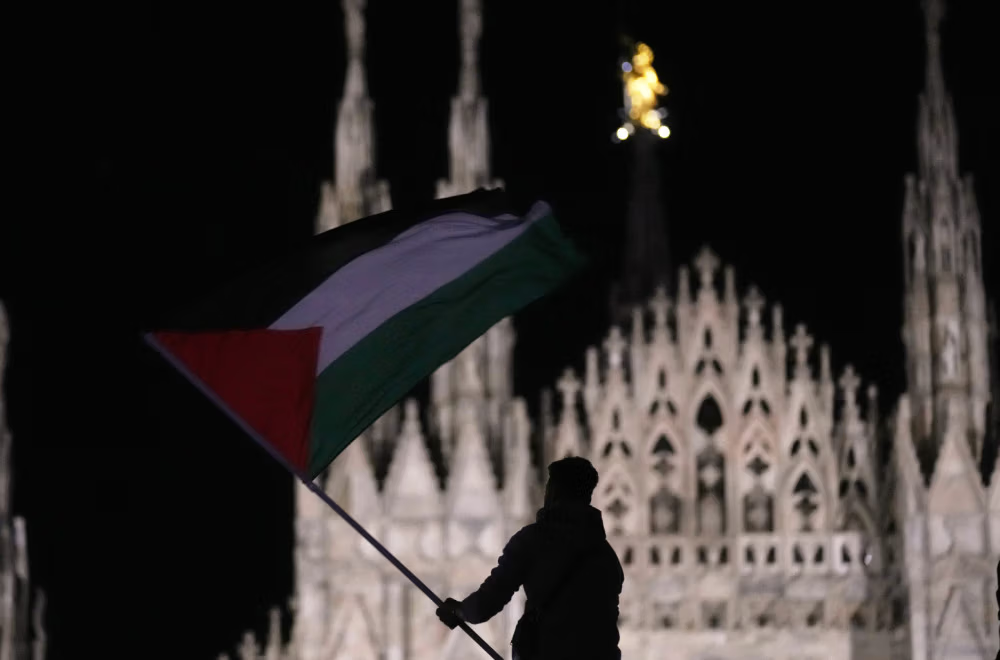
Recent events in Berlin, Milan, and Barcelona paint a vivid picture of this shift, demonstrating a clear escalation in activist methodology. While thousands marching from Kreuzberg to the Brandenburg Gate represents a traditional—and undeniably powerful—form of dissent, the scene at Milan’s central railway station signals something dramatically new. There, protesters chanting “Block Everything” moved beyond symbolic demonstration to direct action, grinding a major European transport hub to a halt and signaling a more aggressive stance.

This is the key takeaway: the playbook for pro-Palestinian activism in Europe is changing. The call is no longer just to be heard, but to be felt, to create tangible friction that governments and the public cannot simply bypass. Slogans like “Boycott Israel” and “Global Movement for Gaza” are crystallizing into a coordinated, multi-pronged strategy aimed at creating palpable economic and social disruption. By targeting critical infrastructure, from transportation networks to major retail outlets, activists are forcing a conversation that governments and the public cannot simply walk past. They are making the conflict an immediate, unavoidable domestic issue, demanding attention and action from the heart of European capitals.
The New Playbook: From Symbolic Dissent to Strategic Disruption
The evolution of protest tactics in response to the Gaza conflict marks a significant turning point in European civil disobedience. What began as traditional demonstrations, echoing historical patterns of protest, has rapidly escalated into targeted, high-impact actions designed to maximize disruption and amplify demands. This shift reflects a growing impatience and a strategic reassessment by activist groups, who now seek to impose a cost on perceived inaction or complicity.
Berlin’s Resonance: The Enduring Power of Traditional Marches
Even amidst these evolving strategies, traditional forms of protest retain their potency. Berlin, with its deep historical consciousness and central role in European politics, has seen massive, peaceful marches drawing tens of thousands. The route from Kreuzberg, a district known for its diverse communities and activism, to the Brandenburg Gate, a symbol of German unity and political power, imbues these demonstrations with significant symbolic weight. These marches serve to demonstrate the sheer scale of public concern and solidarity, registering the breadth of popular sentiment and acting as a vital foundation for the wider movement.
However, the sheer frequency and scale of these traditional marches also highlight a potential limitation: if they do not lead to policy changes, they can breed frustration, pushing activists towards more confrontational methods. While powerful in their numbers, the direct impact of a march on daily life is often limited, allowing governments to acknowledge them without necessarily altering their foreign policy trajectory. This dynamic creates fertile ground for the adoption of more disruptive tactics by segments of the movement.
Milan’s Message: Economic Leverage and the “Block Everything” Mantra
The scene at Milan’s central railway station serves as a stark illustration of this new, more aggressive approach. Protesters chanting “Block Everything” didn’t merely express their anger; they acted upon it, temporarily paralyzing a vital artery of European transportation. This move from symbolic protest to direct economic intervention is a game-changer. By targeting infrastructure, activists aim to create tangible inconvenience for commuters, businesses, and the wider economy, thereby raising the stakes for political leaders.
The choice of a railway station is strategic. It disrupts daily life, causes financial losses, and generates immediate media attention, forcing the public and politicians to confront the issue in a way a peaceful march might not. This tactic is designed to make the conflict impossible to ignore, translating a distant geopolitical issue into an immediate, localized problem for thousands of citizens. The underlying message is clear: if governments will not listen to moral pleas, perhaps economic pressure will compel them to reconsider their stances.
Barcelona’s Blueprint: Global Solidarity and Local Action
Barcelona has emerged as another key locus for this evolving movement, demonstrating the powerful interplay between global slogans and localized action. The calls for “Boycott Israel” and a “Global Movement for Gaza” are not just abstract ideals; they are being translated into concrete strategies on the ground. This includes not only street protests but also concerted efforts to pressure local businesses, academic institutions, and cultural organizations to cut ties or condemn Israeli actions.
The “Boycott Israel” slogan, deeply rooted in the broader Boycott, Divestment, Sanctions (BDS) movement, has found renewed vigor and application. Activists are meticulously identifying targets, organizing online campaigns, and staging direct actions at stores selling Israeli products or companies perceived to be supporting Israel. This granular approach, combined with the overarching narrative of a “Global Movement,” suggests sophisticated coordination, likely leveraging digital platforms to share best practices, mobilize resources, and synchronize actions across different cities and even countries. Barcelona’s vibrant activist scene provides fertile ground for experimenting with these combined strategies, setting a potential blueprint for other European cities.
European Governments Under Pressure: A Tightrope Walk
The escalating protests present a profound and multifaceted challenge to European governments. Leaders in Germany, Italy, Spain, and across the continent are caught in a precarious balancing act between their established foreign policy stances, often aligning with international allies like the United States, and the increasingly vocal and mobilized segments of their own populations. The pressure is no longer just external; it is intensely internal, welling up from their city centers and threatening to destabilize domestic political equilibrium. Navigating this complex terrain—balancing the democratic right to protest with the imperative of public order and managing deeply ingrained historical and political sensitivities—will undoubtedly define their leadership in the months to come.
Navigating Historical Sensitivities: Germany’s Unique Stance
Germany, in particular, faces a uniquely delicate situation. Its historical responsibility for the Holocaust has forged an unwavering commitment to Israel’s security, often framing its foreign policy on the issue. This deep-seated historical and moral obligation profoundly influences how German authorities and mainstream society respond to pro-Palestinian demonstrations, especially when those protests contain elements perceived as antisemitic or anti-Zionist. The German government’s stance often prioritizes the safety and security of its Jewish community and the state of Israel, leading to a sometimes contentious approach to protest regulation.
This creates a significant tension: while the right to protest is enshrined in German law, the interpretation and enforcement of public order regulations, particularly concerning symbols or chants deemed provocative or antisemitic, are often stricter than elsewhere in Europe. This has led to accusations of censorship and disproportionate policing from pro-Palestinian groups, further exacerbating the societal divide. The challenge for Berlin is to uphold its historical commitments while respecting fundamental democratic rights, a task made increasingly difficult by the emotional intensity of the conflict.
Balancing Rights and Order: The Public Imperative
Beyond historical contexts, European governments universally grapple with the fundamental democratic dilemma of balancing the right to free assembly and expression with the need to maintain public order and safety. When protests escalate from peaceful marches to disruptive blockades of critical infrastructure, the calculus changes dramatically. Authorities are then tasked with protecting citizens’ ability to commute, work, and conduct daily life, while simultaneously safeguarding the rights of protesters.
The response to these disruptive tactics has varied, but a common thread is the increasing deployment of police forces, the use of dispersal methods, and legal actions against organizers. However, overly heavy-handed responses risk inflaming tensions further and alienating a wider segment of the population. Striking the right balance requires nuanced judgment, clear communication, and transparent application of laws, all of which are put to the test when faced with highly emotional and politically charged demonstrations.
Foreign Policy vs. Domestic Dissent: A Growing Divide
Perhaps the most significant long-term challenge for European governments is the widening chasm between their established foreign policy positions and the sentiments of a significant portion of their domestic populace. Many European nations have historically aligned with a two-state solution framework, often supporting Israel’s security while also advocating for Palestinian rights. However, the intensity and duration of the Gaza conflict have exposed a growing disillusionment with this traditional approach among certain segments of the public, particularly younger generations and immigrant communities.
This domestic dissent complicates diplomatic efforts and can undermine a unified European foreign policy. Governments risk being seen as out of touch with their own citizens, potentially leading to electoral repercussions. The pressure from the streets may force a re-evaluation of long-held diplomatic positions, compelling leaders to adopt more critical stances towards all parties involved in the conflict, or at the very least, to articulate their existing positions with greater sensitivity to domestic concerns. The future direction of European foreign policy concerning the Middle East will undoubtedly be shaped as much by internal public opinion as by external geopolitical considerations.
The Ascent of a Sustained Global Movement
The branding of these actions as part of a “Global Movement” is not mere rhetoric; it signals an ambition far beyond sporadic, reactive demonstrations. What we are witnessing is the potential for a sustained, highly organized, and internationally coordinated protest wave. Activist networks are rapidly becoming more sophisticated, leveraging digital tools and cross-border collaborations to share tactics, pool resources, and mobilize supporters for continent-wide days of action. This isn’t a passing storm; it’s a fundamental change in the political climate, promising a new era of highly integrated and persistent activism.
Digital Mobilization and Cross-Border Coordination
The speed and scale of recent mobilizations are largely attributable to the mastery of digital platforms by activist groups. Social media channels, encrypted messaging apps, and dedicated online forums have become indispensable tools for planning, communicating, and executing coordinated actions. These platforms enable activists to bypass traditional media gatekeepers, disseminate information rapidly, and rally supporters across national borders almost instantaneously. Sharing tactics, legal advice, and even logistical support between Milan, Barcelona, Berlin, and beyond has become seamless, creating a truly interconnected network.
This digital infrastructure allows for “plug-and-play” activism, where successful strategies implemented in one city can be quickly adapted and replicated in others. The global nature of the internet naturally fosters a “Global Movement” mentality, where local actions are framed within a larger narrative of international solidarity, reinforcing a sense of collective power and purpose among participants.
The “Boycott, Divestment, Sanctions” (BDS) Evolution
While the Boycott, Divestment, Sanctions (BDS) movement has been active for years, the current surge in pro-Palestinian activism shows a clear evolution in its application and intensity. The “Block Everything” mantra in Milan and similar calls for economic disruption can be seen as a more aggressive, direct-action iteration of the BDS philosophy. Instead of solely advocating for long-term institutional divestment or consumer boycotts, activists are now employing immediate, physically disruptive tactics to achieve similar goals of economic pressure and isolation.
This evolution suggests a strategic recalibration, moving beyond advocacy to direct intervention in economic flows. By targeting visible points of commerce and infrastructure, activists aim for immediate, high-profile impacts that generate significant media attention and create direct costs for businesses and governments. The current wave is amplifying the BDS message through more confrontational means, challenging the perception of BDS as a purely passive or ethical consumer choice, and repositioning it as a dynamic engine for immediate political pressure.
Implications for Future Activism: Beyond Gaza
The methodologies honed during the Gaza conflict protests are unlikely to be confined to this single issue. The successful application of disruptive tactics, sophisticated digital mobilization, and cross-border coordination sets a precedent for future activist movements across Europe. Whether it’s climate change, economic inequality, social justice, or other geopolitical crises, future activists will undoubtedly draw lessons from the current playbook.
This means European governments can expect a future where protest movements are more nimble, more globally networked, and more willing to employ direct, disruptive action to achieve their aims. The challenges posed by the Gaza protests could therefore serve as a dress rehearsal for a new era of civil disobedience, requiring governments to adapt their strategies for engagement, policing, and policy-making to a more demanding and technologically savvy activist landscape.
Redrawing Europe’s Political Map: A New Reality
Ultimately, the traffic blockades, shuttered train stations, and surging street protests are a potent symbol of a larger political reality: the Israel-Gaza conflict is not a distant affair for Europe. It is a deeply resonant issue that is actively reshaping domestic politics, testing social cohesion, and forcing a new generation of activists to find more powerful ways to make their voices impossible to disregard. The battle lines are no longer just on a map in the Middle East; they are being drawn on the cobblestones and train tracks of Europe’s own capitals, altering the very fabric of its political and social landscape.
Societal Fault Lines: Testing Cohesion
The intensity of the Gaza conflict has undeniably exacerbated existing societal fault lines within European nations. It has brought to the fore tensions between different ethnic and religious communities, particularly between Jewish and Muslim populations, but also within broader society regarding issues of identity, foreign policy, and historical narratives. Debates surrounding the conflict have often devolved into accusations of antisemitism or Islamophobia, further polarizing public discourse and making nuanced discussion increasingly difficult.
This polarization threatens social cohesion, forcing communities to navigate deeply emotional and often conflicting loyalties. The political challenge for governments is immense: how to foster dialogue and understanding when such raw emotions are at play, and how to protect all communities from hate speech and violence, irrespective of their political stance on the conflict. The societal impact of these divisions will likely be felt for years, influencing everything from local politics to national identity debates.
The Electoral Impact: A New Variable for Politicians
The sustained and often disruptive nature of the Gaza protests introduces a significant new variable into the European electoral landscape. Political parties and individual politicians can no longer afford to ignore this issue or take a purely establishment line without risking alienation from key demographics. Younger voters, urban populations, and immigrant communities, in particular, appear to be highly mobilized and passionate about the conflict, and their votes could prove decisive in upcoming elections.
This pressure might force shifts in party platforms, compel leaders to adopt more nuanced rhetoric, or even lead to the emergence of new political actors who more directly represent the sentiments expressed on the streets. Politicians will increasingly have to consider how their stance on the Israel-Gaza conflict, and their handling of related domestic protests, will be perceived by a newly engaged and politically active segment of the electorate. The traditional calculations of foreign policy and domestic electoral strategy are converging in unprecedented ways.
Europe’s Role on the Global Stage: Reassessment Ahead?
Finally, the internal pressure generated by these protests could compel a fundamental reassessment of Europe’s collective foreign policy and its standing as a diplomatic actor. If European governments are seen by their own citizens as ineffective, hypocritical, or overly aligned with one side of the conflict, it could diminish their moral authority and diplomatic leverage on the global stage. A fragmented approach, driven by differing domestic pressures in each member state, would also weaken the European Union’s ability to act as a unified and influential force in international relations.
The current dynamics might push Europe towards a more independent and critical foreign policy, one less beholden to traditional alliances and more responsive to the humanitarian and human rights concerns expressed by its citizens. The outcome of this internal struggle will not only shape the future of European politics but also redefine Europe’s identity and influence in an increasingly complex and interconnected world.
As Europe grapples with these escalating protests and the profound shifts they represent, what long-term impact do you foresee on the continent’s social cohesion and its foreign policy direction regarding the Middle East?
Read the original story at B92 – Internet.