
Beyond Silicon: The Living Brains Redefining the Future of Computing
For decades, our digital world has been built on silicon. Transistors, microchips, and the relentless pursuit of Moore’s Law have driven an astonishing technological revolution. But what if the next frontier in computing isn’t about smaller, faster electronics, but about something far more organic? What if it’s about life itself?
Recent news has brought to light a fascinating and frankly, mind-bending, race: scientists are actively working to create “living computers” powered by human brain cells. This isn’t science fiction anymore; it’s the nascent field of Organoid Intelligence (OI), and it promises to challenge everything we thought we knew about computation.

The “Why” Behind the Biological Leap
Why would we even consider moving beyond the seemingly endless capabilities of silicon? The answer lies in both its inherent limitations and the unparalleled strengths of biology. Current Artificial Intelligence (AI), despite its impressive feats, consumes enormous amounts of energy. Training large language models, for instance, has a carbon footprint akin to that of small nations, raising serious environmental concerns. Moreover, while silicon-based systems excel at specific, rule-based tasks with incredible speed, they often struggle with the kind of flexible, adaptive, and truly intelligent learning that effortlessly defines the human brain.
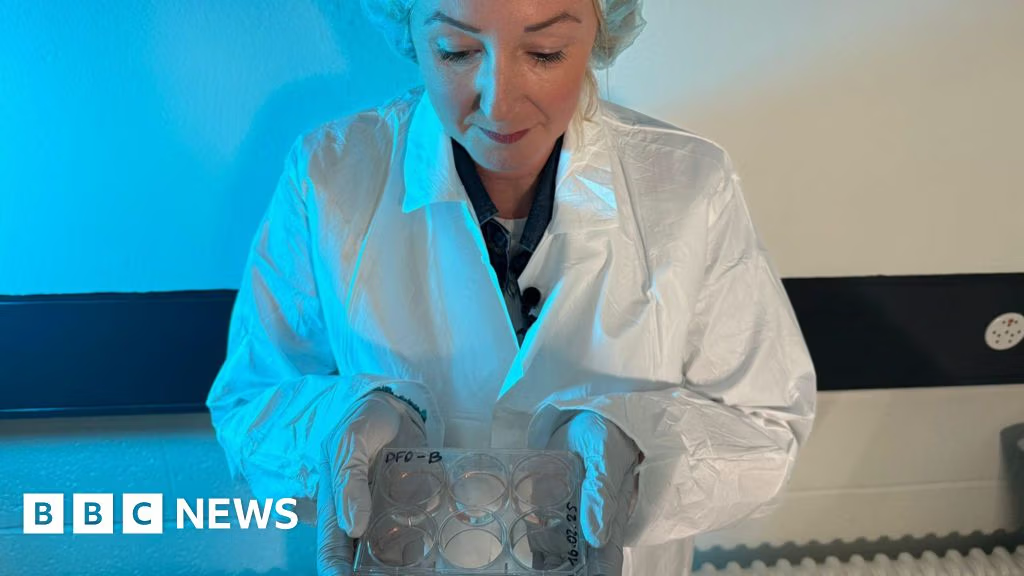
Enter the “mini-brains.” These aren’t full human brains, nor are they intended to be. Instead, they are meticulously crafted brain organoids: tiny, self-organizing clusters of human brain cells meticulously grown in a lab environment. Researchers are now ingeniously connecting these biological structures to external hardware, essentially providing them with controlled inputs and carefully monitoring their computational outputs. The grand vision is to harness the brain’s incredible inherent efficiency and its profound capacity for massively parallel processing and dynamic learning. Consider this: a human brain, operating on roughly 20 watts of power (which is less than a dim lightbulb), can perform computations that would bring even the most powerful supercomputers currently available to their knees, highlighting a monumental gap in efficiency.
Early Glimmers of Biological Computation
The work in Organoid Intelligence is undeniably incredibly early in its development, yet the potential it holds is truly enormous and deeply captivating. Scientists are already demonstrating foundational capabilities, showing that these organoids can perform surprisingly basic but significant tasks. These range from learning simple speech patterns – a rudimentary form of auditory processing – to distinguishing complex mathematical sequences, hinting at pattern recognition and logical processing. It’s crucial to understand that the immediate goal is not about replicating a human brain in its entirety – at least not yet – but rather about astutely leveraging its fundamental computational principles to create entirely new forms of processing and problem-solving.
What This Means for Our Future
The implications of Organoid Intelligence ripple across an incredibly broad spectrum of sectors, promising transformative changes that could redefine our approach to technology, health, and fundamental scientific understanding.
Revolutionizing Medicine and Drug Discovery
Imagine a future where you could test new, highly specific treatments for debilitating neurological diseases like Alzheimer’s or Parkinson’s not just on conventional animal models, which often fail to fully mimic human conditions, but directly on human brain tissue that actively “learns” and “forgets,” showing disease progression and therapeutic response in a truly human context. OI could provide unprecedented, real-time insights into how these devastating conditions manifest at a cellular level and, critically, how best to combat them, potentially accelerating drug development timelines by years, if not decades. This direct human tissue model could lead to more effective and personalized therapies.
A New Paradigm for AI
If biological computers can successfully mimic the brain’s extraordinary energy efficiency and its profound adaptive learning capabilities, they could pave the way for a truly next-generation Artificial Intelligence. Picture intelligent systems that are capable of learning with significantly less data than current models require, systems that can adapt and evolve on the fly in unpredictable environments, and crucially, systems that can tackle complex, nuanced problems that currently stump today’s most sophisticated and power-hungry algorithms. This could lead to AI that is not only more powerful but also vastly more sustainable and capable of true generalized intelligence.
Unlocking the Brain’s Mysteries
By actively building, interfacing with, and observing these “living computers” in controlled experimental settings, scientists will gain an immeasurably deeper and more intimate understanding of how the human brain itself functions. This includes fundamental processes like how memory is formed and retrieved, the intricate mechanisms by which learning occurs, and even potentially shedding light on the very essence of intelligence and consciousness. It’s a remarkably synergistic, closed-loop system of discovery, where building helps us understand, and understanding informs better building, creating a virtuous cycle of scientific progress.
The Ethical Quandary: A Future We Must Navigate Carefully
Yet, this undeniably revolutionary path is not without its profound ethical, philosophical, and societal challenges. The very moment we begin to talk about “living computers” powered by human brain cells, fundamental questions of consciousness, sentience, and identity inevitably surge to the forefront. Do these sophisticated organoids possess any form of subjective experience? Can they feel pain, pleasure, or other sensations? Where do we, as a society, draw the line between a biological computational tool and something that might demand ethical consideration akin to living beings?
These are not merely hypothetical anxieties reserved for a distant future; these are deeply complex conversations that researchers, ethicists, policy-makers, and the public are already grappling with today. As we relentlessly push the boundaries of biological computation and Organoid Intelligence, establishing clear, internationally agreed-upon ethical guidelines and fostering robust, inclusive public dialogue will be absolutely paramount. We must ensure that our scientific ambition, however groundbreaking, is always meticulously matched by our moral responsibility and foresight. The rapid pace of this research demands proactive ethical frameworks and a societal consensus on what constitutes acceptable progress.
The journey into Organoid Intelligence is long and undoubtedly fraught with significant technical hurdles in terms of scaling these mini-brains, ensuring their long-term longevity, and perfecting the intricate interfacing between biological and digital components. But the sheer audacity and transformative potential of the vision – computing not just like the brain, but actively with the brain – points towards a future where the traditional lines between biology and technology become increasingly blurred. It’s a future where intelligence might take forms we can barely conceive of today, and it’s a future we are actively building, one mini-brain at a time. To delve deeper into the origins of this fascinating concept, you can read the original story at BBC News.
What are your thoughts on the ethical implications of creating “living computers” and how do you think society should navigate this exciting but challenging frontier?