
The AAC Playbook: Navigating Change with Strategy and Stability
In the relentless current of the modern world, change isn’t just a phenomenon; it’s a fundamental force that reshapes industries, redefines markets, and compels organizations to adapt or perish. From the breakneck pace of technological evolution, where nimble startups challenge entrenched giants, to the dynamic shifts in global economies, the ability to respond strategically is paramount. Surprisingly, the gridiron of college football offers a compelling microcosm of these larger strategic battles, nowhere more evident than within the American Athletic Conference (AAC).
The AAC is currently experiencing a profound platform shift, a seismic realignment that has dramatically altered its competitive landscape. With traditional powerhouses like UCF, Cincinnati, and Houston migrating to the more lucrative pastures of the Power Five conferences, a significant vacuum has emerged. This isn’t merely a roster reshuffle; it’s an ecosystem disruption, akin to major players exiting a nascent market, creating unprecedented opportunities for others to seize market share and establish new dominance.

For the remaining and incoming teams, this transformation necessitates more than just winning games; it demands shrewd strategic repositioning and a clear vision for thriving in a reconfigured environment. The underlying question isn’t simply “who will win the next championship?” but “who possesses the most effective organizational philosophy and strategy for this new era of the AAC?” This evolving narrative provides invaluable lessons applicable far beyond the confines of sports, offering a real-time case study in competitive strategy.
Tulane: The Agile Innovator and Turnaround Startup
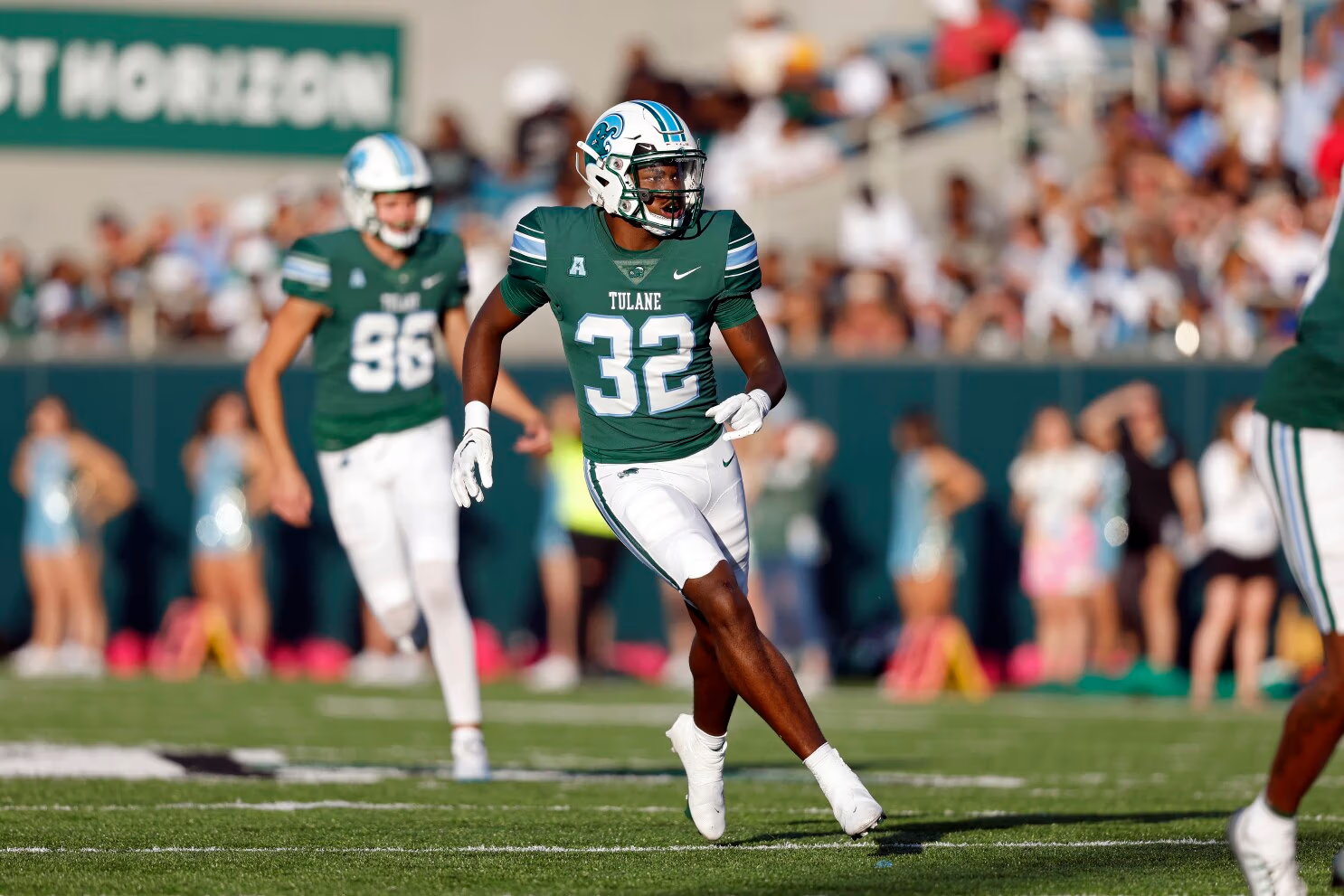
Leading the charge on one side of this strategic dichotomy is Tulane, a team that perfectly embodies the spirit of a successful turnaround startup. For years, the Green Wave operated in relative obscurity, a perennial underdog. However, their recent ascent has been nothing short of remarkable, culminating in a major bowl victory that signaled their arrival on the national stage. This transformation wasn’t accidental; it was the deliberate outcome of meticulous planning, significant strategic investment in both coaching talent and player development, and, crucially, an ingrained willingness to adapt and iterate.
Tulane represents the epitome of an agile player in a volatile landscape. They’ve demonstrated an impressive capacity for rapid evolution, learning from past iterations, optimizing their approach, and aggressively iterating towards success. In a business context, this is akin to a tech company that, after initial struggles, discovers its elusive product-market fit and then scales aggressively, disrupting established norms. Their strategic pivot involved embracing modern offensive schemes, prioritizing high-impact recruiting, and fostering a culture of relentless improvement. This agility allows them to quickly respond to new challenges and capitalize on emerging opportunities within the reconfigured AAC.
Their success underscores the power of a lean, adaptive approach. By continuously analyzing their performance, identifying areas for improvement, and implementing changes swiftly, Tulane has built a sustainable competitive advantage. They aren’t bound by tradition; instead, they are driven by data and a forward-looking perspective, making them a formidable contender in the race for AAC supremacy.
Navy: The Stalwart of Veteran Stability and Core Strategy
On the opposite end of the strategic spectrum stands Navy, a program defined by its deep-rooted institutional knowledge and unwavering commitment to a proven, albeit unique, methodology: the triple-option offense. The descriptor “veteran-laden” isn’t just a reference to player experience; it’s a testament to the consistency of their coaching staff, their steadfast adherence to a distinct strategic identity, and a culture built on discipline and execution.
In a world often fixated on chasing the next big trend, Navy serves as a powerful reminder of the enduring strength of a robust, well-executed core strategy. They may not always be at the forefront of offensive innovation, but their reliance on foundational strengths and a roster hardened by experience provides an immense competitive advantage, particularly in a disruptive environment. While other teams might be scrambling to find their footing amid the conference changes, Navy’s stability offers a reliable bedrock.
Think of Navy as a legacy tech company that, despite market shifts and the emergence of new technologies, maintains its relevance and market share through its deeply ingrained expertise, unwavering commitment to its core value proposition, and a loyal customer base. Their consistent approach to recruiting, player development, and game planning ensures a predictable, yet often frustratingly effective, challenge for any opponent. This steadfastness in the face of change is a form of strategic resilience, allowing them to weather storms that might derail less established programs.
The Power of Consistency in a Changing Landscape
Navy’s long-term success with the triple-option isn’t just about football; it’s about mastering a niche and executing it to perfection. They don’t try to be everything to everyone; they focus on what they do best, year after year. This specialization creates a unique identity and a difficult challenge for opponents, who must dedicate significant practice time to prepare for their distinct style of play. In a fragmented market, this kind of consistent differentiation can be a powerful tool for maintaining relevance and ensuring continued success.
The Clash of Philosophies: Agile Innovation vs. Veteran Resilience
The prospect of Tulane’s agile innovation clashing with Navy’s veteran resilience makes for a profoundly compelling narrative, not just in the realm of sports, but as a dynamic case study in competitive strategy. Their battles for AAC supremacy will transcend mere football games; they will be live demonstrations of how fundamentally different organizational philosophies navigate, compete, and ultimately thrive in a radically altered competitive landscape. It’s the strategic equivalent of a lean, rapidly scaling startup going head-to-head with an established, deeply experienced enterprise.
The future of the AAC, with new teams like North Texas, UAB, Rice, Charlotte, FAU, and UTSA joining the fold, and a fresh hierarchy emerging, becomes a fascinating crucible for these strategies. Will the nimble adaptation of Tulane prove superior in exploiting new opportunities and overcoming unforeseen challenges? Or will the steadfast, deeply ingrained methodology of Navy provide the necessary stability and consistency to outlast and outperform in the long run?
Each encounter between these two programs will offer insights into which strategic approach yields greater returns in an environment characterized by flux. It highlights the critical decision every leader faces: whether to embrace disruption aggressively and pivot with agility, or to double down on proven strengths and maintain a course of steady resilience. Both strategies have merits, and their success often depends on the specific context of the “changing landscape” they inhabit.
Beyond the Gridiron: Universal Strategic Lessons
Ultimately, the lessons gleaned from the AAC’s realignment extend far beyond the gridiron and into every facet of professional life and business. Whether you’re building a startup from the ground up, scaling an existing enterprise, or meticulously crafting your professional career, the underlying principles are remarkably similar. Success in an era of constant change hinges on several critical strategic imperatives:
- Understand Your Changing Environment: Continuously monitor market shifts, competitive movements, and emerging trends. What is your “platform shift?”
- Strategically Reposition Your Strengths: Identify your core competencies and adapt how you apply them to the new reality. How can you leverage your unique advantages?
- Commit to a Clear Approach: Whether it’s the agile innovation championed by Tulane or the stable expertise embodied by Navy, a well-defined and consistently executed strategy is crucial. Indecision is often the greatest risk.
- Embrace Opportunity in Disruption: Recognize that change, while challenging, is also the primary source of new opportunities and pathways to leadership.
The rise of Tulane and the enduring strength of Navy offer compelling blueprints for success in an era overwhelmingly defined by disruption. They illustrate that there isn’t a single “right” way to win, but rather effective ways to strategize within one’s unique circumstances. The stage is set for an exciting new chapter in college athletics, proving once again that in any field, the greatest opportunities often follow significant change and strategic repositioning.
Discover Your Strategic Advantage Today
For more detailed insights into the dynamics of the American Athletic Conference, you can read the original story at Brett Martel Updated 9:42 PM ET, Thursday October 26, 2023.
Which strategic approach do you believe is more sustainable in today’s rapidly changing world: agile innovation or veteran stability? Share your thoughts below!