The Ghost in the Grid: Why a Simple Crossword Puzzle Is a Quiet Tech Revolution
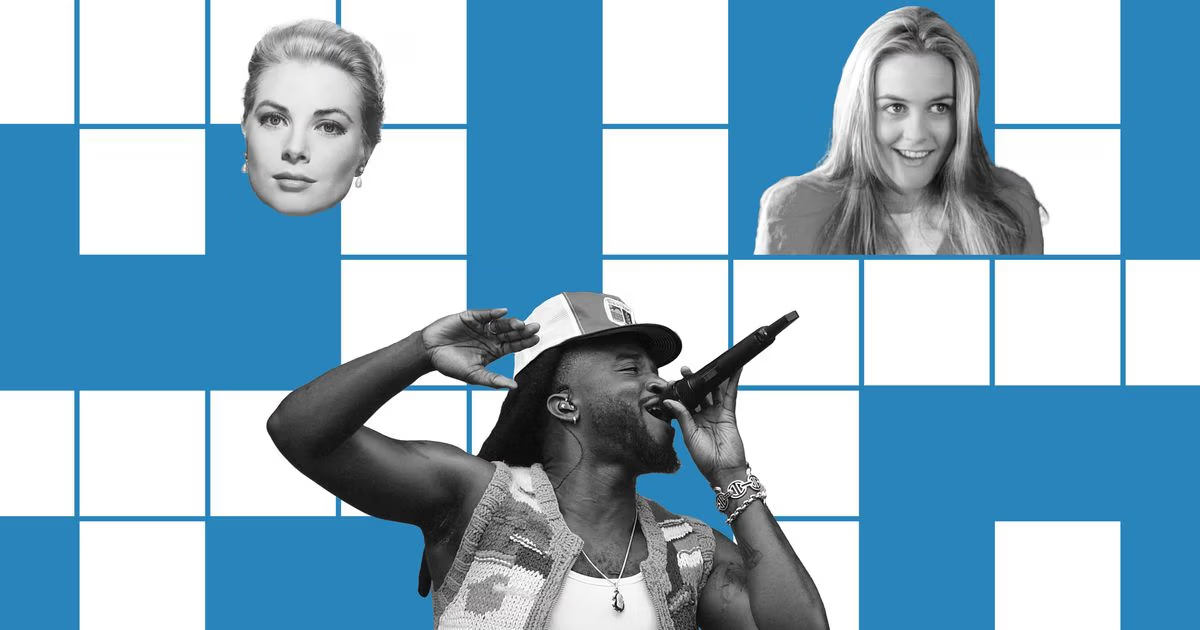
On the surface, it’s just another daily distraction. A cup of coffee, a quiet 15 minutes, and a grid of black and white squares waiting to be filled. Today, Vulture published a crossword puzzle themed around Dwight Schrute from The Office. It’s clever, it’s niche, and it’s perfectly tuned to the cultural zeitgeist of a show that ended years ago but lives forever online.
And that’s exactly why it’s one of the most interesting tech stories you’ll read this week. This isn’t just about a puzzle; it’s a profound signal. We are witnessing the quiet evolution of artificial intelligence, moving beyond mere data processing to something far more intricate: understanding and generating human culture. The very fabric of our digital engagement is shifting, powered by intelligence that can grasp humor, irony, and the subtle nuances that define our shared experiences.

You might be thinking, “It’s a crossword. What’s the tech angle?” But look closer. This isn’t about the puzzle itself; it’s about what the puzzle represents. We are entering an era where content isn’t just created for a niche, but increasingly by an intelligence that deeply understands that niche. This seemingly simple grid of words is, in fact, a harbinger of a future where personalized media, generated on demand and with acute cultural awareness, becomes the norm.
Let’s break down what a puzzle like this signifies for the future of content creation, user engagement, and the very definition of creativity in the digital age.
Takeaway 1: AI Has Mastered Cultural Nuance
For years, we’ve seen AI generate text, but it often lacked a soul. It could recite facts, but it couldn’t truly get the joke or understand the implicit subtext of human communication. This gap between factual accuracy and genuine cultural comprehension has long been a barrier for truly engaging AI-generated content. However, the Dwight-themed crossword signals a critical breakthrough. It requires more than just scraping a wiki page or identifying keywords related to a topic. The constructor—whether human or machine—needs to understand the vibe of the character, the specific obsessions like bears, beets, and Battlestar Galactica, the distinct cadence of his speech, and the subtle in-jokes that only true fans would appreciate. This level of granular understanding is what sets modern generative AI apart from its predecessors.
The seamless creation of such a specific cultural artifact suggests that generative AI is crossing a critical threshold. It’s moving from factual regurgitation to genuine cultural synthesis. Imagine the immense datasets and sophisticated neural network architectures required to not just identify references, but to contextualize them, to understand their comedic timing, and to weave them into a coherent, entertaining product. These models are no longer just language models; they are becoming culture models, capable of weaving together the intricate threads of our shared media obsessions into new forms of entertainment. This has profound implications for how brands connect with audiences, how educational content is delivered, and how we discover new forms of storytelling in the digital landscape.
This mastery of cultural nuance opens up a vast new frontier for content creators. Think about personalized marketing campaigns that truly resonate because they speak directly to an individual’s specific interests and humor, not just their demographic. Consider educational modules that adapt their examples and analogies to the cultural background of the learner. The ability of AI to interpret, learn from, and then synthesize cultural phenomena means that content can now be imbued with a depth and authenticity previously thought exclusive to human creators. This is achieved through advanced deep learning models, particularly transformer architectures, trained on colossal datasets of human-generated text, images, and audio, allowing them to grasp complex semantic relationships and even infer emotional and cultural context. It signals a future where AI can not only understand what we say but also how we feel, what we value, and what makes us laugh, paving the way for truly empathetic digital experiences and highly relevant content creation.
Takeaway 2: The Future of Content is Hyper-Personalized and Infinitely Scalable
Imagine this Dwight puzzle wasn’t the only one. Imagine that, based on your streaming history, your social media activity, or even your past puzzle preferences, you were served a crossword themed around the starships of The Expanse, the political intrigue of Succession, or the baking terminology of The Great British Bake Off. This isn’t just a hypothetical scenario; it’s the near-future reality that AI-driven content generation promises. The capacity to generate bespoke content for millions of individuals simultaneously, each tailored to their unique tastes and interests, transforms the media landscape entirely.
This is the scalable future that AI-driven content generation promises. Media companies won’t just be competing to create the next big hit; they’ll be competing to create an infinite stream of personalized, engaging micro-experiences that keep you locked into their ecosystem. The daily crossword, a format that’s over a century old, becomes the perfect, low-stakes delivery vehicle for this new reality. It’s a daily habit, and habits are the holy grail of digital engagement. By consistently offering fresh, relevant content that feels personally crafted, platforms can dramatically increase user retention, satisfaction, and overall time spent within their digital properties. This hyper-personalization extends beyond puzzles; imagine news feeds curated not just by topic, but by your preferred tone and depth, or interactive stories that branch based on your personality and moral choices.
The economic implications are enormous. Companies can reduce the cost and time associated with manual content creation for niche audiences, allowing for an explosion of specialized content that was previously uneconomical to produce. This paradigm shift means less generic, one-size-fits-all content and more deeply resonant experiences. Furthermore, this opens new avenues for monetization; imagine premium subscriptions for an AI-generated personalized daily novel or an interactive historical narrative tailored to your ancestral background, transforming the content monetization models. However, it also raises questions about potential filter bubbles, where users are only exposed to content that reinforces their existing views, and the ethical responsibilities of platforms to ensure a balanced media diet and exposure to diverse perspectives. Balancing personalization with critical thinking will be a crucial challenge for content platforms as this technology matures. Nevertheless, the promise of content perfectly attuned to individual preferences is a powerful driver of engagement and a key component of the evolving digital economy, shaping everything from entertainment to information consumption.
Takeaway 3: The “Author” is Becoming a Murky Concept
Who made this puzzle? Was it a single, clever human constructor, meticulously crafting each clue and ensuring every intersection was perfect? A dedicated team of writers specializing in The Office lore? Or was it an advanced AI model prompted by a human editor, generating the bulk of the content with remarkable speed and accuracy? The simple answer to these questions is becoming increasingly complex, pointing towards a significant shift in the nature of creative authorship and the future of intellectual property.
Increasingly, the answer will be “all of the above.” The future of creative work isn’t about humans versus machines, but about humans collaborating with them in a symbiotic relationship. An editor might provide the overarching theme (“Dwight Schrute’s Wacky World”) and a few cornerstone clues that establish the tone and difficulty. An AI, powered by vast datasets of crosswords and character knowledge, could then handle the complex grid-fill algorithms, generate the bulk of the remaining clues, and ensure everything intersects perfectly, even suggesting alternative wordings for maximum impact or thematic relevance. This partnership leverages the unique strengths of both: human creativity, insight, and nuanced judgment, combined with AI’s efficiency, analytical power, and ability to process and synthesize vast amounts of information instantly.
This blurs the lines of authorship and creativity in profound ways. When an AI generates a painting from a text prompt, who is the artist? When a sophisticated language model assists in writing a novel, where does human authorship end and machine contribution begin? The Dwight Puzzle is a perfect, harmless example of this new paradigm in action. It’s a quiet announcement that the machines are officially in the writer’s room, not just as tools for research or transcription, but as active co-creators, and they’re starting to pull their creative weight. For human creators, this can be incredibly liberating, allowing them to offload repetitive or highly analytical tasks, freeing up more time for conceptualization, strategic direction, and injecting truly unique, irreplicable human insights and emotional depth. This necessitates new legal and ethical frameworks for intellectual property, attribution, and the very definition of a “creative work” in an age of augmented intelligence. As AI becomes more sophisticated, these questions will move from theoretical discussions to practical realities impacting industries from publishing to music to visual arts, fundamentally reshaping creative workflows, professional identities, and the entire creative economy.
So, while you’re figuring out that seven-letter word for “a paper salesman’s principal crop” or pondering why a beet is sometimes more than just a vegetable, take a moment to appreciate what you’re looking at. It’s not just a puzzle. It’s a postcard from the future of media—a future that is more personal, more automated, more culturally aware, and more collaboratively constructed than we ever imagined. The seemingly mundane act of solving a crossword puzzle has transformed into a profound insight into the unfolding technological revolution impacting our daily lives, subtly but powerfully redefining our relationship with content and creativity.
Read the original story at Vulture.
What are your thoughts on AI co-creating content for niche interests? Do you welcome the idea of hyper-personalized media, or does it raise concerns for you about filter bubbles or the future of human creativity?