The Web’s Human Heartbeat: Why AI Hasn’t Taken Over (Yet)
For the past few years, it feels like we’ve been bracing for the Great Content Singularity. Every new AI model, from large language models to generative text tools, sparked fresh predictions: the end of human writers, a web awash in perfectly bland, algorithmically optimized prose. We’ve all seen the dazzling demos and the occasional uncanny valley output, wondering if our digital landscape was about to become an endless scroll of AI-generated content, devoid of genuine human insight or creative flair.
This sense of an impending AI takeover has fueled countless discussions among content creators, marketers, and SEO specialists alike. The fear was palpable: would our unique voices be drowned out? Would the demand for human ingenuity diminish in favor of rapid, scalable, albeit soulless, automated content production? The allure of instantly generated articles, social media posts, and even entire websites was undeniable, pushing many to experiment with these powerful new tools.

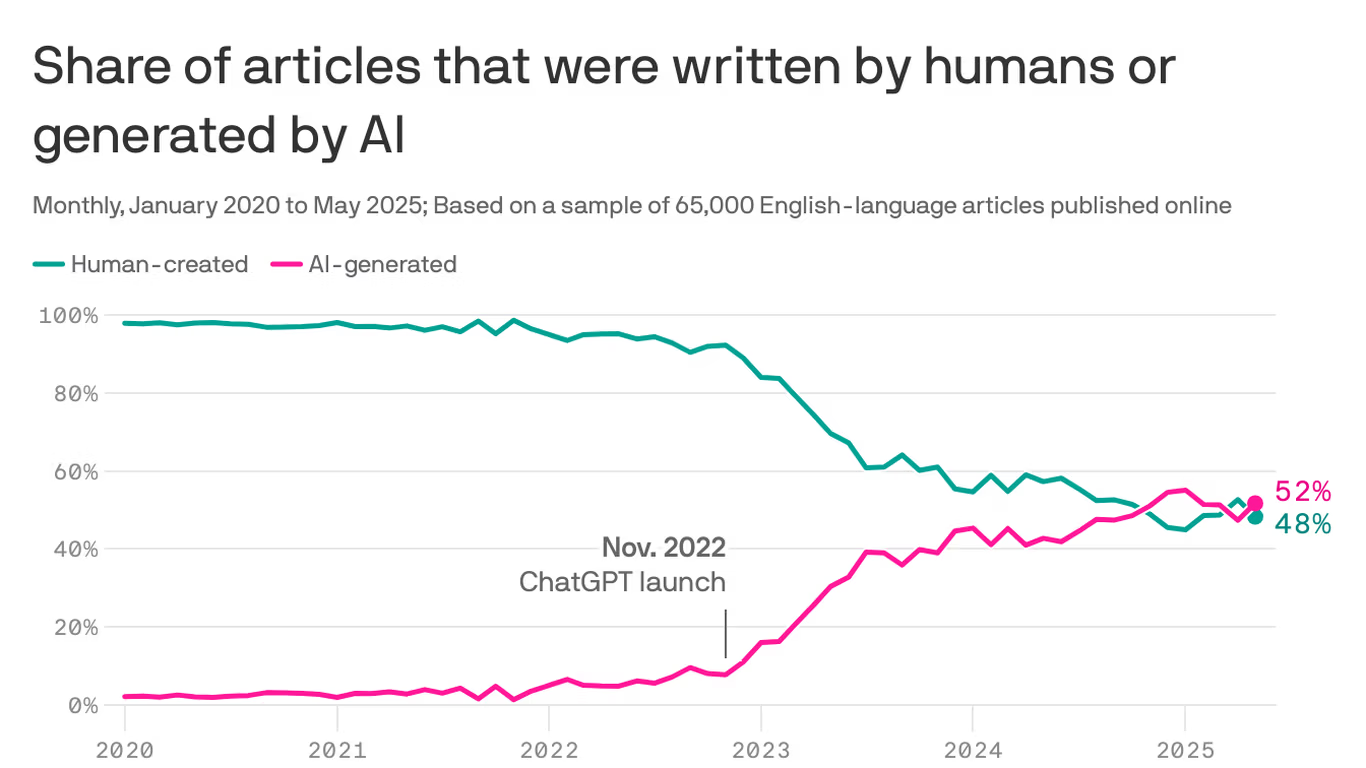
So, imagine my intrigue—and relief, to be honest—when a recent Axios report dropped a fascinating counter-narrative: the vast majority of the web is still, predominantly, written by humans. This isn’t just a fleeting data point; it’s a profound pause in the relentless AI hype cycle, and it forces us to reconsider the evolving, often complex, relationship between human creativity and artificial intelligence. It suggests that while AI is a powerful assistant, the core essence of digital communication still relies on the irreplaceable touch of human thought and emotion.
The Enduring Human Touch
The core takeaway is unequivocally clear: despite the meteoric rise of sophisticated AI writing assistants and the growing ease with which text can be generated at scale, human authors remain the primary architects of our online world. This isn’t to say AI isn’t *present*—it’s certainly used for everything from brainstorming initial ideas and drafting outlines to summarizing complex reports and translating content into multiple languages. Indeed, AI tools are deeply integrated into many content workflows. But the full, polished, and ultimately published content that fills our screens, engages our minds, and drives meaningful interactions still overwhelmingly bears the intricate fingerprints of human thought, intention, and perspective. The distinction lies between assistance and ultimate authorship.
Why the discrepancy between expectation and reality? Why hasn’t the “singularity” arrived for content? I believe it boils down to a few critical and inherently human factors that AI, in its current form, simply cannot replicate or fully substitute. These factors speak to the intrinsic value we place on authenticity, originality, and connection in our digital interactions.
Nuance and Empathy
While AI can mimic tone and style remarkably well, even adopting personas with impressive accuracy, it still fundamentally struggles with true empathy, unique perspective, and the subtle nuances that make human communication truly resonate. Great writing often comes from lived experience, a deep understanding of cultural context, personal biases (used judiciously, of course), and an intuitive grasp of the unspoken emotions or underlying motivations of an audience. These are areas where AI, by its very nature as a pattern-matching and prediction engine, remains inherently limited. It can process vast amounts of data about human emotions and expressions, but it doesn’t *feel* them.
Consider the depth required to write a truly poignant personal essay, a satirical piece that skewers societal norms with precision, or even a sensitive news report covering a deeply human tragedy. These tasks demand more than just assembling coherent sentences; they require an understanding of irony, sarcasm, subtext, and the intricate web of human emotions that form the bedrock of our shared experience. AI might generate grammatically perfect prose, but it often lacks the soul, the genuine insight that stems from personal suffering, joy, or profound contemplation. This nuanced understanding is what allows human writers to connect with readers on an emotional level, fostering trust and loyalty that purely generative content often fails to achieve.
The Quest for Originality
In a digital world that is already drowning in information—a veritable ocean of content where differentiation is increasingly difficult—originality is not just a desirable trait; it’s a premium commodity. AI is exceptional at synthesizing existing data, identifying trends, and repackaging information in new formats. It can quickly generate summaries, variations, and compilations of what has already been said. However, genuine innovation, groundbreaking thought, truly unique storytelling, or the formulation of entirely novel concepts still largely emanate from human consciousness. We crave fresh perspectives, innovative solutions, and unique narrative arcs, not just efficient repackaging of existing knowledge.
Human creativity involves connecting disparate ideas in novel ways, challenging established paradigms, and daring to explore uncharted intellectual territory. It’s about asking “what if?” and pursuing answers that haven’t yet been articulated. While AI can assist in the preliminary stages of research or even suggest creative prompts, the leap of imaginative insight, the spark of an entirely new idea that captures the zeitgeist, or the crafting of a narrative that transcends current trends, remains largely within the human domain. This pursuit of the unique and the unprecedented is what drives engagement, builds thought leadership, and ultimately makes content memorable and impactful in a crowded online space.
The “Human-in-the-Loop” Reality
For many content creators, and indeed for entire content teams, AI isn’t perceived as a replacement but rather as a powerful co-pilot or an incredibly efficient assistant. It has become an indispensable tool that handles the drudgery, the initial grunt work, or provides the structural scaffolding upon which richer content can be built. Think of it as an architect drawing up blueprints (AI) while a skilled craftsman meticulously builds and decorates the house (human). AI can swiftly conduct initial research, generate multiple headlines, draft outlines, summarize long articles, or even create initial paragraphs to overcome writer’s block.
However, the final crafting, the infusion of a distinct brand voice, the critical editing for accuracy and tone, the strategic integration of SEO keywords, and the ultimate creative spark still overwhelmingly come from a human editor or writer. This collaborative model means that even content “assisted” by AI often retains a significant and crucial human input. The human provides the strategic direction, refines the output, fact-checks for biases or inaccuracies, and ensures the content aligns with broader marketing objectives and audience expectations. This “human-in-the-loop” approach ensures that efficiency gains from AI don’t come at the cost of quality, authenticity, or strategic alignment.
Quality Control and Trust
Both readers and content platforms are becoming increasingly discerning about the origins and quality of the content they consume or promote. There’s a growing awareness of AI-generated content, which can sometimes be identified by its generic phrasing, lack of genuine insight, or subtle inaccuracies (often referred to as “hallucinations”). Consequently, there is a strong and growing preference for verified, authoritative sources that stand behind their work with human accountability. Trust is an invaluable currency online, and it is meticulously built on authenticity, transparency, and the demonstrable expertise of the author.
In an age where misinformation and shallow content are rampant, readers gravitate towards sources they can rely on for accurate, insightful, and well-researched information. A brand or publisher that consistently delivers genuinely human-crafted content, infused with demonstrable expertise and unique perspective, fosters a deeper level of trust and loyalty. This human accountability extends beyond just writing; it includes critical fact-checking, ethical considerations, and a commitment to providing real value. Platforms, too, are developing more sophisticated methods to evaluate content quality and may implicitly or explicitly favor content that shows verifiable human input and expertise, reinforcing the importance of human quality control in the digital ecosystem.
What This Means for the Future
This revelation—that human content still dominates—isn’t a sign that AI is failing; rather, it refines our understanding of where its true value lies, and equally importantly, where human ingenuity remains absolutely irreplaceable. It reshapes our perspective from one of competition to one of symbiosis, highlighting the unique strengths each brings to the digital content landscape. The future isn’t about one replacing the other, but about intelligent, strategic collaboration.
A Shift in Focus for Content Creators
The future of content creation isn’t about trying to compete with AI on speed or sheer volume—areas where machines will always excel. Instead, it’s about content creators strategically doubling down on precisely what AI *cannot* do: offer truly deep, original insights, inject genuine personality, tell compelling stories that evoke profound emotion, and provide genuine, unfiltered human perspective. This means honing skills that emphasize critical thinking, creative problem-solving, empathy, and the ability to weave narratives that resonate on a deeply human level.
Content creators should lean into their unique voice, leverage their personal experiences, and focus on delivering content that challenges assumptions, inspires action, or provides a truly fresh viewpoint. For instance, crafting a meticulously researched long-form article with a unique thesis, developing an engaging video script full of personal anecdotes, or designing an interactive guide that reflects specialized industry experience—these are the tasks where human touch provides unparalleled value. By cultivating these distinct human attributes, creators can future-proof their careers and establish themselves as indispensable in a world awash with automated text.
The Rise of the “AI-Empowered Human”
Rather than widespread replacement, we should expect to see a significant rise in roles and skill sets focused on leveraging AI tools to dramatically enhance human output, not replace it entirely. This is the era of the “AI-Empowered Human.” New specializations are emerging rapidly, such as prompt engineering, where individuals become experts at communicating effectively with AI models to elicit the best possible results. AI content auditing will become crucial, requiring humans to review, fact-check, and refine AI-generated drafts for accuracy, brand voice, and ethical compliance. Hybrid content creation workflows, where AI handles initial drafts or data synthesis and humans perform critical analysis, creative refinement, and final editing, will become the industry standard.
The most successful creators and strategists in the coming years will be those who master the art of collaborating with AI. They will understand AI’s strengths (speed, data processing) and weaknesses (lack of true understanding, potential for bias), using it as a sophisticated tool to amplify their own creativity and efficiency. This shift isn’t about surrendering creative control but intelligently delegating repetitive tasks to focus human effort on higher-order thinking, strategic planning, and the unique artistic elements that only a human can provide.
The Premium on Authenticity
In an increasingly noisy and often saturated digital world, authenticity will emerge as the ultimate differentiator and a powerful magnet for audience attention. As the prevalence of AI-generated content grows, so too will the discerning eye of the audience, who will instinctively seek out genuine human connection and verifiable expertise. Brands, publishers, and individual creators who can consistently deliver genuinely human-crafted, insightful, and trustworthy content will not only capture attention but also build deep, enduring loyalty.
Authenticity fosters trust, and trust is the bedrock of lasting relationships between content creators and their audience. This means transparently standing by one’s work, providing real-world examples, sharing unique perspectives, and demonstrating genuine expertise rather than just regurgitating information. For businesses, this translates into building a stronger brand identity and authority, as consumers are more likely to engage with and purchase from entities they perceive as real, credible, and genuinely invested in providing value. In a world of infinite choices, the human touch becomes the most valuable asset, creating content that truly resonates and establishes a lasting emotional connection.
Evolving Search and Discovery
The major search engines and social platforms are not static entities; they constantly evolve to deliver the best possible user experience. As the volume of AI-generated content increases, it’s highly probable that search engines and social algorithms will increasingly prioritize content that demonstrates verifiable human expertise, original thought, and genuine engagement. We can anticipate the development of more sophisticated algorithms designed to distinguish between purely AI-generated, generic material and rich, human-crafted content that offers unique insights and real value.
This could mean an enhanced focus on signals related to E-E-A-T (Experience, Expertise, Authoritativeness, and Trustworthiness) where real-world experience and human authorship are highly valued. Platforms might develop mechanisms to identify and reward content that shows deeper research, personal insights, or a truly unique perspective, potentially de-prioritizing content that is merely a rehash of existing information, regardless of how well it’s written by an AI. For SEO professionals and content strategists, this implies a continued emphasis on creating high-quality, genuinely useful, and uniquely human content that AI cannot easily replicate, moving away from purely keyword-stuffing tactics towards true audience value.
The web’s human heartbeat is a powerful reminder that technology, no matter how advanced or seemingly capable, often serves primarily to amplify our capabilities rather than negate them entirely. The digital future won’t be a sterile, AI-generated void of perfectly bland prose, but rather a rich, dynamic tapestry woven by humans, enhanced and intelligently assisted by our silicon partners. It’s a future where human ingenuity, empathy, and creativity continue to lead the way, leveraging AI as a powerful tool in their arsenal.
Read the original story at Axios.
What unique human quality do you believe will remain absolutely indispensable in the future of online content creation?