Crossing a Border? Your Digital Life is an Open Book.
You’ve meticulously packed your passport, secured your tickets, and laid out a change of clothes. But have you considered the most intimate item you own—the small glass and metal rectangle in your pocket that virtually holds your entire life? Your smartphone. We treat it as an extension of ourselves, a private vault of conversations, cherished photos, sensitive financial data, medical information, and fleeting personal thoughts. It’s an indispensable tool, a constant companion, and for many, the primary connection to their world. Yet, the moment you reach an international border, that perception of privacy can be brutally shattered, and that vault can be pried wide open.
A recent CNET report sheds a stark light on a reality many travelers are unaware of, and few are prepared for: at U.S. borders, your Fourth Amendment rights against unreasonable searches and seizures are significantly diminished. Unlike searches conducted within the interior of the country, U.S. Customs and Border Protection (CBP) agents operate under a unique legal framework. They possess expansive authority to search your electronic devices—be it your phone, laptop, tablet, or any other digital storage medium—without the need for a warrant, and often, without even requiring reasonable suspicion.

This isn’t a rare event reserved solely for high-risk individuals or those flagged for specific concerns. It’s a practice that has skyrocketed in recent years, demonstrating a clear trend toward increased digital scrutiny. Statistics from CBP itself illustrate this alarming trajectory, jumping from around 8,500 electronic device searches in 2015 to a staggering figure exceeding 45,000 in 2022. This exponential increase underscores that virtually any traveler, regardless of their background or perceived threat level, could be subjected to such an intrusive inspection.
The scope of these searches goes far beyond a cursory glance through your photos or a quick check of your social media. Agents can, and often will, demand you unlock your device. Should you comply, they are then legally empowered to utilize advanced forensic tools to create a complete, bit-for-bit copy of its entire contents. This includes everything from your private messages, call logs, and precise location history, to your banking apps, browsing data, emails, and even drafts of unsent communications. This cloned data can then be stored by the government for years, analyzed at leisure, and potentially shared with a wide array of other government agencies, all without your explicit consent or knowledge.
The implications of such pervasive digital access are profound. For the average traveler, it means a complete surrender of digital autonomy, exposing their most personal moments and sensitive information to government scrutiny. For journalists, activists, business professionals, and legal counsel, the risks are even higher, potentially compromising sources, trade secrets, legal strategy, or even their personal safety. So, what’s the defense in a world where your password, biometric lock, and ingrained assumptions of digital privacy are no longer a shield?
Understanding the legal landscape is crucial. The broad authority exercised by CBP at the border stems from the “border search exception” to the Fourth Amendment. This exception has historically allowed customs officials to conduct routine searches of persons and effects entering the country without a warrant or suspicion. While courts have generally upheld the government’s interest in national security and enforcing customs laws, the application of this exception to highly personal electronic devices remains a contentious area, with ongoing legal challenges attempting to define its limits. However, for now, the prevailing legal interpretation grants CBP significant leeway, distinguishing between “basic” searches (which require no suspicion) and “advanced” searches (which may require some level of “reasonable suspicion,” though this threshold is often lower and less clearly defined than probable cause).
This ambiguity and expansive authority create a precarious situation for anyone traveling internationally. The question isn’t whether your data can be accessed, but rather how to protect it when the default assumption is that it will be accessible if an agent so chooses.
The Only Winning Move Is Not to Play: Embracing the Travel Phone Strategy
The CNET article highlights a brilliantly simple, if slightly dystopian, solution to this dilemma: the “burner phone,” or what we might more accurately and less dramatically call a “travel phone” or “sterile device.” The core principle behind this strategy is profoundly logical and undeniably effective: The only data that can’t be searched is the data that isn’t there.
Your primary, everyday smartphone is a massive liability at the border. It’s a meticulously curated archive of your entire life, holding years of personal history, sensitive communications, financial records, health information, and potentially even professional secrets. Bringing it to a border crossing that permits warrantless forensic examination is akin to handing over your personal diary, photo albums, banking statements, and entire filing cabinet all at once, inviting unparalleled scrutiny into every facet of your existence. This makes securing your primary digital identity a paramount concern for modern international travel.
A travel phone, by contrast, is a carefully prepared, blank slate. It’s a device intentionally stripped of all non-essential personal data, designed specifically for the limited digital needs of your trip. By adopting this proactive defense, you dramatically minimize your digital footprint at the border, effectively reducing the scope and potential impact of any search.
Building Your Digital Go-Bag: A Step-by-Step Guide for International Travel
Creating an effective travel phone isn’t complicated, but it does require foresight and discipline. Don’t wait until the day before your trip; plan ahead to ensure your digital privacy strategy is robust and ready.
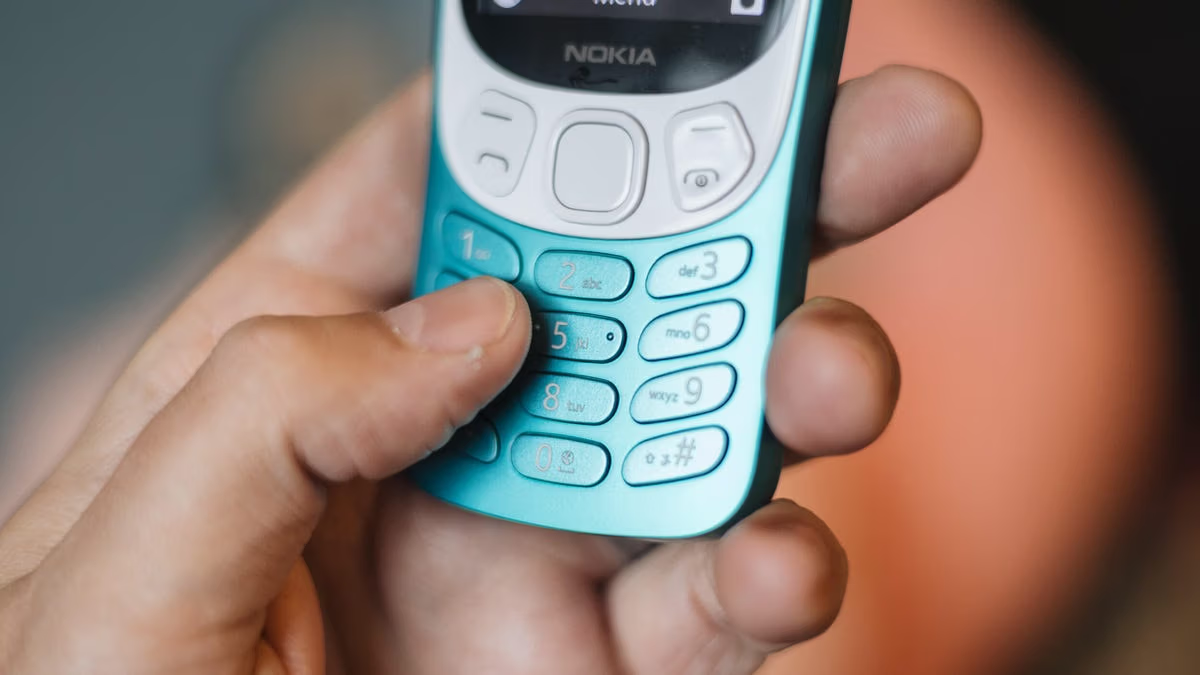
- Go Minimalist: Choose Your Device Wisely. Instead of risking your expensive, primary smartphone, pick up an inexpensive secondary phone. This could be an older model you have lying around, a basic feature phone, or a new budget-friendly smartphone. The key is that it’s a device you wouldn’t be devastated to lose, have confiscated, or if its limited data were compromised. The lower the monetary and sentimental value, the less psychological burden you’ll carry. For ultimate minimalism, some travelers opt for a “dumb phone” that only handles calls and basic texts, avoiding data entirely.
- Start Fresh: Create a Brand New, Temporary Digital Identity. This is critical. Do NOT use your personal Google or Apple account on your travel phone. Instead, create a brand new, temporary Google or Apple account, completely separate from your primary identity. Use a new, secure email address (perhaps from a privacy-focused provider like ProtonMail) for this setup. Ensure this temporary account has no links to your real name, address, or other personal identifiers that could compromise your privacy. This creates an isolated digital persona, making it much harder to connect the travel phone’s activities to your main digital life.
- Load Only the Essentials: Apps for Your Journey. Install only the absolute minimum apps you need for your trip. This might include: an airline app for boarding passes, a hotel app for bookings, a reliable map service (e.g., Google Maps or Apple Maps, downloaded for offline use), and an encrypted messenger like Signal or WhatsApp for secure communication with contacts abroad. Consider a reputable VPN (Virtual Private Network) app if you’ll be using public Wi-Fi, which adds another layer of security. Resist the urge to install social media, banking apps (unless absolutely necessary and with strong multi-factor authentication), or any apps linked to your extensive personal data. Every app is a potential vector for data exposure.
- Stay Cloud-Based: Keep Sensitive Documents Off the Device. For any important documents you might need—such as visa confirmations, insurance details, copies of your passport, or itinerary—keep them in a secure, encrypted cloud service that you can access from the travel phone’s web browser, but do NOT download them locally onto the device. Services like ProtonDrive, Cryptomator, or even password-protected PDFs stored on a reputable cloud service can work. This ensures that if the device itself is seized or forensically copied, those sensitive documents are not present on its local storage. Remember to log out of the cloud service immediately after accessing what you need.
- Wipe It Clean: Digital Hygiene Before Heading Home. Before you cross the border back home, sign out of all accounts on your travel phone and perform a factory reset. This erases all data, settings, and installed apps, returning the device to its original state. This final step is crucial for maintaining your digital hygiene and ensuring that no residual data from your trip could be later accessed or linked back to you, especially if you plan to reuse the device for future travel.
Beyond these steps, consider disabling biometric unlocks (fingerprint, face ID) and relying solely on a strong, complex passcode that you can quickly activate. Purchase a local SIM card upon arrival, or use an eSIM, to avoid using your primary phone number abroad, further separating your travel identity. Be mindful of public Wi-Fi; always use a VPN if connecting to unsecured networks.
Should a CBP agent request to search your travel phone, remain polite and cooperative. While you can verbally express concern for your privacy, refusing to unlock or hand over your device can lead to delays, extended detention, or even denial of entry into the U.S. Knowing your limited rights at the border is key; compliance, while unfortunate, is often the most pragmatic path to avoid greater inconvenience, especially when armed with a sterile device.
Beyond Travel: The Broader Implications of Digital Border Scrutiny
This isn’t merely a clever travel hack or a niche concern for the privacy-conscious. The widespread adoption of the “travel phone” strategy is a profound indicator of where our relationship with technology, personal privacy, and government oversight is headed. We are rapidly entering an era where our digital identity is as intensely scrutinized and potentially compromised as our physical one, and sometimes, even more so.
The underlying assumption that a personal electronic device is a private space is quickly becoming obsolete. The concept of carrying a single, all-encompassing personal device—a digital hub containing every facet of your life—may soon become a relic of a more naive, less digitally-aware time. This shift signals a fundamental re-evaluation of how we manage our digital lives in a world of pervasive surveillance capabilities.
The Normalization of Digital Self-Censorship and the Chilling Effect
If travelers are compelled to assume their devices can be inspected at any border, it inevitably fosters a chilling effect on digital expression and behavior. People may begin to self-censor, altering how they communicate, what they photograph, what they browse, and what information they store, out of fear that it could be misinterpreted or used against them during a border crossing. This erosion of digital freedom impacts not only international travel but also shapes our domestic digital habits, blurring the lines between public and private space.
For specific groups like journalists, human rights activists, lawyers, and business executives, the stakes are exceptionally high. Their devices often contain confidential sources, sensitive client data, intellectual property, or evidence of human rights abuses. The necessity of a sterile device for these individuals isn’t just a convenience; it’s a critical operational security measure to protect themselves, their work, and those they represent.
The Future of Travel: Digital Preparedness as Standard Practice
Will the “travel phone” become as standard a packing item as a universal power adapter or travel-sized toiletries? It’s highly probable. As awareness grows and the number of electronic device searches continues to climb, digital preparedness will become an integrated part of the international travel checklist. Travelers may routinely provision a specific, scrubbed-clean travel phone, consciously detaching their actual lives from their border-crossing digital persona.
This trend could also spur innovation in the tech industry, leading to more privacy-focused travel devices, secure cloud services specifically designed for temporary access, or even software solutions that facilitate rapid data sanitization for border crossings. The demand for robust digital privacy solutions in travel is only set to increase.
The Path Towards Digital Passports and Centralized Control
The practice of extensive digital border searches might also be viewed as a subtle but significant step towards a more centralized, government-controlled digital identity system. The idea of a government-approved, easily searchable version of our digital selves—a “digital passport” that aggregates our online activities and personal data—might seem far-fetched, but the infrastructure and legal precedent are quietly being built right now, one border search at a time.
This raises profound questions about the balance between national security and individual liberties. How much personal digital autonomy are citizens willing to cede for perceived safety? What are the long-term implications for global digital freedom, surveillance, and the potential for abuse if such systems become widespread? The ongoing debate around border searches of electronic devices is not just about a phone; it’s about the very future of digital privacy in an interconnected world.
In conclusion, the landscape of international travel has irrevocably changed. Your digital life, once considered sacrosanct behind a passcode, is now an open book at the border. The era of digital preparedness is upon us, requiring a strategic shift in how we approach our most intimate devices when crossing international lines. Traveling light isn’t just about the weight of your suitcase anymore; it’s fundamentally about minimizing your digital footprint and safeguarding your personal data.
Read the original story at CNET.
Given the increasing scrutiny of digital devices at borders, how do you think this trend will reshape our relationship with technology and personal privacy in the coming decade?