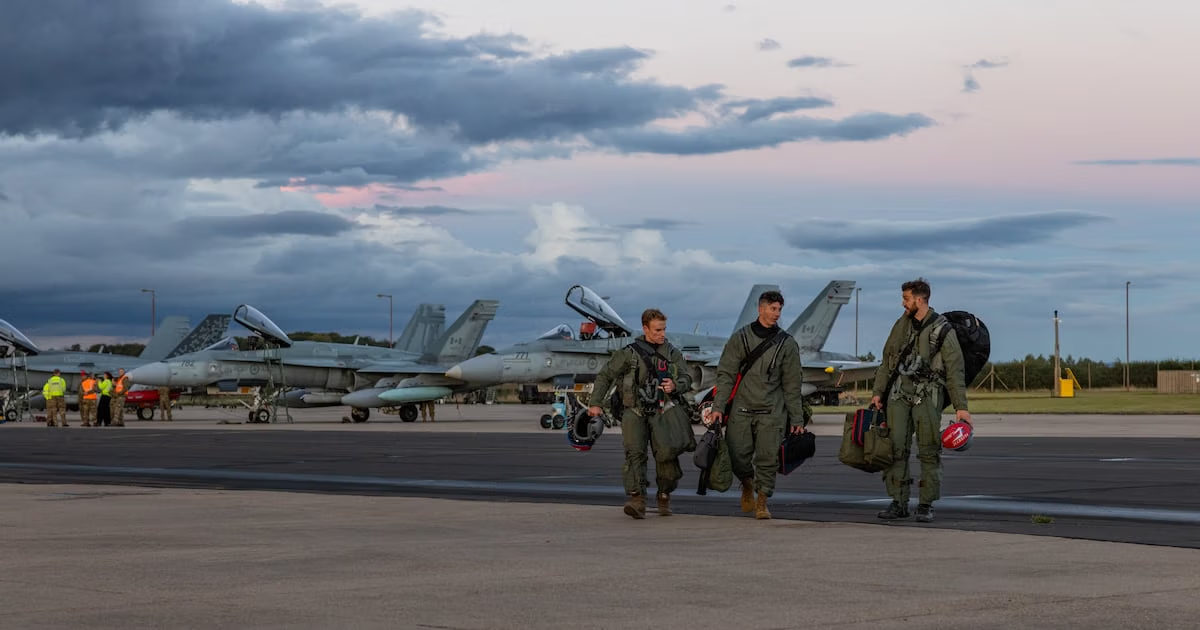
On Europe’s Tense Frontier, Canadian Jets Confront a New, Unblinking Foe
The familiar roar of a CF-18 Hornet tearing through the skies over Eastern Europe has long been a potent symbol of NATO’s unwavering resolve. For decades, Canadian pilots, as part of the Royal Canadian Air Force (RCAF), have diligently taken their turn in the high-stakes ballet of air policing, a vital mission to guard the alliance’s eastern flank against traditional aerial incursions. Their training and operational focus were honed for intercepts against formidable, piloted adversaries, primarily Russian Sukhoi fighters testing response times and sovereign airspace. However, the adversary they now train to confront is fundamentally changing. It’s no longer just the predictable shadow of a known military aircraft; it’s the quiet, persistent, and often anonymous buzz of a drone – an unblinking, uncrewed foe presenting a vastly different set of challenges.
A recent series of intensified drills involving the Royal Canadian Air Force in Europe, highlighted by the stark declaration from military officials that “we are on the front line,” pulls back the curtain on a significant and urgent evolution in modern security doctrine. This isn’t merely a routine training deployment or a symbolic show of force. It represents a critical, live-fire adaptation to the new realities of 21st-century conflict, where the traditional lines of engagement are increasingly blurred, and the threats are predominantly asymmetric. These exercises are not just about maintaining readiness; they are about redefining what readiness means in an era where advanced technology can be leveraged by state and non-state actors alike to challenge established air superiority.

The Front Line is Now a Grey Zone: Understanding Asymmetric Threats in European Airspace
The core of this compelling story isn’t the long-standing fact that Canadian jets are deployed in Europe – that represents a cornerstone of Canada’s commitment to NATO. The truly crucial development, and the urgent impetus behind their heightened vigilance, is the alarming prevalence of repeated incursions by unidentified drones. These “ghostly incursions” are more than mere nuisances; they represent a classic grey-zone tactic, carefully calibrated to operate below the threshold of conventional warfare, yet capable of achieving strategic objectives without direct confrontation. The challenges posed by these small, often slow-moving objects are profound, forcing a re-evaluation of established defense protocols and pushing the boundaries of aerial interception tactics.
Ghostly Incursions: The Anatomy of a Grey-Zone Tactic
These persistent drone overflights embody the very essence of grey-zone warfare, offering an adversary a distinct advantage through deniability and cost-effectiveness. Unlike a conventional fighter jet incursion, which instantly escalates tensions and provides clear attribution, a drone can be launched with minimal operational footprint and its origin can often be obscured. This ambiguity is its primary weapon. These unmanned aerial systems (UAS) serve multiple, intertwined purposes. Are they meticulously gathering intelligence on critical NATO airbases, meticulously mapping radar blind spots, and observing rapid response protocols? Are they systematically testing the precise limits of the alliance’s rules of engagement, probing for weaknesses in decision-making or response times? Or are they simply a low-cost, yet highly effective, method of psychological harassment, designed to keep allied forces perpetually on edge, draining resources, and fostering a pervasive sense of vulnerability?
The answer, in most cases, is likely a strategic combination of all the above. For the Royal Canadian Air Force, this transforms their mission from a relatively straightforward intercept scenario into a complex, multi-faceted challenge. The sheer variety of potential drone types – from commercially available quadcopters modified for surveillance, to highly sophisticated military-grade reconnaissance platforms – adds layers of complexity. Each presents a different threat profile and requires tailored detection and response methods. This strategic ambiguity surrounding the intent and origin of these drones is precisely what makes them so potent and difficult to counter within existing military frameworks. It blurs the line between accidental trespass and deliberate hostile action, forcing rapid, nuanced decision-making under intense pressure.
The Pilot’s Dilemma: From Intercepting Jets to Identifying Drones
For the Canadian pilots patrolling Europe’s tense frontier, the fundamental nature of their mission has undergone a profound transformation. The traditional challenge of intercepting a known military aircraft, where parameters like speed, altitude, and intent are relatively clear, has been supplanted by the vastly more intricate task of detecting, identifying, and potentially neutralizing a small, slow-moving object that could be anything from a harmless commercial drone that has drifted off course, to a sophisticated military surveillance asset, or even a weaponized platform. This ambiguity is not merely a technical hurdle; it is a critical strategic weapon wielded by potential adversaries. Distinguishing between a legitimate civilian drone and a hostile military one in a high-stakes operational environment requires extraordinary situational awareness, advanced sensor capabilities, and rapid, accurate intelligence assessment.
The difficulties are manifold. Small drones possess a notoriously low radar cross-section, making them incredibly hard to detect with conventional radar systems designed for larger aircraft. Their relatively slow speeds can make them challenging to track, especially against ground clutter or in congested airspace. Furthermore, the rules of engagement for an unmanned aircraft are inherently different and far more complex than for a piloted one. How does one respond without escalating a situation? What is the threshold for a defensive strike against an uncrewed system? These are the uncharted waters Canadian pilots are navigating, demanding not only superior flying skills but also an advanced understanding of electronic warfare, legal frameworks, and geopolitical implications. This requires a new paradigm in training, one that focuses heavily on sensor interpretation, rapid identification protocols, and decision-making under conditions of extreme uncertainty. The mental agility and tactical flexibility demanded of these pilots are unprecedented, as they must continuously adapt their strategies to an evolving, often unseen, threat.
Adapting to Asymmetric Air Warfare: Canada’s Role and NATO’s Response
This development signals three critical shifts for Canada and its NATO allies, demanding a proactive and integrated response across the alliance. The increasing sophistication and proliferation of unmanned aerial systems necessitate a fundamental rethinking of air defense strategies, resource allocation, and international cooperation. Canada, through its sustained presence and direct experience on the “front line” in Eastern Europe, plays a crucial role in shaping these adaptations and contributing to a unified, resilient NATO posture against these evolving threats.
The Evolution of Air Policing: Crafting a New Playbook for Drone Threats
The mission of air policing, once largely defined by Cold War-era intercept scenarios involving large, identifiable aircraft, is rapidly moving beyond these established parameters. Future air patrols will demand not only advanced technology but also sophisticated tactics specifically designed to counter small, unmanned aerial systems (UAS) and potential drone swarms. This evolution raises a cascade of difficult and urgent questions for policymakers and military strategists alike: When precisely does an unidentified drone constitute a sufficient threat to warrant engagement? What level of force is appropriate for a system that may not be piloted and could range from a nuisance to a weapon? How do allied forces avoid inadvertently escalating a minor incident into a major diplomatic or military crisis, especially when dealing with potentially deniable incursions?
Canadian pilots, operating alongside their NATO counterparts, are quite literally writing this new playbook in real-time. Their experiences are invaluable in developing and refining the protocols for detection, identification, tracking, and neutralization of these elusive targets. This involves exploring a range of counter-UAS (C-UAS) technologies, from advanced radar and optical sensors capable of detecting small objects, to electronic warfare systems that can jam control signals, and even kinetic solutions like specialized missiles or directed energy weapons. The integration of artificial intelligence and machine learning is also becoming paramount for rapid threat assessment and predicting drone behavior. This shift is not just about intercepting; it’s about establishing a comprehensive defensive shield against a new class of aerial threats, where agility, precision, and de-escalation are as crucial as raw firepower.
A Test of NATO’s Cohesion: Unified Deterrence in a Fragmented Threat Landscape
These repeated drone incursions are not merely technical probes of radar systems; they are profound tests of political will and the fundamental cohesion of the NATO alliance. An adversary utilizing these grey-zone tactics seeks to understand how NATO responds – not just militarily, but politically. Will the alliance be decisive and unified in its response, or will disagreements among member states on how to act create exploitable fissures? The strength of NATO lies in its collective defense, and an inability to present a unified front against ambiguous, deniable threats would embolden potential aggressors. Canada’s sustained presence in Eastern Europe, operating seamlessly alongside Romanian, British, and American counterparts, is therefore far more than a simple deployment; it is a powerful statement of unified deterrence.
Every successful detection, identification, and, if necessary, intercept of these drones sends a clear, unambiguous message: the alliance is vigilant, adaptable, and united in its resolve to protect its airspace and its member states. It demonstrates that NATO is not bound by outdated doctrines but is actively evolving to counter contemporary challenges. This collaborative operational environment fosters invaluable intelligence sharing, joint tactical development, and a shared understanding of the evolving threat landscape, strengthening the overall deterrent posture. It reassures frontline nations that they are not alone and collectively reinforces the principle that an attack on one is an attack on all, even if that “attack” comes from a small, unblinking drone.
The Imperative of Modernization: Equipping for Tomorrow’s Aerial Battlefield
While the CF-18 Hornets continue to be capably flown by dedicated Canadian pilots, they are, by modern aviation standards, an aging platform. The increasing sophistication of drone technology and the complex electronic warfare environment in which they operate underscore the urgent and undeniable need for modernized capabilities. The future of aerial combat won’t solely be about sheer speed and raw firepower; it will increasingly hinge upon advanced sensor fusion, unparalleled data processing capabilities, stealth characteristics, and the ability to effectively counter a swarm of intelligent, networked, unmanned threats. This reality makes the acquisition and integration of next-generation fighters, such as the F-35, not just a matter of military prestige, but an absolute operational imperative for Canada.
The F-35’s advanced sensor suite, its ability to fuse data from multiple sources into a single, comprehensive picture, and its formidable electronic warfare capabilities are precisely what are needed to detect, track, and engage evasive drone targets in a cluttered electromagnetic spectrum. Its stealth capabilities reduce its own detectability, allowing it to operate with greater impunity in contested airspaces. The lessons and experiences being garnered by Royal Canadian Air Force pilots on Europe’s “front line” today are building an incontrovertible case for the investment in these tools they will desperately need tomorrow. Modernization ensures that Canada can not only maintain its commitments to NATO but also protect its own sovereign airspace against similar evolving threats, safeguarding national security in an increasingly complex global environment. It represents a forward-looking strategy to maintain technological superiority and operational effectiveness against adversaries who are constantly innovating.
Beyond the Horizon: What These Drills Mean for Global Security
Ultimately, the rigorous drills and demanding operational tempo in Eastern Europe are far more than a routine exercise or a mere photo opportunity for military officials. They are a critical, real-world glimpse into the future of conflict—a future where the front line is not a static trench in the ground, but a dynamic, highly contested airspace. It is an environment patrolled by dedicated Canadian pilots who are rapidly learning to fight an adversary that may not even have a pilot of its own, an enemy that leverages technology to create ambiguity and disrupt traditional defense paradigms. The invaluable lessons gleaned, the innovative tactics developed, and the crucial experience gained by Canadian airmen and airwomen in this evolving theatre today will profoundly shape the security landscape for decades to come, directly influencing how democratic nations like Canada protect their skies and their interests from increasingly elusive and technologically adept threats. This ongoing adaptation is not just about defense; it’s about deterrence in a rapidly changing world.
What further investments in technology and training do you believe are most crucial for Canada and its NATO allies to effectively counter the evolving threat of asymmetric drone warfare in contested airspaces? Share your thoughts in the comments below!