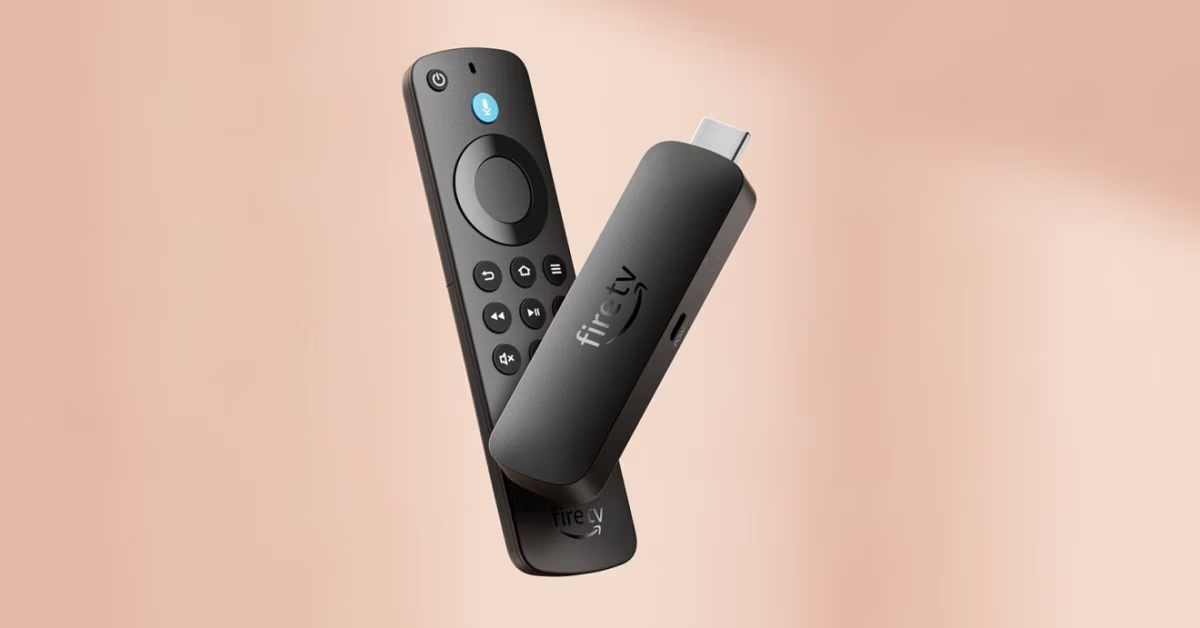
In the ever-evolving landscape of technology, some ideas surface that, while perhaps not immediately dominant, hint at seismic shifts to come. An insightful piece from The Verge once spotlighted just such a concept from Amazon: an operating system dubbed Vega, with a pivotal “trick” up its sleeve – cloud-streamed applications.
Forget the traditional model of software installed locally, hogging resources and demanding powerful hardware. The premise of Vega OS was elegantly simple yet profoundly disruptive: instead of apps running on your device, they would run in Amazon’s vast cloud infrastructure, streamed seamlessly to your screen. This isn’t just about accessing a website; it’s about experiencing a full application, with all its interactivity, without the local device bearing the computational burden.

The Cloud in Your Pocket: Unpacking Amazon Vega OS and Cloud-Streamed Applications
Amazon’s Vega OS represented a bold vision for the future of computing, challenging the foundational principles of traditional operating systems. At its core, Vega proposed a radical departure: instead of your device’s processor and memory handling the heavy lifting of applications, these tasks would be offloaded to powerful servers in Amazon Web Services (AWS). Your smartphone, tablet, or even a specialized “Vega device” would transform into a sophisticated thin client, acting merely as a window to a robust, cloud-based computing environment. Imagine opening a professional video editing suite or a complex 3D modeling program on a device no more powerful than a basic e-reader, all rendered in real-time and streamed directly to your display.
This paradigm shift isn’t merely about convenience; it’s about fundamentally rethinking the relationship between hardware and software. By divorcing application execution from local device capabilities, Vega OS promised to unlock unprecedented flexibility and accessibility for users worldwide. It leveraged Amazon’s monumental investment in cloud infrastructure, positioning AWS not just as a backbone for websites and services, but as the very engine powering personal computing experiences, moving us closer to truly hardware-independent computing.
Shifting the Computational Load: How Vega’s “Trick” Works
The magic behind cloud-streamed applications lies in remote rendering and interaction. When you launch an app on a Vega-powered device, the application itself boots up and runs entirely on a dedicated instance within AWS. All the computational processes—data processing, complex graphics rendering, real-time calculations—happen in the cloud. What gets sent back to your device is essentially a compressed video stream of the application’s interface, along with synchronized audio. Conversely, your device captures your inputs (touches, swipes, keyboard strokes, voice commands) and sends them back to the cloud server, which then processes them and updates the application state in real-time. This continuous loop, ideally with minimal latency, creates the illusion that the application is running locally on your hardware.
This architecture carries immense implications for users, developers, and the tech industry as a whole, ushering in an era of democratization of power and truly instant access to software.
Democratization of Power: Breaking Hardware Barriers
One of the most compelling promises of cloud-streamed applications is the ability to democratize access to powerful software. Historically, running demanding applications like computer-aided design (CAD) software, high-end gaming titles, or professional video editing suites required significant financial investment in robust hardware—often a high-end desktop PC or a powerful workstation. Vega OS aimed to dismantle this barrier. A relatively inexpensive device, potentially even an older model or a basic tablet, could theoretically run applications that traditionally demand a workstation-grade machine. This significantly lowers the barrier to entry for a vast segment of the population, including students, users in developing economies, and those who simply cannot afford to upgrade their gadgets every few years. It also extends the useful lifespan of existing devices, promoting sustainability in technology by reducing the pressure for constant hardware upgrades.
Imagine a scenario where educational institutions could provide access to specialized design software on basic tablets, or small businesses could leverage enterprise-grade tools without investing in costly on-premise infrastructure. This model shifts the focus from raw device specifications to reliable network connectivity, making powerful computing a utility rather than a luxury, fostering true digital inclusion.
Instant Access, Zero Installation: A Seamless Software Experience
The friction associated with traditional software installation—downloading large files, navigating complex installation wizards, managing system requirements, and dealing with perpetual updates—would largely vanish with Vega OS. Applications would be always available, always the latest version, and always ready to go, streamed on demand. This promises a truly fluid and frictionless user experience. Users would no longer worry about software compatibility issues, running out of storage space, or performance degradation due to too many installed apps. The “app store” experience would transform from downloading and installing code to simply streaming a service. This model also simplifies IT management for businesses, as software deployments and updates can be centrally managed in the cloud, ensuring consistency, security, and compliance across all user endpoints with minimal administrative overhead.
Furthermore, the concept of “local storage” for applications would diminish, freeing up significant space on devices and potentially simplifying backup and recovery processes, as user data, distinct from the application itself, could also reside primarily in the cloud, accessible from any Vega-enabled device, offering robust data persistence and cross-device continuity.
A Deeper Amazon Ecosystem: Strategic Control and Integration
For Amazon, Vega OS was more than just a convenience feature; it represented a profound strategic play to further entrench and expand its already vast ecosystem. By hosting the operating system and all applications on AWS, Amazon gains unparalleled control and insight into the user experience. This level of integration allows for seamless cross-service functionality, potentially weaving everything from Kindle content, Prime Video, Alexa voice commands, Amazon Music, and direct shopping experiences into one cohesive, cloud-powered environment. User data, preferences, and interactions could be leveraged across these services to offer highly personalized and contextually relevant experiences, creating a powerful network effect that keeps users within the Amazon sphere.
This strategy also dramatically leverages Amazon’s massive AWS infrastructure, turning its colossal computing power into a direct consumer-facing utility. It opens up new revenue streams through subscription models for cloud-powered applications and services, further solidifying Amazon’s position at the heart of the digital economy. The potential for vendor lock-in, while highly beneficial for Amazon, is also a significant consideration for users, as switching ecosystems could become more complex, highlighting the importance of open standards and data portability.
The Future it Foreshadowed: Cloud-Streamed Computing Today
While Vega OS itself might not have become a widely adopted consumer product under that specific name, the underlying philosophy of cloud-streamed computing is not just relevant today, but actively shaping the technological landscape. This “trick” was a glimpse into a future we’re already witnessing and participating in across various domains:
The Rise of Cloud Gaming: Gaming Without Limits
Perhaps the most prominent and consumer-facing example of Vega’s vision manifesting is the booming market of cloud gaming services. Platforms like Nvidia GeForce Now, Xbox Cloud Gaming, and the pioneering (though now defunct) Google Stadia operate on this exact principle. Games, traditionally the most graphically intensive and demanding local applications, are streamed from powerful cloud servers directly to players’ devices. This allows users to enjoy high-fidelity, graphically rich gaming experiences on almost any screen—smartphones, tablets, smart TVs, or even low-spec laptops—without needing expensive gaming PCs or consoles. The local device simply receives the video feed and sends back controller inputs, unlocking a truly ubiquitous gaming experience that transcends traditional hardware limitations and brings AAA titles to everyone.
Virtual Desktops and SaaS: Enterprise and Beyond
Beyond entertainment, the corporate world is increasingly adopting cloud-hosted virtual desktops (Desktop-as-a-Service or DaaS) and Software-as-a-Service (SaaS) models at an accelerating pace. Services like Windows 365 allow companies to stream a full Windows desktop environment, complete with all corporate applications, to any device. This offers unparalleled flexibility for remote work, enhanced security through centralized data management, and simplified IT administration, as updates and patches can be applied universally from the cloud. Similarly, countless SaaS applications, from customer relationship management (CRM) systems like Salesforce to productivity suites like Google Workspace and Microsoft 365 (browser-based versions), run entirely in the cloud, accessible via a web browser or lightweight client. This eliminates the need for local installation and maintenance, providing instant access and ensuring all users are always on the latest version of their critical business tools.
The “Dumb” Device, “Smart” Cloud: The Thin Client Reimagined
The concept of thin, inexpensive, energy-efficient devices serving as gateways to powerful cloud resources continues to gain traction. Chromebooks are a prime example, relying heavily on web apps and cloud services, with minimal local storage and processing power. These devices offer excellent battery life, fast boot times, and robust security, primarily because their core functionality is offloaded to the cloud. This trend points towards a future where devices are increasingly designed for connectivity and interaction, with the heavy computational lifting handled remotely. This allows for more innovative form factors, longer battery life, and lower manufacturing costs, making advanced computing accessible to a broader audience and paving the way for ubiquitous computing. It signals a shift from raw local power to efficient access, making every device a potential portal to a supercomputer.
Challenges and Critical Considerations for Cloud-First Operating Systems
While the vision articulated by Vega OS and actualized by modern cloud services offers immense advantages, it is not without its significant challenges. The viability and quality of a truly cloud-streamed operating system hinge on several critical factors that need continuous innovation and robust solutions:
Internet Connectivity: The Achilles’ Heel of Cloud Computing
The most immediate and apparent challenge for cloud-streamed everything remains internet connectivity. Latency, bandwidth, and reliability are absolutely crucial for a seamless experience. A patchy Wi-Fi signal, a congested network, or a limited mobile data plan can quickly transform a seamless, responsive experience into a frustrating, laggy, and unusable one. For cloud gaming, even a few milliseconds of latency can mean the difference between victory and defeat. For productivity apps, constant buffering or disconnections can lead to lost work, reduced efficiency, and immense frustration. The promise of “any device, anywhere” is only as strong as the network infrastructure supporting it. While 5G networks are expanding and fiber internet becomes more ubiquitous, ensuring consistent, high-speed, low-latency connectivity for everyone, everywhere, remains a significant hurdle, particularly in remote or underserved areas.
Furthermore, reliance on internet connectivity raises concerns about offline functionality. What happens when you’re on a plane, in a remote area, or during a network outage? A purely cloud-based OS would need robust offline caching mechanisms or a hybrid approach, combining local processing for basic tasks with cloud streaming for demanding ones, to remain truly practical for all scenarios.
Data Privacy, Security, and Ownership: Trusting the Cloud
When all your interactions, applications, and potentially even your personal data reside predominantly in a third-party cloud, issues of data privacy and ownership become paramount concerns. Users must place immense trust in the cloud provider (in Vega’s case, Amazon) to secure their data from breaches, respect their privacy, and adhere to stringent regulatory compliance standards such as GDPR or CCPA. Questions arise: Who truly owns the data generated when using a cloud-streamed application? How is it used for analytics or advertising? Can it be easily retrieved or moved if a user decides to switch providers? While major cloud providers invest heavily in cutting-edge security measures, the concentration of vast amounts of data in single points of failure inherently carries heightened risks. The potential for vendor lock-in, where users become heavily reliant on one ecosystem, also becomes a more pronounced issue, limiting user choice and fostering reduced market competition.
Robust encryption, transparent data policies, strong legal frameworks, and user-centric data controls are essential to build and maintain user trust in a fully cloud-powered computing paradigm. Striking the right balance between convenience, personalization, and absolute user control over their digital lives is a complex, ongoing challenge that will define the success of future cloud-first operating systems.
Conclusion: Vega’s Enduring Legacy in Cloud Computing
Amazon’s early foray with Vega OS, focusing on the revolutionary concept of cloud-streamed applications, was a powerful articulation of a computing future that minimizes local hardware constraints and maximizes flexibility and access. While Vega itself may not have revolutionized personal computing directly under that specific brand, its underlying “trick” has profoundly influenced subsequent technological developments, demonstrating a clear and compelling path towards a world where the true power of our devices isn’t in their internal components, but in their seamless, ubiquitous connection to an infinite cloud.
As 5G networks mature, low-earth orbit satellite internet expands global coverage, and edge computing brings processing power closer to the user, the barriers that once seemed insurmountable for a truly cloud-first operating system are steadily diminishing. The vision of a “cloud in your pocket”—where powerful, always-up-to-date applications are instantly accessible from any device, anywhere—is moving from a speculative concept to tangible reality. This paradigm promises to redefine digital accessibility, foster innovation, and reshape how we interact with technology for decades to come, leading us into an era of truly personalized and adaptive computing experiences.
Read the original story at The Verge.
What are your thoughts on a future where your entire OS and applications are streamed from the cloud? Would you enthusiastically embrace the unparalleled convenience, or do concerns about constant internet dependency and data privacy make you hesitant?