The Digital Battleground: Why Critical Thinking is Europe’s New Frontier
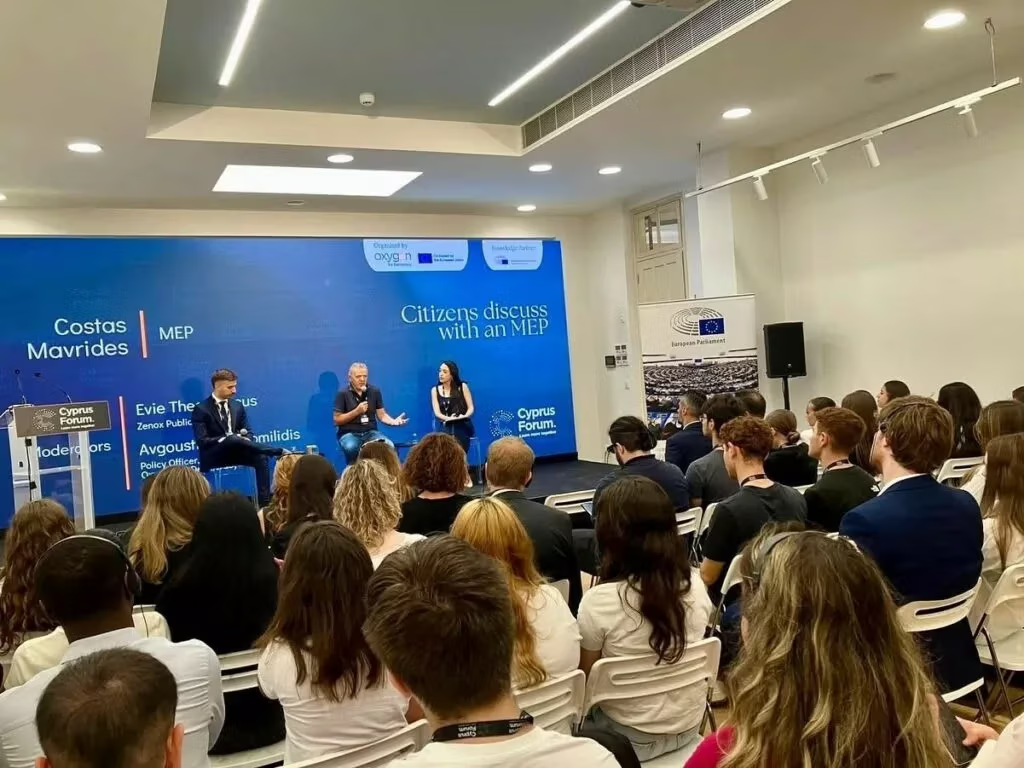
In an era increasingly defined by the endless scroll and the algorithm-driven narrative, a potent and pointed message has emerged from the heart of European politics. It’s a clarion call that suggests the very future of the continent may not be decided in the hallowed halls of power, but rather within the discerning minds of its youngest citizens. This powerful intervention came from Costas Mavrides, a Cypriot Member of European Parliament, who during the “Cyprus Forum 2025 Youth,” urged young people to arm themselves with the most crucial tool available—critical thinking. This, he argues, is the only instrument sharp enough to cut through the cacophony and often misleading noise of digital demagoguery that characterizes much of contemporary public discourse.
Mavrides’ address was far more than a standard political speech; it was a strategic plea, a profound recognition of a shifting landscape where information overload often equates to understanding deficit. He masterfully framed the upcoming European Parliament elections not merely as a routine civic duty, but as a critical juncture, a moment of profound decision for the continent. The fundamental choice, as he articulated it, boils down to two paths: one, being passive consumers of information, often meticulously tailored to provoke emotional reactions rather than foster genuine understanding; and the other, becoming active, discerning, and engaged participants in shaping the Union’s destiny. This distinction is pivotal for the resilience and progression of the European project itself.

This urgent message resonates with increasing intensity far beyond the sunny shores of Cyprus, echoing across the entire European continent. The modern political discourse, in a significant and often alarming shift, is now predominantly fought on the vast, volatile digital battleground of social media. Here, the subtle art of nuanced debate is frequently overshadowed, if not outright drowned out, by simplistic slogans, emotionally charged soundbites, and the relentless drumbeat of populist rhetoric. Mavrides’ emphatic warning against the “siren song of populism” is not a mere turn of phrase; it is a direct and stark acknowledgment of a potent and pervasive threat that challenges the very fabric of liberal democracies.
The Erosion of Nuance: Social Media’s Impact on Discourse
The rise of social media platforms, while offering unprecedented connectivity, has simultaneously ushered in an era of profound informational fragmentation. Algorithms, designed to maximize engagement through personalized feeds, inadvertently create echo chambers where individuals are primarily exposed to information that confirms their existing biases. This self-reinforcing loop severely limits exposure to diverse perspectives and complex arguments, leading to an erosion of nuance in public discourse. Topics that demand thoughtful consideration are reduced to digestible, often polarizing, memes or soundbites, leaving little room for the grey areas that define most real-world challenges. Consequently, young people, who are native inhabitants of this digital landscape, are particularly susceptible to having their understanding of complex issues shaped by these simplified, often biased, narratives rather than by a comprehensive and balanced examination of facts.
Furthermore, the speed at which information (and misinformation) propagates across these networks means that sensationalism often takes precedence over accuracy. Headlines are crafted to grab attention, not necessarily to convey truth, and emotional responses are prioritized over rational analysis. This environment fosters a superficial engagement with political and social issues, where “likes” and shares become proxies for understanding or agreement, without necessitating a deeper dive into the veracity or implications of the content. This rapid-fire, low-engagement consumption model actively discourages the very critical thinking skills Mavrides advocates, making it harder for individuals to pause, question, and evaluate the underlying motives or evidence behind a given piece of information.
The Siren Song of Populism: A Threat to European Values
Populism, in its contemporary digital manifestation, thrives precisely in this environment of reduced nuance and heightened emotionalism. It offers seemingly simple solutions to complex problems, often by identifying an ‘elite’ or an ‘other’ as the root cause of societal woes. This narrative, amplified by social media, can quickly galvanize segments of the population who feel unheard or disenfranchised, promising direct action and often appealing to nationalist sentiments or anti-establishment rhetoric. Mavrides rightly identifies this as a critical threat because the core foundations of the European project—cooperation, democracy, and reasoned progress—are antithetical to populist approaches that often prioritize division, immediate gratification, and emotional appeals over long-term, collaborative solutions.
The European Union, by its very nature, is a testament to the power of multilateralism, compromise, and the painstaking work of building consensus across diverse cultures and economies. Populist movements, often rooted in nationalistic ideologies, frequently challenge this framework, advocating for isolationism or a return to perceived simpler times. When citizens, particularly the impressionable young, are not equipped with the critical faculties to question the grand promises and often unrealistic narratives of populism, they become vulnerable to its allure. This can lead to decisions at the ballot box that undermine the very institutions designed to foster peace and prosperity, thereby jeopardizing decades of integration and cooperation. The ability to discern rhetoric from reality, and to demand evidence over mere assertion, becomes a crucial defense mechanism against such divisive forces.
Mavrides’ Strategic Plea: Beyond Civic Duty, Towards Active Participation
Costas Mavrides’ plea is not a perfunctory call for voter turnout; it’s a far more profound strategic intervention, recognizing a pivotal generational shift and the evolving nature of civic engagement. He acknowledges that simply casting a ballot, while essential, is no longer sufficient in an age where the battle for minds is waged continuously online. His message is an invitation to transcend passive observation and move towards genuine, impactful participation that is informed by critical thought.
The Youth Demographic: Untapped Power in a Fragmented Information Ecosystem
Young Europeans today represent an unprecedented demographic bloc. They are the first generation to come of political age entirely immersed in this hyper-connected, yet often fragmented, information ecosystem. Their digital fluency and ubiquitous presence online give them immense potential as agents of change. However, as Mavrides subtly points out, this power largely remains latent unless it is activated by genuine, critically informed engagement. The sheer numbers of young people across Europe, combined with their collective digital voice, could significantly sway political outcomes and shape policy debates, provided they are not merely echoing curated content but are actively contributing thoughtful, analytical perspectives.
Their understanding of technology, their innate ability to navigate digital spaces, and their openness to new ideas are invaluable assets. Yet, these very strengths can become vulnerabilities if not coupled with discernment. The speed of information flow, the prevalence of user-generated content, and the blurring lines between news, opinion, and entertainment require a sophisticated filtering system that only critical thinking can provide. Tapping into this demographic’s power means empowering them not just to consume information, but to produce, curate, and critically evaluate it, turning their digital native skills into a force for informed civic action.
From Passive Consumers to Architects: Defining Genuine Engagement
The distinction between passive consumption and active participation is central to Mavrides’ argument. In the digital realm, a “like,” a “share,” or a brief comment can give a superficial impression of engagement. While these actions contribute to visibility, they often lack the depth of critical inquiry or the substance required to meaningfully contribute to democratic processes. Mavrides suggests that merely interacting with content, however frequently, does not equate to building a future. Instead, genuine engagement involves a deliberate process of questioning, analyzing, challenging, and synthesizing information.
Becoming an “architect” of Europe, rather than just an inheritor, implies taking ownership and responsibility for the future direction of the Union. This involves not only understanding policy debates but also scrutinizing the sources of information, recognizing biases, and forming independent, evidence-based opinions. It means moving beyond knee-jerk reactions to complex issues and instead engaging in reasoned discourse, even when it’s uncomfortable or challenges preconceived notions. This active intellectual labor is what transforms raw information into actionable knowledge, enabling young people to become thoughtful voters, engaged citizens, and ultimately, effective leaders who can genuinely shape the continent’s destiny.
The Stakes are High: Navigating Europe’s Monumental Challenges
The call for a critically thinking generation arrives at a time when Europe stands at a crossroads, facing a confluence of monumental challenges that demand not just resilience, but also astute judgment and informed decision-making from its citizens. From external geopolitical pressures to internal transitions, the continent’s ability to navigate these complexities will largely depend on the intellectual rigor of its populace.
Geopolitical Instability: The Need for Informed Decision-Making
In an increasingly volatile global landscape, characterized by conflicts, hybrid warfare, and escalating international tensions, Europe finds itself grappling with significant geopolitical instability. Disinformation campaigns, often orchestrated by state actors or malign influences, are a pervasive threat, designed to sow discord, undermine trust in democratic institutions, and manipulate public opinion. In this environment, the capacity of citizens, especially the young, to critically evaluate news, identify propaganda, and understand the real implications of global events is paramount. An uninformed or easily swayed populace becomes a significant vulnerability, susceptible to narratives that could push Europe towards undesirable paths or fracture its internal cohesion.
Critical thinking allows individuals to differentiate between genuine threats and manufactured fear, to understand the intricacies of international relations beyond simplistic narratives of ‘us vs. them’. It empowers them to scrutinize foreign policy decisions, question military interventions, and support diplomatic efforts based on facts rather than emotional appeals. The ability to make informed decisions about Europe’s role on the world stage, its alliances, and its strategic priorities is a direct function of its citizens’ collective critical intelligence.
The Green Transition and Economic Futures: Evaluating Complex Solutions
Another defining challenge for Europe is the ambitious green transition—a fundamental shift towards a sustainable, decarbonized economy. This endeavor is incredibly complex, involving sweeping changes in energy production, transportation, agriculture, and industrial processes. It presents both immense opportunities and significant economic and social costs, requiring difficult policy choices and trade-offs. Similarly, shaping robust and equitable economic futures in a rapidly evolving global market demands sophisticated understanding.
Here, critical thinking is indispensable. Citizens must be able to evaluate the scientific basis of climate change, understand the proposed solutions, scrutinize their feasibility and potential impacts, and differentiate between genuine progress and ‘greenwashing.’ They need to understand complex economic models, assess the merits of various fiscal policies, and recognize the long-term implications of short-term economic fixes. Without critical thinking, debates around these crucial issues risk devolving into ideological battles or being swayed by lobbying efforts, rather than being guided by evidence and a clear-eyed vision for a sustainable and prosperous future.
Protecting Democratic Institutions: A Foundation for Future Generations
At the very heart of the European project lies its commitment to democratic institutions and the rule of law. These foundations, however, are not immutable; they require constant vigilance and active participation to sustain them. Critical thinking plays a vital role in protecting and strengthening these institutions by fostering an informed citizenry capable of holding power to account, discerning credible leadership, and resisting authoritarian impulses.
When citizens are equipped to question, analyze, and challenge, they become less susceptible to demagoguery and more likely to demand transparency and accountability from their elected representatives. Critical thinking combats voter apathy by demonstrating the tangible link between informed choices and societal outcomes. It ensures that public discourse remains vibrant and inclusive, preventing the erosion of freedoms and checks and balances that are cornerstones of a healthy democracy. For future generations, preserving and enhancing these democratic safeguards is paramount to inheriting a continent where their voices truly matter and where their rights are protected.
Practical Steps: Cultivating a Culture of Critical Inquiry
The recognition of critical thinking’s importance is only the first step; the true challenge lies in actively cultivating a culture where such inquiry is not just valued but systematically developed. This requires a multi-faceted approach involving educational reforms, individual commitment to media literacy, and broader societal support.
Educational Initiatives: Equipping the Next Generation
The most fundamental arena for fostering critical thinking is the education system. Schools and universities across Europe must move beyond rote memorization and embrace curricula that prioritize analytical reasoning, problem-solving, and skeptical inquiry. This means teaching students how to evaluate sources, understand logical fallacies, construct reasoned arguments, and engage in constructive debate. Subjects like history, civics, and even mathematics can be reframed to emphasize critical analysis rather than just factual recall.
Specialized media literacy programs should be integrated at all levels of education, starting from primary school. These programs would explicitly teach young people about the digital landscape they inhabit: how algorithms work, the business models of social media, how disinformation spreads, and techniques for fact-checking and identifying bias. By equipping students with these foundational skills early on, they become more resilient to manipulation and more capable of navigating complex information environments responsibly.
Media Literacy and Digital Citizenship: Tools for Empowerment
Beyond formal education, individuals themselves bear a responsibility to cultivate their own media literacy and develop strong digital citizenship habits. This involves a conscious effort to diversify information sources, actively seek out differing viewpoints, and fact-check claims before accepting or sharing them. Tools and techniques for verifying information, such as cross-referencing multiple credible news outlets, utilizing fact-checking websites, and understanding the difference between editorial opinion and investigative journalism, are crucial.
Digital citizenship extends beyond mere consumption; it involves responsible participation. This means engaging respectfully in online discussions, understanding the impact of one’s own digital footprint, and actively contributing to a healthier online environment by challenging misinformation and promoting verified content. It’s about being an informed and ethical participant in the digital public square, recognizing that online interactions have real-world consequences.
The Role of Institutions and Parents
While education and individual effort are key, broader societal structures also have a role. Public institutions, including governments and cultural organizations, can support critical thinking through public awareness campaigns, funding for independent journalism, and promoting platforms for nuanced debate. Parents, too, play a vital role in guiding their children’s digital habits, encouraging questioning, and fostering open discussions about current events and online content. By working in concert, these various stakeholders can create an ecosystem that genuinely champions and cultivates critical inquiry across all generations.
The Road Ahead: A Call to Action for Every European Citizen
Costas Mavrides’ potent message serves as a crucial reminder that the future of Europe is not a predetermined path, nor is it solely the prerogative of politicians and policymakers. It is, fundamentally, a collective enterprise, shaped by the individual choices and intellectual rigor of its citizens. The battle for the future is increasingly understood as a battle for the narrative—a struggle for truth and reasoned discourse against the tide of simplification and sensationalism.
As Europe navigates a landscape rife with monumental challenges—from persistent geopolitical instability and the complexities of the green transition to the existential threats posed by digital demagoguery—the critical question looms large: Will the next generation of European leaders and voters be guided by sound judgment, informed analysis, and a commitment to democratic values? Or will they be swayed by the loudest, most divisive voices echoing through their digital feeds, sacrificing long-term stability for short-term emotional gratification?
Mavrides is making a clear bet, and an urgent hope, that by actively fostering a widespread culture of critical inquiry, young Europeans will unequivocally choose the former. He has laid the challenge squarely at their feet: to move decisively beyond the passive consumption of the scroll, to reject the allure of the algorithm, and instead, to embrace their role as the discerning, active architects of the Europe they wish not merely to inherit, but to purposefully build and safeguard for generations to come. This is not just a call to think; it is a call to action, to agency, and to the profound responsibility of shaping a continent’s destiny.
What specific steps do you believe European educational systems or even individual communities can take to more effectively equip young people with robust critical thinking skills in today’s digital age?
Read the original story at Latest News In Cyprus.