
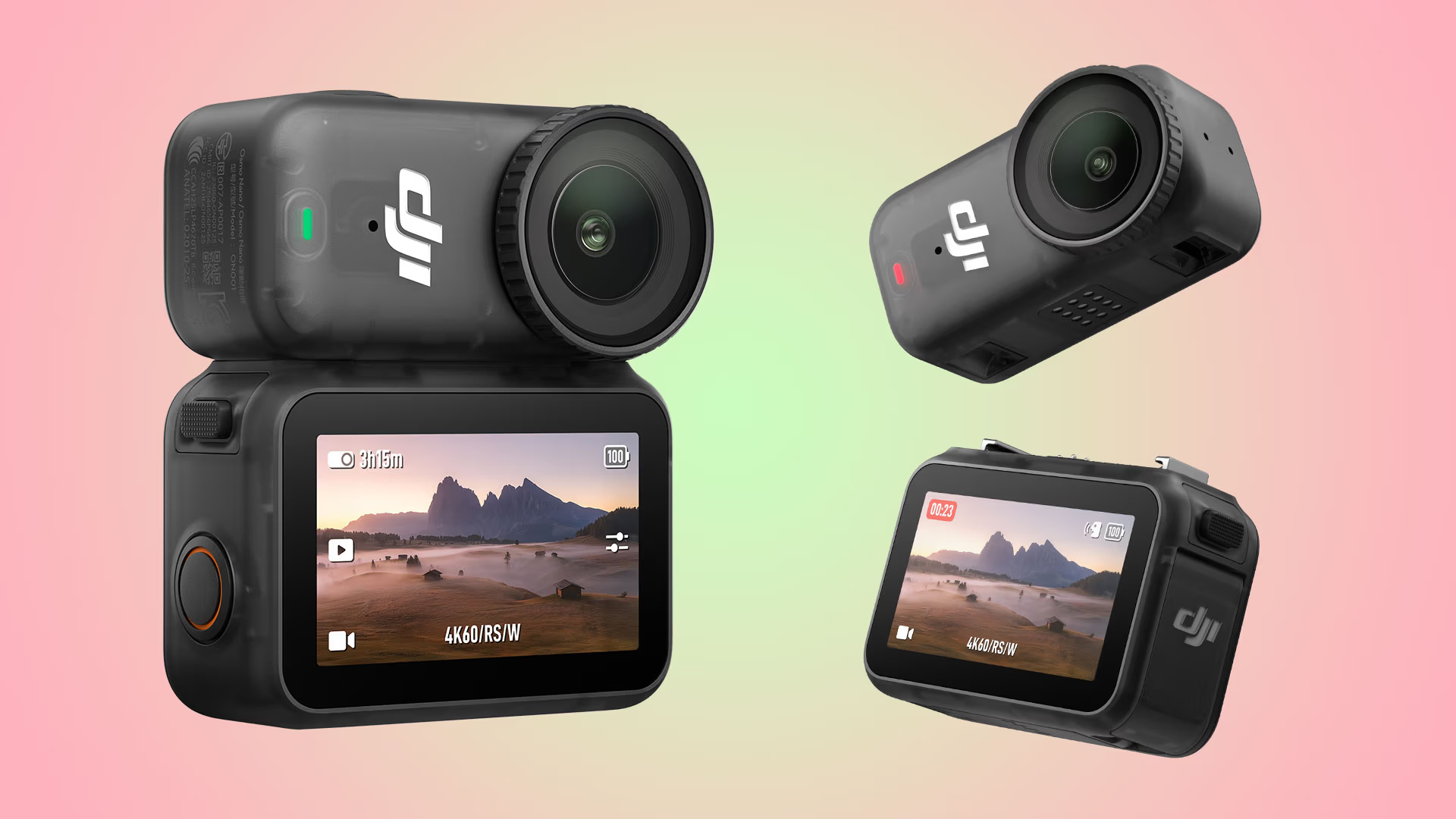
In the rapidly evolving landscape of camera technology, we’ve grown accustomed to a somewhat predictable rhythm of innovation. Each year brings incremental improvements: sensors might gain a fraction of an inch, frame rates tick up slightly, and camera bodies shed a few grams. These iterative steps are valuable, pushing the boundaries of what’s possible in subtle ways. Yet, every so often, a product emerges that doesn’t just refine an existing concept; it fundamentally challenges the very definition of what a camera can be, daring to rethink the entire formula. DJI’s recently unveiled Osmo Nano is precisely one such groundbreaking product, poised to redefine expectations for filmmakers and content creators alike.
At first glance, the technical specifications alone are enough to capture attention and spark curiosity. Imagine a camera system that, in its core head unit, weighs a mere 52 grams – that’s an astonishingly light 0.1 lbs – yet is capable of capturing breathtaking 4K video at a silky-smooth 120 frames per second. Such numbers in a package so minuscule are undeniably remarkable, especially considering the quality expected from DJI. However, to dwell solely on these impressive figures would be to miss the profound implications of this device. The Osmo Nano is far more than just another compact action camera designed for adventurous exploits; it represents a visionary leap, offering a tangible glimpse into the future of creative filmmaking and how we interact with our capture tools.

The Magic is in the Modularity: Unlocking Unprecedented Creative Freedom
The true genius, the revolutionary spirit, and the core innovation of the DJI Osmo Nano lie not in its individual components, but in its elegantly deconstructed, modular design. Unlike conventional action cameras, such as a sturdy GoPro or even DJI’s own unified Action series, which present as a single, immutable block, the Nano reimagines the camera as a dynamic, adaptable system. It intelligently separates the critical elements of capture: a minuscule camera head housing the lens and sensor, a main body responsible for sophisticated processing and controls, and a dedicated battery module. While these components can connect seamlessly for traditional use, their most powerful feature is their ability to operate independently, connected only by a slender cable. This separation is key to its transformative potential.
To fully grasp this paradigm shift, it’s helpful to think of the Osmo Nano less as a rigid, traditional camera and more like a sophisticated set of high-tech filmmaking LEGOs. This inherent modularity isn’t just a clever design trick; it’s a profound unlocking of possibilities that were, until now, exclusively the domain of high-end cinema rigs – systems that command exorbitant prices and require complex, bulky extension units and intricate cabling. These professional setups, while powerful, often involve significant weight, setup time, and a considerable financial investment, making them inaccessible for most everyday creators or even many specialized productions.
Consider the myriad of creative scenarios that were previously either impossible, prohibitively difficult, or simply too expensive to achieve with existing technology. Imagine needing a truly immersive first-person-view (FPV) shot for a high-octane snowboarding descent. Instead of strapping a cumbersome, bulky camera block to your helmet, adding uncomfortable weight and drag, you can now affix the minuscule Osmo Nano camera head directly to your goggles. The main processing unit and battery can then be discreetly stashed in a jacket pocket, keeping the weight off your head and maintaining comfort and aerodynamics. This separation allows for agile, unobstructed movement and a genuine POV perspective.
The creative applications extend far beyond extreme sports. Picture a documentary filmmaker needing to capture a dynamic, intimate shot from inside a car’s engine bay, detailing the intricate workings of a finely tuned machine, or a musician aiming to record a unique perspective from the headstock of a guitar, showcasing the delicate fingerwork on the fretboard. These are precisely the types of challenging environments where the Osmo Nano truly shines. Its tiny sensor and lens unit can venture into spaces where no traditional camera, or even a conventional action camera of this quality, could possibly fit. This isn’t merely about making the camera itself smaller; it’s about fundamentally liberating the *lens* – the eye of the camera – from the bulk of its electronics, granting creators unparalleled freedom to position it anywhere their imagination, and the demands of the shot, might take them. This capability opens up entirely new narrative and visual avenues, pushing the boundaries of cinematic storytelling for everyone.
Punching Far Above its Weight Class: Professional-Grade Image Quality in Miniature
While the diminutive size and groundbreaking modularity of the DJI Osmo Nano rightfully grab headlines, it’s its utterly professional image quality that delivers the true knockout punch. This isn’t just a tiny camera; it’s a professional filmmaking tool compressed into an almost weightless package. The Osmo Nano records in 10-bit D-Log M, a specification that, for the non-cinematographers in the room, represents a monumental leap in color fidelity and post-production flexibility. D-Log M is a professional-grade color profile, often referred to as a “flat” profile, meaning it captures footage with reduced contrast and saturation directly from the sensor. This seemingly muted image is, in fact, a treasure trove of visual data, preserving an expansive dynamic range that would otherwise be lost. It’s designed to capture over a billion distinct shades of color, in stark contrast to the 16.7 million colors captured by standard 8-bit systems. This immense color depth provides unparalleled flexibility in post-production, allowing filmmakers to intricately color grade their footage with precision, achieving rich, cinematic looks and seamlessly matching the color science of much larger, significantly more expensive cinema cameras.
This is the critical takeaway: DJI has achieved something extraordinary. They have distilled the advanced color science and image processing capabilities typically found in their pro-level drones and larger, high-end cameras – systems like the Mavic 3 series or the Ronin 4D – and packed them into a body that is, for all intents and purposes, feather-light. This fusion of professional-grade color data and minuscule form factor is unprecedented. When you combine this cinematic color quality with the capability for stunning 4K slow-motion footage at 120 frames per second, and integrate it with DJI’s industry-leading RockSteady electronic image stabilization, you don’t just get a camera; you get a revolutionary tool. The ability to capture high-resolution, high-frame-rate video allows for incredibly smooth, dramatic slow-motion sequences that reveal intricate details and elevate storytelling. Meanwhile, RockSteady stabilization, known for its exceptional performance in smoothing out even the most jarring movements, ensures that footage from this tiny, highly mobile camera remains fluid and professional, whether it’s mounted on a helmet, a dashboard, or held in an unconventional rig.
The synergy of these advanced features transforms the Osmo Nano into what will undoubtedly become a secret weapon across a diverse range of productions. Documentary filmmakers will find it invaluable for capturing intimate, observational shots in confined spaces or from unique perspectives that would be impossible with larger setups. YouTubers and social media creators can elevate their content with cinematic slow-motion and dynamic, impossible angles, setting their work apart in a crowded digital landscape. Even Hollywood productions, often in need of “crash cams” or specialized units for intricate practical effects shots, will discover the Nano’s robust quality and adaptability to be a game-changer. It means that high-fidelity cinematic capture is no longer constrained by the size or weight of the camera, democratizing access to professional-level aesthetics.
Advanced Imaging Features at a Glance:
- 10-bit D-Log M: Unlocks over a billion colors for superior dynamic range and precise color grading in post-production.
- 4K 120fps Slow Motion: Captures crisp, detailed footage ideal for dramatic slow-motion effects, emphasizing action and detail.
- DJI RockSteady Stabilization: Ensures incredibly smooth, stable footage even in dynamic and challenging shooting conditions, crucial for a camera this small and versatile.
- Professional Color Science: Inherits the renowned color profiles from DJI’s pro-level cameras and drones, allowing seamless integration into multi-camera workflows.
What This Means for the Future of Filmmaking and Camera Design
The DJI Osmo Nano doesn’t just feel like another product launch; it feels like a genuine turning point in the trajectory of camera technology. It boldly blurs the traditionally distinct lines between various camera categories. Is it an action camera? Yes, in its ruggedness and portability. Is it an FPV drone camera? Its lightweight, modular nature certainly makes it ideal for specialized drone applications, even acting as a standalone FPV unit. Is it a professional “crash cam” designed to capture high-quality footage from precarious positions without fear of significant loss? Absolutely. This convergence of capabilities signals a decisive move away from the long-standing paradigm of the “all-in-one” block camera and heralds the arrival of a more flexible, system-based approach to capturing unique and challenging angles.
This innovative design philosophy forces us to reconsider fundamental questions about camera architecture. We’re no longer merely asking, “How small can we make a camera while maintaining acceptable image quality?” The conversation has evolved. Now, we’re beginning to ask, “How can we fundamentally change a camera’s shape, distributing its components, to best serve the demands of a specific shot or creative vision?” By intelligently breaking the camera down into its core, independent components – the sensor/lens, the processor, the power supply – DJI isn’t just shrinking a device; they are dramatically expanding the creative canvas available to everyone. This means filmmakers can achieve perspectives that were previously either too dangerous, too complex, or simply physically impossible. Imagine integrating multiple Nano camera heads into a custom rig for multi-angle capture, or discreetly placing them for hyper-specific product shots.
The implications of this shift are far-reaching. It democratizes advanced filmmaking techniques, making high-quality, creatively ambitious shots accessible to a much broader audience, from aspiring YouTubers and indie filmmakers to established production houses. It encourages experimentation, pushing creators to think outside the box about camera placement and movement. The future of camera design, as hinted by the Osmo Nano, points towards greater specialization, with sensor heads becoming even more compact and specialized, while processing power is centralized or distributed more effectively. This modular approach is not just a trend; it’s a logical evolution that prioritizes creative freedom and adaptability above all else. And in a world hungry for unique visual stories, that’s an infinitely more exciting and impactful development than merely shaving off a few more grams from an existing design.
The DJI Osmo Nano challenges us to rethink not just what a camera looks like, but what a camera *does*. By prioritizing the lens’s placement over the housing’s rigidity, it empowers creators to truly unleash their imagination. How do you envision using the DJI Osmo Nano to capture a shot that was previously impossible?
Read the original story at Cined.com.