
Beyond Remakes: The Philosophy of ‘Reimagined’
In the expansive and often nostalgic world of classic Japanese Role-Playing Games (JRPGs), certain titles are held in such high regard they feel less like video games and more like treasured historical artifacts, carefully preserved for their cultural and mechanical significance. These are the games we revisit, discuss, and sometimes, even fear to touch. And then, there’s Dragon Quest VII. It transcends the typical definition of an artifact, presenting itself instead as a glorious, sprawling, and at times, utterly maddening epic. It was a game so inherently massive in scope and ambition that playing it felt akin to traversing an entire geological era, charting the very evolution of a world.
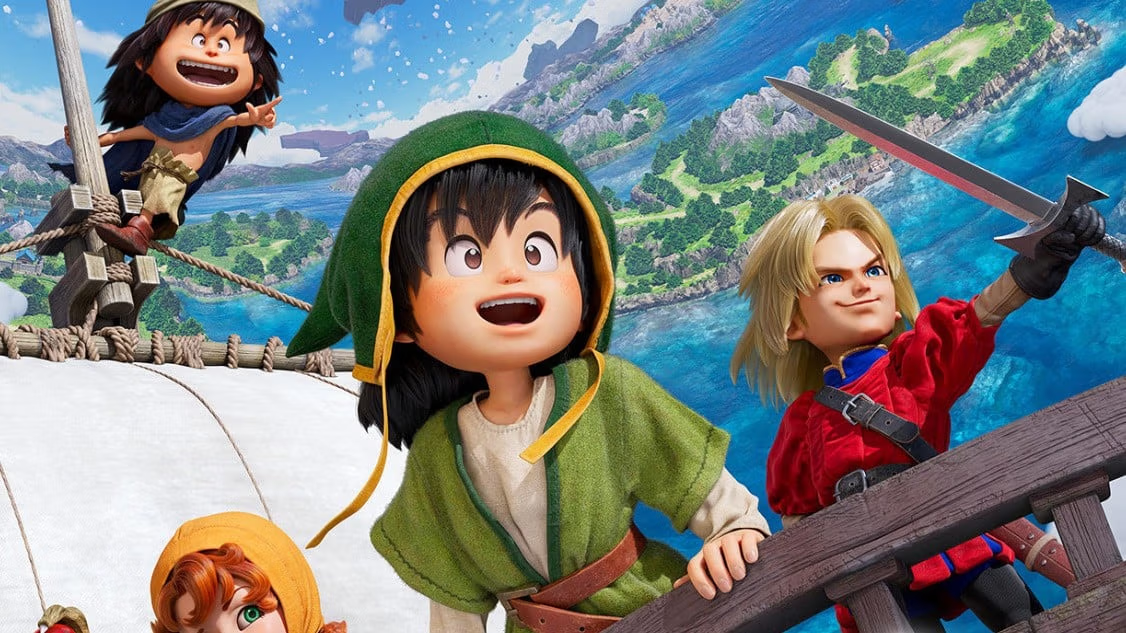
Today, the gaming world collectively held its breath as Square Enix finally unveiled a substantial 17 minutes of gameplay for Dragon Quest VII: Reimagined. This wasn’t merely a reveal of updated graphics or a new coat of paint; it was a profound declaration of a new philosophy in how we approach the revitalization of cherished classics. This isn’t just a game being remade; it’s a genre staple being thoughtfully deconstructed and lovingly rebuilt with modern sensibilities.

The operative word here, and one that demands meticulous consideration, is “Reimagined.” This isn’t a casual descriptor; it’s a deliberate, strategic choice that sets this project leagues apart from the safer, more conventional labels like “Remastered” or even “Remake.” To understand its weight, consider the distinctions: a remaster typically involves polishing the existing chrome, perhaps bumping up resolution or frame rates while leaving the core engine and design untouched. A remake, on the other hand, usually entails rebuilding the entire car from the ground up, using the original blueprint but with entirely new components and often, some design tweaks. A “reimagining,” however, goes a step further. It critically asks: Should this have even been a car in the first place? It questions the fundamental design choices, the core experience, and how that experience translates (or doesn’t) to contemporary expectations and player habits. For anyone who has invested countless hours into the original PlayStation release or its subsequent 3DS remake, you instinctively grasp why Dragon Quest VII stands as the quintessential candidate for this kind of profound, deep-level rethinking.
The Colossal Asterisk: Confronting DQVII’s Legacy
Let’s be unequivocally honest: the original Dragon Quest VII: Fragments of the Forgotten Past is, by many metrics, an absolute masterpiece. It boasts one of the most compelling and emotionally resonant narratives in JRPG history, a truly innovative class system that offered unparalleled character customization, and an expansive world that genuinely felt ancient and lived-in. Its thematic exploration of historical revisionism, memory, and the cyclical nature of destruction and rebirth was remarkably sophisticated. Yet, for all its undeniable brilliance, it came with a colossal, glaring asterisk. This asterisk represented its notoriously slow, almost glacial start. Players could spend literal hours—sometimes upwards of five or six—before they even engaged in their first meaningful combat encounter, let alone unlocked the game’s iconic job system. The core mechanic of meticulously searching for ancient fragments to restore long-lost islands, while conceptually brilliant, often devolved into a meandering, directionless slog, riddled with pixel-hunting and frustrating backtracking. It was a game that demanded an almost monk-like level of patience and perseverance, a commodity that, frankly, is increasingly rare and less expected in today’s fast-paced, instant-gratification gaming landscape.
The 17-minute gameplay showcase we were treated to today from Dragon Quest VII: Reimagined suggests that Square Enix is tackling this complex legacy head-on, not with timid adjustments, but with a bold, surgical approach. The vibrant, unmistakably modern visuals were, to some extent, anticipated. Clearly built upon the robust and beloved foundation of Dragon Quest XI: Echoes of an Elusive Age‘s engine, the world of DQVII now gleams with a richer palette, more intricate detailing, and a dynamic presentation that finally does justice to Akira Toriyama’s timeless character and monster designs. The classic, turn-based combat, a hallmark of the series, remains intact, but now with iconic monsters popping and slithering across the screen with unprecedented fluidity and new life, their animations brimming with personality. What wasn’t a given, however, and what truly captured the attention of long-time fans and newcomers alike, was the palpable shift in pacing.
Streamlining the Epic: Pacing and Quality-of-Life Reimagined
What the showcase strongly suggested was a meticulously streamlined opening sequence, designed to whisk players into the heart of the adventure far more swiftly than its predecessors. We anticipate a clearer, more intuitively guided path towards the initial discoveries, reducing the early game’s infamous sense of aimless wandering. Crucially, the quality-of-life improvements appear to extend far beyond a mere speed-up button for combat or traversal—though these are undoubtedly welcome. We expect enhancements to the fragment-finding process, perhaps visual cues, improved map functionality, or clearer progression indicators that respect player time without sacrificing the joy of discovery. The entire process of discovering the past, piece by painstaking piece, and witnessing its immediate, tangible impact on the present world appears significantly more dynamic, visually rewarding, and emotionally resonant. This isn’t about haphazardly cutting beloved content or dumbing down the experience; it’s about expertly reframing it. Square Enix seems to grasp that the true, enduring soul of Dragon Quest VII isn’t found in the friction of its outdated or cumbersome mechanics, but in the profound wonder and emotional satisfaction of seeing a broken world heal, island by island, through the player’s direct, meaningful actions. This reverence for the core narrative combined with a willingness to modernize the delivery is a testament to true “reimagining.”
A Blueprint for JRPG Resurrection: Learning from Final Fantasy VII Remake
This ambitious undertaking of Dragon Quest VII: Reimagined represents a much larger, and incredibly fascinating, trend in the gaming industry. It feels, in many respects, like a spiritual successor to the groundbreaking philosophical approach taken with the Final Fantasy VII Remake project. That seminal title dared to suggest that you can, indeed, honor a classic—a truly monumental classic—not by meticulously preserving every single pixel and design flaw in amber, but by lovingly deconstructing its most vital elements and boldly rebuilding them for the sensibilities and expectations of a contemporary audience. It’s a powerful admission that game design principles from over two decades ago, however brilliant or revolutionary they might have been at the time, are not infallible, and that evolution is not betrayal when executed with respect and vision. The developers aren’t just updating graphics; they’re engaging in a dialogue with history, questioning what worked, what didn’t, and how the core essence of a beloved experience can be liberated from its mechanical constraints.
The Future is Bright: No Sacred Cow Too Big
What does this groundbreaking approach mean for the broader landscape of classic JRPGs and the future of game preservation and revitalization? It signals a profound shift: that no sacred cow, no matter how revered or seemingly untouchable, is too big or too complex to be thoughtfully reassessed and reimagined. If Square Enix is demonstrating this level of ambitious, surgical refinement on a gargantuan, 100+ hour behemoth like Dragon Quest VII—a game notorious for its specific pacing challenges—what other beloved, yet perhaps similarly flawed, classics could be next in line for this transformative treatment? This initiative sends a clear message to the industry and to players: developers aren’t just selling us simplistic nostalgia trips anymore. Instead, they are actively engaging with a game’s entire history—acknowledging both its triumphs and its stumbles—to meticulously craft something that feels simultaneously timeless and thrillingly new. It hints at a future where the past is not just remembered but revitalized, where core experiences are preserved while frustrating barriers to entry are systematically removed, inviting new generations to discover the magic.
Dragon Quest VII: Reimagined is rapidly shaping up to be far more than just another nostalgic trip down memory lane for seasoned fans. It promises to be a bold, dynamic conversation between the past and the present, a testament to thoughtful game design evolution, and it might just be the definitive blueprint for how to truly resurrect JRPG giants for an entirely new generation of players without losing the heart of what made them special. Are you ready to see this forgotten past truly reimagined?
Read the original story at Nintendo Life.