The Cultural Frontline: Why the EU’s Latest Funding for Ukraine is More Than Just an Arts Grant
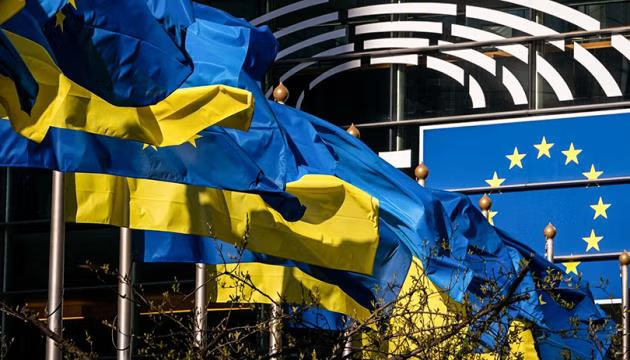
In the brutal calculus of war, where missiles and munitions dominate headlines, the European Union has made a potent, if quieter, strategic move. The announcement of over €1.17 million in funding for four Ukrainian cultural projects is far more than a simple act of patronage; it is a clear and deliberate investment in the very soul of the nation it seeks to support. This is soft power wielded with precision, a statement that the battle for Ukraine is being fought not only in the trenches but in its art studios, digital galleries, and community centers.
This strategic allocation of resources, channeled through the EU’s “Creative Europe” program, represents a targeted strike against the narrative of erasure that underpins Russia’s aggression. It acknowledges that the fight for Ukraine’s sovereignty extends beyond its territorial borders, reaching deep into its cultural fabric and national identity. By empowering Ukrainian artists and cultural institutions, the EU is directly bolstering the nation’s spiritual resilience and affirming its place within the broader European cultural landscape. This isn’t merely about preserving existing heritage; it’s about actively fostering new creative expressions and ensuring that the vibrant spirit of Ukraine continues to thrive even amidst unimaginable adversity.

The four selected projects are a microcosm of a nation fighting for its present and future, embodying a diverse range of cultural initiatives. They include a sophisticated digital platform meticulously designed to launch Ukrainian artists onto the global stage, ensuring their voices and visions resonate far beyond their national borders. Another project is a dynamic, youth-focused initiative specifically crafted to engage the next generation in smaller towns, fostering cultural participation and a sense of community pride in areas that might otherwise feel marginalized. A third focuses on leveraging cultural activities to reinforce shared European values of democracy, human dignity, and freedom, consciously aligning Ukraine’s aspirations with the core tenets of the EU.
Perhaps most tellingly, one grant will specifically support “Circus without Borders,” an initiative using the transformative power of circus arts to provide essential psychosocial support for displaced children and war veterans. This single project encapsulates the profound dual purpose of this cultural funding: to preserve a vibrant cultural life amidst the chaos and to provide a tangible means of healing the deep, invisible wounds of war. It’s a powerful recognition that national resilience is built not just on military strength and economic stability, but crucially, on the psychological well-being of its people and the enduring strength of their shared identity. By supporting such initiatives, the EU is investing in the mental fortitude and emotional recovery that will be indispensable for Ukraine’s long-term survival and prosperity.
Beyond Bombs and Borders: The Long-Term Impact of Cultural Investment
This move by the European Union signals a crucial evolution in Europe’s understanding of the conflict. While military and humanitarian aid are undeniably vital for Ukraine’s immediate survival and defense, this deliberate cultural investment is about ensuring Ukraine has a future worth fighting for—a future vibrant with its own unique identity and deeply integrated into the European family. It’s a forward-thinking strategy that understands the importance of soft power and cultural diplomacy in shaping geopolitical outcomes. This funding is not reactive; it’s a proactive step designed to achieve three critical, long-term strategic objectives that extend far beyond the current military skirmishes.
Forging Deeper Bonds: Accelerating Ukraine’s European Integration
One of the most significant long-term objectives of this EU funding for Ukrainian cultural projects is the reinforcement and acceleration of Ukraine’s European integration. By embedding Ukrainian cultural institutions, artists, and projects within a flagship EU program like Creative Europe, Brussels is not merely offering financial assistance; it is actively building the connective tissue that binds Ukraine to the European family in a practical, grassroots manner. Creative Europe is designed to support cultural and audiovisual sectors across the EU, fostering cooperation and promoting shared values. Integrating Ukrainian entities into this program means they will engage in cross-border collaborations, share best practices, and participate in a broader European cultural dialogue.
This kind of cultural exchange is immensely powerful. It fosters mutual understanding, breaks down perceived barriers, and creates a sense of belonging. When Ukrainian artists collaborate with German theaters, when digital platforms connect Ukrainian designers with French galleries, or when youth initiatives partner across borders, it naturally builds a shared space. This practical integration makes future political and economic alignment feel not just possible, but natural and inevitable. It demonstrates that Ukraine’s cultural heritage is not an outlier but a vital and enriching component of the diverse European tapestry. This investment lays the groundwork for seamless cultural interoperability, which is a precursor to deeper political and economic integration, preparing Ukraine for the responsibilities and benefits of potential EU membership. It’s an investment in common identity and shared destiny, making the aspiration of “Europe whole and free” a more tangible reality.
The benefits extend beyond mere symbolic gestures. Participating in Creative Europe opens up opportunities for Ukrainian cultural professionals to access training, resources, and networks that are essential for growth and resilience. It standardizes administrative processes, encourages adherence to European project management principles, and facilitates the exchange of ideas and talent. This deepens professional ties and builds a robust infrastructure for the cultural sector, making it more resilient and internationally competitive. Ultimately, this cultural integration is a powerful tool for nation-building, ensuring that Ukraine’s path towards Europe is paved with shared experiences and mutual respect, rather than purely political declarations.
Defying Erasure: Countering Russia’s Cultural War
Perhaps nowhere is the strategic importance of this funding more evident than in its role in countering the aggressor’s narrative. Russia’s full-scale invasion of Ukraine has been accompanied by a relentless and systematic campaign to deny, destroy, and appropriate Ukrainian culture and history. This is not a coincidental byproduct of the war; it is a core tenet of Russia’s imperialistic agenda, which seeks to undermine Ukraine’s independent statehood by dismantling its distinct national identity. From the destruction of museums and libraries to the forced Russification of occupied territories and the propagation of propaganda claiming a shared, indivisible heritage, Russia aims to erase Ukraine from the map of unique cultures.
By funding the preservation and active promotion of Ukrainian culture, the EU directly refutes this insidious narrative. Every euro invested, every digital art piece promoted, every play staged, every traditional craft revived, becomes an unequivocal act of defiance. It is a powerful declaration that Ukrainian identity is not only distinct and valuable but also has a rightful and cherished home within the broader European cultural landscape. This cultural diplomacy is a weapon against disinformation, a shield against historical revisionism, and a beacon for truth.
The projects themselves are meticulously chosen to highlight the vibrancy and uniqueness of Ukrainian creative expression. The digital platform for artists ensures that Ukrainian voices are amplified globally, directly challenging Russian attempts to silence them. Youth initiatives instill a sense of pride and ownership in the next generation, inoculating them against foreign cultural aggression. By actively supporting the arts, music, literature, and traditions of Ukraine, the EU is helping to safeguard a heritage that Russia seeks to dismantle. This cultural frontline is crucial for demonstrating that Ukraine is not merely a geographical territory but a nation with a rich, unique history and a forward-looking artistic spirit that refuses to be suppressed. It’s an investment in the collective memory and future self-determination of a people under attack, providing tangible evidence of international recognition and solidarity for their distinct cultural legacy.
Rebuilding the Soul: Culture as a Foundation for Post-War Recovery
When the fighting eventually ceases, the task of rebuilding Ukraine will be monumental, extending far beyond the reconstruction of infrastructure and economy. The nation will face a profound challenge of psychological and social recovery, grappling with widespread trauma, grief, and the need to redefine its national purpose in the wake of immense destruction. This EU funding is a crucial down payment on that long and arduous process, ensuring that the cultural institutions and artists who will be instrumental in helping the nation process its trauma and redefine itself are not lost to the war, but are instead empowered and ready to lead the charge.
A strong and vibrant cultural sector will be absolutely essential for fostering dialogue, preserving collective memory, and forging a renewed sense of national purpose. Art, in all its forms, provides avenues for expression that words often cannot capture. Through theater, music, visual arts, and literature, individuals and communities can process their experiences, mourn their losses, and articulate their hopes for the future. Cultural projects like “Circus without Borders” directly address the psychological toll of conflict, offering therapeutic outlets for displaced children and war veterans to heal and reintegrate. These initiatives are not luxuries; they are fundamental components of mental health and social cohesion in a post-conflict society.
Moreover, cultural institutions will play a pivotal role in commemorating the past and shaping the future narrative of Ukraine. Museums will house the memories of the war, preserving stories of resilience and sacrifice. Artists will create new works that reflect the nation’s journey, helping to articulate a post-war identity that is both authentic and forward-looking. By supporting these institutions now, the EU is investing in the very infrastructure of healing and collective sense-making. It ensures that when the time comes to rebuild, Ukraine will have a robust cultural foundation upon which to reconstruct not just its buildings, but its spirit, its communities, and its enduring sense of self. This is an investment in human dignity and the power of creativity to overcome even the deepest wounds of war, laying the groundwork for a truly resilient and reimagined Ukraine.
A Small Investment with Monumental Returns: Arming the Cultural Frontline
In the grand scheme of multi-billion euro aid packages for military hardware and humanitarian assistance, €1.17 million may seem like a mere footnote, a modest sum easily overlooked. However, to view this EU funding through such a lens would be to fundamentally misunderstand its profound strategic value, which is, in fact, immeasurable. This targeted investment is not about scale of expenditure; it is about the precision of its impact and the depth of its message. It is a declaration, clear and unequivocal, that Ukraine’s spirit—its vibrant creativity, its rich heritage, and its intrinsic connection to the democratic world—is as vital to defend and preserve as its physical borders and its sovereign territory.
This is not just funding; it’s the arming of a cultural frontline. It recognizes that modern warfare is fought not only with conventional weapons but also through narratives, identities, and values. By empowering Ukrainian artists and cultural practitioners, the EU is providing tools for resilience, healing, and national affirmation that are indispensable for long-term victory. This is a testament to the enduring power of soft power and cultural diplomacy in an era of complex geopolitical conflict. It’s an investment in the very essence of what makes Ukraine, Ukraine, ensuring that its soul remains intact, even as its land is ravaged by war.
The ripple effects of this relatively small investment will resonate for generations. It will foster deeper ties between Ukraine and Europe, strengthen Ukrainian identity against external aggression, and provide the crucial building blocks for post-war societal healing and national reconstruction. When historians look back at this conflict, this commitment to Ukraine’s cultural integrity may very well be recognized as one of the most insightful and enduring investments in its ultimate victory and its future as a free, sovereign, and culturally rich European nation.
What other forms of cultural diplomacy do you believe are most effective in times of conflict, and why?