Europe’s Gaza Policy: A Chorus of Condemnation, A Whisper of Action
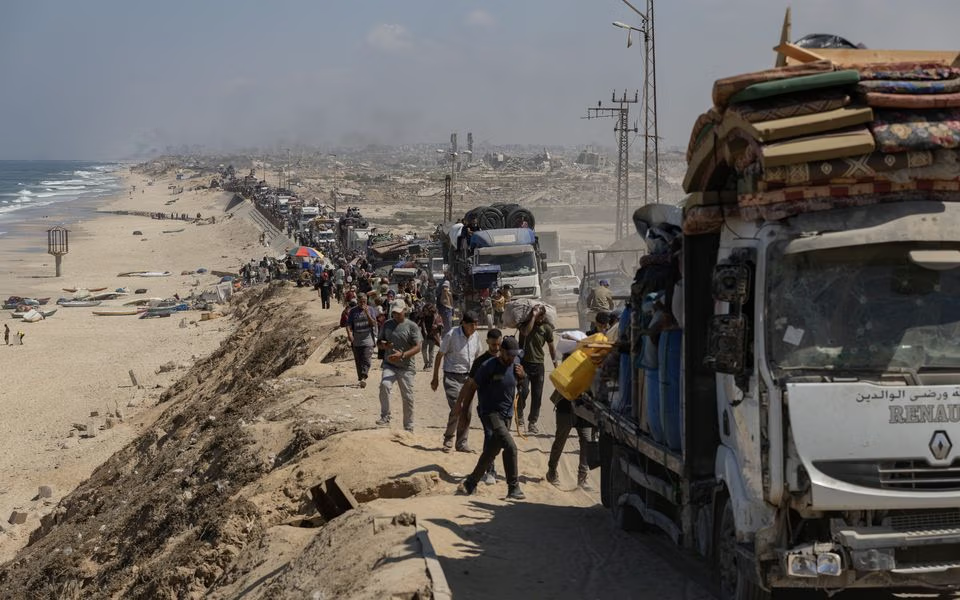
In the august halls of Brussels, the language employed by the European Union’s leading diplomat, Josep Borrell, is as stark as it is unambiguous. He speaks with gravitas of a “man-made famine” and a “humanitarian catastrophe” unfolding in Gaza, wielding the full rhetorical force of the EU’s moral megaphone. This powerful articulation reflects Europe’s foundational commitment to human rights and international law, yet on the more pragmatic geopolitical stage, where concrete actions carry far more weight than impassioned words, Europe’s collective voice tragically diminishes into a hesitant murmur of indecision. The relentless and agonizing conflict in Gaza has relentlessly exposed a deep and increasingly crippling fracture within the European Union, laying bare a bloc that possesses the intellectual capacity to diagnose a crisis with stark, undeniable clarity but appears tragically paralyzed when it comes to prescribing and implementing a meaningful, unified cure.
This growing predicament is not merely a failure of immediate policy or strategic misstep; it represents a profound crisis of identity for the entire European project. The EU, an entity that has meticulously crafted its global image as a beacon of multilateralism, a normative power guided steadfastly by human rights, and an unwavering champion of international law, now finds itself disturbingly unable to forge a coherent and unified stance on one of the most urgent and devastating humanitarian issues of our contemporary era. This internal incoherence deeply compromises its aspirational role as a global moral authority and an effective geopolitical actor. The very core of this debilitating problem lies in the ever-widening chasm between the divergent priorities and historical sensitivities of its 27 sovereign member states.

On one side of this fundamental divide, a growing number of influential nations, including Spain, Ireland, and Belgium, are progressively pushing for a significantly tougher diplomatic line on Israel. Their advocacy extends beyond mere calls for immediate cease-fires; it encompasses serious discussions about leveraging the EU’s considerable economic and political power, and even overtly floating the recognition of a Palestinian state as a tangible step towards a two-state solution. Their positions are often rooted in a strong humanitarian imperative, historical solidarity with the Palestinian cause, and a firm belief in the consistent application of international law, which they argue should apply equally to all parties in a conflict.
On the opposing side stands a powerful and historically entrenched camp, prominently led by Germany, Austria, and the Czech Republic, which maintains an unwavering and steadfast commitment to Israel’s security. This deep-seated support is profoundly and indelibly shaped by the immense historical weight and moral imperative of the Holocaust, forging a unique bond and a deep sense of responsibility towards the state of Israel’s existence and security. For these nations, any robust criticism of Israeli actions or proposals for punitive measures are viewed through a lens of extreme caution, often perceived as potentially undermining Israel’s fundamental right to defend itself, a right they consider sacrosanct given their own historical trauma.
Historical Echoes and National Interests Shaping Europe’s Stance
The stark dichotomy in Europe’s Gaza policy is thus a complex tapestry woven from diverse historical narratives, deeply held national interests, and differing interpretations of international obligations. For countries like Germany, the concept of “Staatsräson” – reason of state – directly links German identity and its post-war moral compass to the security of Israel. This deep-seated commitment means that proposals for economic sanctions or conditioning trade agreements are met with profound resistance, viewed not just as policy disagreements but as potential moral transgressions. Conversely, nations like Ireland and Spain, with their own histories of struggle against occupation or colonialism, often resonate more strongly with the Palestinian narrative, advocating for self-determination and upholding the rights of occupied peoples. This fundamental divergence in historical perspective and national strategic interests creates an almost insurmountable barrier to a truly unified European foreign policy. The inability to reconcile these powerful, often emotionally charged, national narratives profoundly impacts the EU’s capacity to act cohesively and decisively on the international stage, transforming critical foreign policy discussions into fraught internal battles.
From Rhetoric to Reality: The EU’s Paralysis in Action on Gaza
The immediate and most visible consequence of this profound internal division is a debilitating political stalemate that renders the European Union largely ineffective as a significant global actor in the Gaza conflict. While EU officials engage in considerable rhetoric condemning the violence and lamenting the humanitarian crisis, their tangible actions often fall short, constrained by the necessity of consensus among its 27 diverse member states. The gap between the EU’s stated values and its practical application on the ground has never been more apparent, leading to widespread accusations of hypocrisy and a significant erosion of its moral authority. The persistent failure to bridge this chasm underscores a fundamental weakness in the EU’s common foreign policy mechanisms, particularly when confronted with issues that touch upon deep historical sensitivities and divergent national security priorities.
Symbolic Gestures vs. Real Economic Leverage
A prime example of this paralysis is the discussion surrounding sanctioning violent Israeli settlers. While such a move might carry some symbolic weight, demonstrating a degree of disapproval, it is often seen as a largely token gesture in the face of a rapidly deteriorating humanitarian situation and continued conflict. Crucially, the bloc finds itself utterly incapable of even initiating a serious conversation about leveraging its real, substantial economic and political power through broader economic sanctions against Israel or, more significantly, conditioning its vital trade agreement with Israel – the EU-Israel Association Agreement. This agreement provides Israel with privileged access to the world’s largest single market. The sheer economic power the EU wields, if applied collectively, could serve as a formidable tool for de-escalation and adherence to international law. However, the requirement for unanimity among member states effectively grants a veto to those steadfastly opposed to any measure that might be perceived as punitive towards Israel, thus neutering the EU’s most potent diplomatic and economic instruments.
Even within the United Nations, the disarray among EU members is strikingly evident and deeply problematic. On numerous occasions, when resolutions advocating for a cease-fire or condemning specific actions in Gaza are brought before the UN General Assembly or Security Council, the 27 member states visibly splinter their votes. This public display of disunity—a cacophony of competing voices and diverging positions—ensures that the EU’s collective stance is consistently reduced to the lowest common denominator. This typically translates into vague calls for restraint from all parties and pledges of humanitarian aid, without the requisite political muscle or unified diplomatic pressure to compel genuine adherence to international humanitarian law or to force a sustainable resolution. This internal discord at such a crucial global forum significantly diminishes the EU’s standing and influence, undermining its claims of being a unified, values-driven actor on the world stage.
Eroding Credibility: The Global Ramifications of EU’s Inaction
Looking ahead, this persistent paralysis in responding cohesively to the Gaza crisis carries profoundly significant and potentially long-lasting consequences for Europe’s role and reputation in the world. The stark and undeniable contrast between the EU’s swift, unified, and punishing response to Russia’s unprovoked invasion of Ukraine and its markedly hesitant, deeply divided, and often ineffective approach to the Gaza conflict has not gone unnoticed by the international community. This perceived double standard is particularly damaging to the EU’s standing in the Global South, where it is increasingly viewed as applying its cherished values selectively, based on geopolitical convenience rather than universal principles.
Double Standards and the Global South’s Perspective
Across the diverse nations of the Global South, accusations of double standards are now widely circulating and rapidly eroding Europe’s long-cultivated credibility as a neutral arbiter, a consistent champion of international law, and a steadfast proponent of a rules-based international order. The message being inadvertently, or perhaps intentionally, sent is that the application of European values – such as sovereignty, human rights, and the protection of civilians – is conditional and selective, heavily dependent on who is being aggressed upon and who the aggressor is. For many developing nations, whose histories are often marked by colonialism or external interference, this selective moral compass reinforces existing skepticism about Western powers and undermines the EU’s soft power influence. This damages diplomatic relationships, hinders collaboration on other critical global issues like climate change or sustainable development, and ultimately pushes these nations to seek alliances with other emerging global powers less burdened by perceived moral inconsistencies.
The perceived hypocrisy not only undermines the EU’s standing but also weakens the very fabric of the international system it purports to uphold. If the EU, a major global player, demonstrates that international law can be applied inconsistently, it sets a dangerous precedent for other nations. This erosion of trust jeopardizes multilateral efforts and strengthens the arguments of those who contend that the international order is rigged against certain states or regions. The long-term implications for global governance, peace, and security are substantial, as the EU’s ability to advocate for universal principles is directly tied to its perceived consistency and integrity on the global stage.
The Future of European Foreign Policy: A Fractured Path Ahead
Ultimately, the escalating crisis in Gaza is proving to be a critical stress test that the EU’s fledgling common foreign policy is unequivocally failing. This period of intense geopolitical pressure is revealing fundamental structural weaknesses and ideological cleavages that threaten the very concept of a unified European voice on the world stage. If the bloc cannot summon the political will and collective resolve to act decisively and consistently when its purported core values of human rights, international law, and humanitarian protection are so explicitly and gravely at stake, it risks permanently confirming that it is less a cohesive, values-driven global actor and more a loose collection of disparate national interests, each pulling in its own direction.
Challenges to EU Unity and Effectiveness
The institutional design of the EU’s Common Foreign and Security Policy (CFSP), which largely relies on unanimity for significant foreign policy decisions, is proving to be a major impediment. While designed to protect national sovereignty, this requirement effectively grants every member state a veto, paralyzing the collective body when faced with deeply divisive issues like the Israel-Palestine conflict. This structural rigidity, coupled with the profound historical and geopolitical differences among member states, makes it incredibly challenging for the EU to articulate and implement a proactive, coherent strategy. Instead, it is often relegated to reactive statements and minimal actions, failing to live up to its potential as a global power. The internal divisions extend beyond policy specifics to fundamental questions of moral priority and strategic alignment, exacerbating the difficulty in achieving consensus.
The Rise of “Coalitions of the Willing” and EU Fragmentation
In the absence of a unified, robust EU response, the future may increasingly see the emergence and rise of smaller “coalitions of the willing” within the EU. This phenomenon is already manifesting as individual member states, such as Spain, Ireland, and Belgium, find themselves compelled to pursue their own independent diplomatic policies and make their own sovereign decisions – for instance, regarding the recognition of a Palestinian state – in the stark absence of any overarching EU-wide consensus or collective action. While such independent initiatives might achieve specific, localized diplomatic goals or allow individual nations to uphold their particular values, they will inevitably further undermine the very idea and foundational principles of a strong, coherent, and unified European voice on the complex and interconnected world stage. This fragmentation risks weakening the EU’s overall influence and allowing other global powers to exploit its internal divisions, diminishing its capacity to champion its values and interests effectively.
The existential question emanating from this crisis is no longer merely what Europe will ultimately do for the suffering people of Gaza, but rather, what this protracted and deeply divisive crisis is fundamentally doing to Europe itself, and to the future trajectory of its ambitious project of political and moral unity.
What are the long-term implications for the European Union’s global standing and its internal cohesion if it continues to struggle to reconcile its core values with its foreign policy actions on critical humanitarian issues?