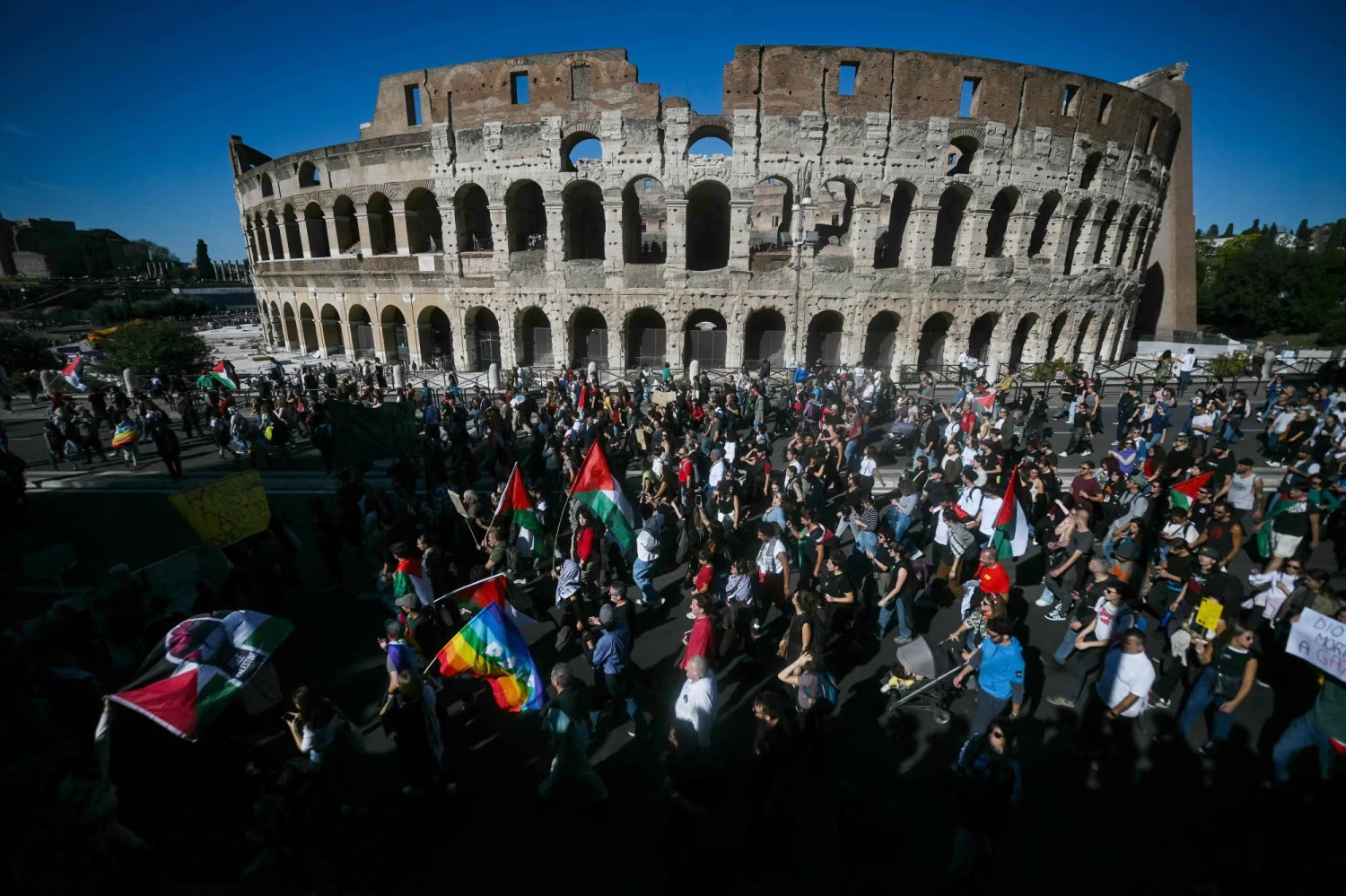
Europe’s Streets Roar for Palestine: A Political Reckoning for the Continent
The historic avenues of London, Paris, and Berlin, long the backdrop for Europe’s own political dramas, were transformed this weekend into a vast, unified stage for a conflict thousands of miles away. As hundreds of thousands of people marched in support of the Palestinian cause, their message was directed not only at the Middle East but squarely at the leaders in their own capitals. This was more than a protest; it was a powerful public rebuke of Europe’s official foreign policy regarding the Israeli-Palestinian conflict, and a clear sign of a political chasm that is becoming increasingly impossible for governments to ignore.
While protests concerning the Palestinian question are not entirely new to European cities, the sheer scale, simultaneous coordination, and diverse demographic participation of these recent demonstrations signal a critical and profound shift. This is no longer a fringe issue confined to specific communities or activist circles; it has unequivocally evolved into a mainstream movement. It is now capable of mobilizing a significant and broad cross-section of European society, transcending typical political divides and ethnic backgrounds. The vast sea of flags and banners, carried by young and old alike, by students, professionals, and families, tells a compelling story of a public conscience increasingly at odds with the cautious, often contradictory, and frequently perceived as inadequate, diplomatic stances of their respective governments.

The core demands articulated by these countless voices—an immediate and unconditional ceasefire in Gaza, unimpeded and sufficient humanitarian access to a besieged population, and a renewed, robust push for a just and lasting political solution rooted in international law—are not radical propositions within the framework of global diplomacy. Yet, they profoundly challenge a diplomatic status quo that has prevailed for decades, a status quo often seen as prioritizing geopolitical stability and traditional alliances over human rights and international justice. This collective demand for accountability and action represents a powerful call for Europe to live up to the values it frequently espouses on the global stage, urging its leaders to translate rhetoric into meaningful policy changes.
So, what does this massive outpouring of public sentiment mean for the future of Europe’s foreign policy and its internal political landscape?
Immense Pressure on European Leaders
First and foremost, these unprecedented demonstrations place immense and immediate pressure on European leaders, forcing them onto a precarious political tightrope. They must now delicately balance their long-standing alliances and complex geopolitical interests, particularly concerning the Middle East and their relationship with the United States, with the undeniable and increasingly vocal demands of their own electorate. Ignoring such a vast and widespread mobilization carries significant political risks, threatening to alienate a substantial portion of the population, especially the younger generations who are increasingly shaping the political discourse through their adept use of social media and persistent grassroots activism.
The images from this weekend are not just fleeting news clips destined for momentary consumption; they are potent political capital. For opposition parties, these scenes offer powerful ammunition to critique incumbent governments’ foreign policy decisions and their perceived detachment from public opinion. For ruling coalitions, often fragile and diverse, these protests create internal divisions and present a severe headache as they struggle to maintain a united front on sensitive international issues. The credibility of democratic institutions is also at stake; if citizens feel their concerns are systematically dismissed by their elected representatives, it risks eroding trust in the democratic process itself.
Moreover, this pressure isn’t merely theoretical. It translates into real-world challenges for governments. Leaders face heightened scrutiny in parliamentary debates, increased media questioning, and a greater demand for transparency and justification of their diplomatic positions. Decisions made in distant capitals are now scrutinized on local streets, linking international affairs directly to domestic politics and public accountability. This public sentiment can directly influence electoral outcomes, compelling politicians to rethink their approach to avoid a backlash at the ballot box. The concept of European solidarity, often touted, is tested when differing national stances on such a critical issue emerge, creating a complex web of internal political dynamics that further complicates a unified European response.
Potential Recalibration of European Foreign Policy
Second, this groundswell of public opinion signals a potential, and arguably overdue, recalibration of European foreign policy. For many years, Europe has often been perceived as following the diplomatic lead of the United States on the Israeli-Palestinian conflict, adopting a more cautious and less assertive stance compared to its own stated values. This new, powerful public voice could fundamentally empower a more independent and assertive European voice on the world stage, one that is less tethered to historical precedents and more responsive to humanitarian imperatives and international law.
As leaders feel the intense heat from their citizens, they may be more inclined to advocate for stronger and more decisive resolutions at the United Nations, demanding an immediate ceasefire and the protection of civilians. This could involve applying greater diplomatic pressure through various channels, moving beyond mere rhetoric to tangible actions such as specific diplomatic initiatives, aid conditionality, or even considering targeted sanctions against those impeding humanitarian efforts or violating international norms. The prospect of Europe carving out a distinct ethical foreign policy, one that aligns more closely with its self-proclaimed role as a champion of human rights and international law, becomes a more realistic possibility.
The power of the street is undeniably forcing a conversation in the hallowed halls of power that many had previously tried to avoid or defer. Civil society organizations, human rights advocates, and grassroots movements are now bolstered by this vast public backing, making it much harder for policymakers to ignore their calls for action. This recalibration could see Europe taking a more proactive role in mediating a lasting peace, advocating for a viable two-state solution that respects the dignity and rights of both Palestinians and Israelis, and ensuring the delivery of crucial humanitarian assistance without political obstruction. It presents an opportunity for Europe to assert its moral authority and strategic independence, potentially reshaping its standing in the global geopolitical landscape.
Ultimately, these massive marches are a vivid and undeniable illustration that foreign policy is no longer a distant, elite-driven affair, disconnected from the daily lives of ordinary citizens. In our profoundly interconnected world, conflicts abroad resonate deeply at home, becoming intrinsically intertwined with domestic questions of identity, social justice, and the very fundamental values Europe claims to champion – human rights, democracy, and adherence to international law. The hundreds of thousands who marched this weekend have done more than simply demand change elsewhere; they have thrown down a profound challenge to their own leaders, asking whether their governments truly represent the will of the people and the ethical compass of their nations.
How European governments choose to respond to this powerful wave of public sentiment will define not only Europe’s future role and influence in the Middle East but also, perhaps more critically, the health, legitimacy, and democratic vitality of its own institutions in the eyes of its citizens.
Read the original story at The Japan Times.
What steps do you believe European leaders should prioritize to bridge the gap between public sentiment and their current foreign policy on the Israeli-Palestinian conflict?