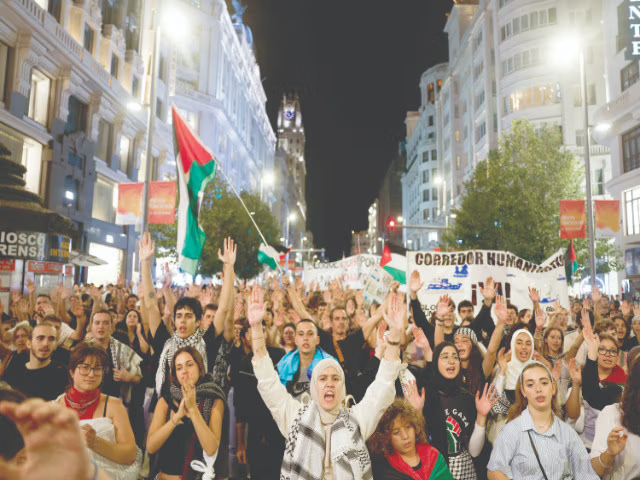
The European Streets Speak: A Political Reckoning on Palestine Policy
From the rain-slicked avenues of London to the historic boulevards of Berlin and the sun-drenched squares of Madrid, a single, resonant chant is echoing with unprecedented force: “Free Palestine.” What was once a cause largely championed by dedicated activist circles and specific segments of the population has now erupted into a truly mass movement, a seismic political phenomenon that is compelling the entire European continent to confront its conscience, its long-standing foreign policy, and its foundational values. The recent, sustained wave of pro-Palestine demonstrations sweeping across Europe is far more than just a series of protests; it represents a fundamental and undeniable challenge to the established political order and the traditional diplomatic calculus.
The sheer scale, unwavering persistence, and widespread geographical reach of these *pro-Palestine demonstrations in Europe* are what unequivocally set this current moment apart. We are not merely witnessing isolated weekend marches that dissipate with the news cycle, but rather a robust, sustained, and truly continent-wide mobilization that has rapidly become a defining and unavoidable feature of Europe’s contemporary political landscape. As extensively reported by various outlets, major capitals from Paris to Rome, Copenhagen to Dublin, have consistently seen tens of thousands, sometimes hundreds of thousands, of citizens take to the streets. These demonstrators remain undeterred by official bans in some jurisdictions, or by the sometimes harsh rhetoric from political leaders. This pervasive act of civil disobedience, particularly notable in places like Germany where historical sensitivities often limit such public expressions, signals a profound and growing disconnect between the serene corridors of power and the fervent will of a significant, vocal, and increasingly organized segment of the populace. This collective outcry is forcing *European governments* to reassess their stance on the *Israeli-Palestinian conflict* and the moral implications of their *foreign policy decisions*.

Shattering the Old Paradigm: A Grassroots Foreign Policy Referendum
The key takeaway here is not just the impressive numbers of participants, but the clear and unambiguous message they collectively carry. This is, in essence, a *grassroots foreign policy referendum* playing out in real-time on Europe’s boulevards and plazas. For decades, *European governments* have meticulously navigated the complexities of the *Israeli-Palestinian conflict* with a carefully calibrated diplomacy, often seeking to align themselves with the United States’ position while issuing tempered, often abstract, calls for a *two-state solution*. That delicate, often ambiguous, balance is now irrevocably shattering under the crushing weight of public outrage and moral indignation, fueled by the staggering and continuously rising *death toll in Gaza* and the unfiltered, often brutal, reality of the conflict streaming onto social media feeds directly into the homes and consciousness of millions. The *European protests* represent a generation, and indeed a broader swathe of society, that is bypassing traditional diplomatic channels, rejecting the incrementalism of past policy, and loudly demanding moral clarity over geopolitical nuance and strategic expediency. They are asserting that *public opinion in Europe* must play a decisive role in shaping the continent’s stance on critical international issues.
This unprecedented mobilization is driven by several converging factors. The sheer scale of the humanitarian crisis in Gaza, with its devastating impact on civilian lives, infrastructure, and access to basic necessities, has resonated deeply across European societies. Unlike previous conflicts, the ubiquity of smartphones and social media platforms has ensured that images and videos from Gaza are instantly accessible, creating a visceral and immediate connection that traditional news cycles often failed to achieve. This direct access to information has allowed citizens to form their own opinions, often diverging sharply from official government narratives, leading to a profound sense of disillusionment and a demand for greater accountability from their elected representatives regarding *European foreign policy on Palestine*. The perceived double standards, where condemnations for other conflicts are swift and strong, but responses to actions in Gaza are seen as muted or complicit, has also fueled a deep sense of injustice.
European Leaders Face an Intractable Dilemma: Reconciling Alliances with Public Will
Looking ahead, this powerful *mass movement for Palestine* presents *European leaders* with an increasingly intractable dilemma. How do they effectively reconcile their deeply entrenched historic alliances and security concerns – particularly with the United States and, by extension, Israel – with the undeniable democratic imperative to listen to, and act upon, the clear will of their citizens? The pressure on *European governments* is no longer merely external; it has evolved into a potent, unignorable domestic force that directly impacts electoral prospects and national cohesion. We are already witnessing the first, significant signs of this profound political shift, with nations like Spain, Ireland, and Norway formally recognizing a *Palestinian state* – a diplomatic move that would have been almost unthinkable and politically perilous just a year ago. This is not a coincidence or an isolated policy decision; it is a direct and unmistakable consequence of the burgeoning *groundswell of public opinion* that refuses to be silenced or ignored. These nations, often with strong historical empathy for struggles against occupation, are demonstrating a willingness to challenge established norms, responding to the growing demand for a more ethically driven and independent *EU foreign policy*.
The Domestic Political Fallout: A Shifting Landscape
The internal debates within various European Union member states are becoming increasingly fractious. Governments are finding themselves caught between the demands of traditional allies and the passionate calls of their own electorates. The political costs of ignoring the *pro-Palestine protests in Europe* are rapidly escalating. For many mainstream political parties, particularly those reliant on the votes of younger generations and diverse urban populations, maintaining a status quo foreign policy position on the Israeli-Palestinian conflict is becoming an electoral liability. We are seeing a new calculus emerge, where neglecting domestic public sentiment on this issue can directly translate into lost votes and diminished political legitimacy. This shift underscores how foreign policy, traditionally a domain insulated from direct public participation, is increasingly being shaped by citizen activism and the demands of an engaged populace. The conversations within parliaments and ministries are now mirroring the intensity of the street, forcing a re-evaluation of long-held assumptions and allegiances.
Profound Implications: Reshaping Electoral Politics and Global Diplomacy
The future implications of this sustained *pro-Palestine movement in Europe* are truly profound and extend far beyond the immediate horizon. This movement has the very real potential to fundamentally reshape *electoral politics* across the continent, compelling mainstream parties to urgently recalibrate their long-standing positions on the Middle East or risk alienating a growing and increasingly politically active bloc of voters, particularly among the young, who are often more global-minded and less tethered to Cold War-era geopolitical alignments. The youth vote, increasingly mobilized and informed by global events, is becoming a formidable force that can no longer be overlooked. Furthermore, it emphatically signals a new era where *foreign policy is no longer the exclusive domain of diplomats* and heads of state, conducted behind closed doors. The streets have emphatically found their voice, and they are demanding a legitimate say in how their nations act on the world stage, especially concerning issues of *human rights, international law*, and global justice. This democratisation of foreign policy decision-making marks a significant departure from historical norms.
A Continent Remade: From the Pavement Up
This is a powerful assertion of democratic will, challenging the very foundations of how foreign policy is conceptualized and executed. It suggests a future where European nations might adopt more independent, principled foreign policy stances, less bound by traditional alliances and more attuned to international law and human rights. This shift could significantly alter Europe’s standing on the global stage, potentially positioning it as a stronger advocate for universal justice and a more critical voice against perceived injustices, irrespective of political friendships. The question is no longer *if* European policy on the Middle East will change, but rather how quickly these transformations will occur, and which political actors and parties will be astute enough to adapt, or conversely, be left behind by the rapidly shifting political tides. The continent is not just “reeling” under the weight of these *pro-Palestine protests*; it is being actively and irrevocably remade from the pavement up, forged by the collective will of its citizens. This historic awakening promises to redefine Europe’s moral compass and its role in a complex, interconnected world.
Read the original story at The Express Tribune.
As Europe grapples with this powerful surge of public opinion, how do you foresee the balance between historical alliances and democratic demands shaping the future of European foreign policy?