Navigating the Storm: Von der Leyen’s State of the Union is a Battle Plan for Europe’s Future
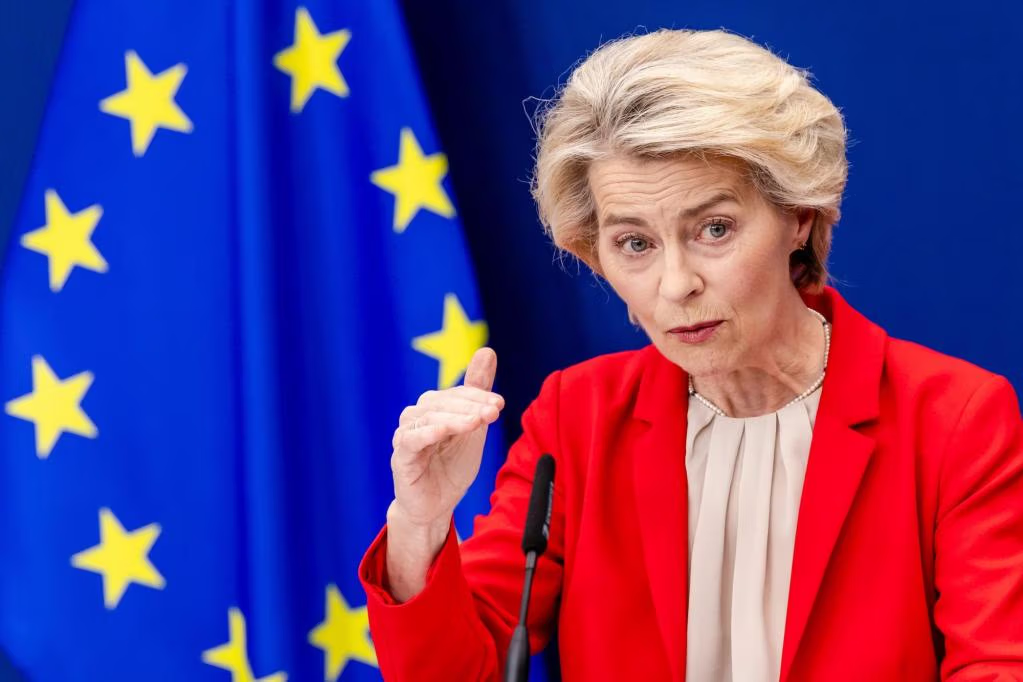
When European Commission President Ursula von der Leyen steps up to the podium for her annual State of the European Union address, she won’t just be delivering a speech. She will be attempting to chart a course through a perfect storm of geopolitical, economic, and ideological challenges that are testing the very foundations of the 27-nation bloc. This is far more than a political report card; it’s a high-stakes blueprint for a continent at a crossroads, demanding not just vision, but concrete strategies to safeguard Europe’s future and reinforce its role on the global stage.
The address comes at a moment of profound transformation for the European Union. The remarkable unity forged in the crucible of Russia’s invasion of Ukraine remains a significant achievement, a testament to the bloc’s capacity for collective action in crisis. However, the subsequent energy crisis, persistent inflation that erodes household incomes, and the grinding realities of a prolonged war on its doorstep are undeniably fraying nerves from Lisbon to Warsaw. These pressures expose the delicate balance between ambition and pragmatism, solidarity and national interest. Von der Leyen’s formidable task is to reaffirm that hard-won solidarity while simultaneously offering a credible, actionable path forward on the defining issues of our time, ensuring the EU remains a beacon of stability and prosperity in an increasingly volatile world.
Her speech is therefore a critical inflection point, an opportunity to reset the narrative and mobilize political will across the Union. It’s a moment when the EU must confront its internal divisions, strengthen its external resolve, and demonstrate to its citizens that it has robust answers to their most pressing concerns regarding security, prosperity, and climate action. As the world watches, her words will be dissected for signs of both continuity and innovation, hope and realism. Here are the key takeaways to watch for and what they signal for the future direction of the European project:
The Geopolitical Reality Check: From Aid to Enlargement
The war in Ukraine will inevitably dominate much of the discourse surrounding the State of the European Union address, but the focus is profoundly shifting. While the initial response centered on immediate sanctions, humanitarian aid, and military support, the conversation is no longer just about crisis management. It’s about the monumental, bloc-altering question of EU enlargement – specifically, how the EU can realistically integrate Ukraine, Moldova, and nations in the Western Balkans without sacrificing its own institutional integrity or diluting its core values. This is a delicate balancing act, one that carries immense strategic implications for Europe’s long-term security, economic stability, and global standing.
A clear, credible path to membership offers a powerful incentive for these aspiring nations to undertake deep-seated democratic and economic reforms, serving as a vital bulwark against Russian influence and fostering regional stability. For Ukraine and Moldova, the prospect of EU membership provides a powerful anchor to the democratic West, crucial for their post-war reconstruction and national sovereignty. For the Western Balkans, it renews a long-stalled promise, essential to preventing further instability and external interference in a historically volatile region. Von der Leyen will need to articulate a vision that combines this strategic imperative with practical, step-by-step measures, signaling both unwavering commitment and necessary caution regarding the pace and conditions of integration.
However, the challenges are formidable. Integrating new members, especially those with complex economic and political histories and significant development gaps, raises thorny questions that strike at the very heart of the EU’s operational framework. The current decision-making processes, often reliant on unanimity in sensitive areas like foreign policy or taxation, could become even more unwieldy and prone to paralysis with additional members. Furthermore, the financial implications are staggering. Enlargement would necessitate significant reforms to the EU’s multi-annual budget, common agricultural policy, and structural funds, potentially redirecting resources from existing member states. This could ignite fierce debates over burden-sharing and national contributions, demanding a bold but pragmatic approach to financing the future of an expanded Union and ensuring that all members benefit from a more cohesive bloc.
Von der Leyen’s words will therefore be a litmus test for the EU’s long-term strategic ambition and its capacity for self-reform. Will the Union prioritize geopolitical necessity and seize a historic opportunity to extend its zone of peace and prosperity, or will internal resistance to institutional and financial adjustments prevail? Her address must offer concrete proposals on how the EU plans to evolve its institutions, its budget, and its approach to rule of law oversight to accommodate new members, ensuring that enlargement strengthens, rather than weakens, the European project. It’s about envisioning a larger, more robust Europe capable of projecting its values and protecting its interests on the global stage, solidifying its place as a key geopolitical player in a multipolar world.
The Green High-Wire Act: Competitiveness vs. Climate
Europe’s ambitious Green Deal—its groundbreaking plan to become the first climate-neutral continent by 2050—is facing a powerful economic and political backlash. Initially hailed as a visionary framework for sustainable growth and a global benchmark for environmental action, it is now confronting the harsh realities of implementation in a turbulent global economy. With European businesses feeling the intense pressure of high energy costs, exacerbated by the war in Ukraine, and fierce global competition, particularly from highly subsidized industries in the U.S. (via the Inflation Reduction Act) and China, a potent narrative is growing: that the green transition is coming at the unacceptable expense of European industry, jobs, and overall economic competitiveness.
Ursula von der Leyen must perform a delicate high-wire act: she needs to unequivocally recommit to the EU’s foundational climate goals while simultaneously proving she has a robust, credible plan to bolster European economic competitiveness. This dual imperative demands an industrial strategy that accelerates decarbonization without deindustrialization. Expect to hear proposals aimed at directly addressing the concerns of businesses and citizens. This includes, but is not limited to, securing critical raw materials essential for green technologies, such as lithium, cobalt, and rare earths, often through diversified sourcing, strategic partnerships, and increased domestic extraction and processing capabilities within the EU to reduce strategic dependencies. Boosting clean tech manufacturing within the EU, from solar panels and wind turbines to batteries and hydrogen electrolysers, will be another key focus, aiming to foster innovation, create high-value jobs, and ensure Europe remains at the forefront of the green industrial revolution.
Furthermore, cutting red tape and streamlining permitting processes for renewable energy projects and clean industrial investments will be paramount. Businesses frequently cite bureaucratic hurdles and slow approval times as major impediments to scaling up green innovations and attracting necessary capital. Von der Leyen’s speech must articulate how the EU can create a more agile, attractive investment environment for green technologies, ensuring that Europe remains a leader, not just a market, for the global energy transition. This will involve significant public and private investment, leveraging existing mechanisms like the Green Deal Industrial Plan and potentially exploring new common funding instruments to level the playing field against global competitors.
How von der Leyen frames this delicate balance will be absolutely crucial in countering the rise of the populist right across Europe. These political forces have skillfully seized on concerns over energy costs, inflation, and perceived over-regulation to rally voters ahead of next year’s pivotal European Parliament elections. Her message must demonstrate that the Green Deal is not just an environmental imperative but also a profound economic opportunity, a strategy for future prosperity, energy security, and technological sovereignty. It’s about building a sustainable economy that is resilient, competitive, and fair for all Europeans, effectively disarming the arguments of those who seek to roll back climate ambition in the name of economic expediency and short-term gains.
The Unspoken Campaign: Securing a Second Term
Underneath every policy proposal, every strategic pronouncement, and every ambitious vision outlined in Ursula von der Leyen’s State of the European Union address, there will be a powerful, unmistakable undercurrent: her undeclared but widely anticipated bid for a second five-year term as European Commission President. This speech is not merely an annual policy review; it is her primary platform, arguably her most significant political moment of the year, to convince European leaders, the broader European public, and her own political family that she is indeed the steady, visionary hand needed to navigate the turbulent waters ahead.
To secure a second mandate, von der Leyen must project an unshakeable combination of strength, strategic vision, and an unparalleled ability to hold the diverse, often-fractious coalition of 27 member states together. Her performance will be scrutinized not just for the substance of her policy announcements, but for the tone, conviction, and leadership qualities she exhibits. She must demonstrate that she can effectively manage the competing national interests that constantly threaten to pull the EU apart, finding common ground on issues ranging from migration and fiscal policy to defense and digital regulation. This requires not only acute political acumen but also deep diplomatic skill and the capacity to forge consensus among disparate viewpoints.
Every phrase, every emphasis, and every omission in her address will be meticulously analyzed by political pundits, national capitals, and potential rivals. It will be viewed not just as a policy statement, but as a crucial pillar in her evolving campaign to remain at the helm of the European project. She will need to highlight past achievements – from the EU’s unified response to the pandemic and its vaccine strategy, to the swift and robust reaction to Russia’s aggression in Ukraine, and the rollout of the NextGenerationEU recovery fund – while acknowledging the challenges that remain and outlining a clear, forward-looking path. The speech must present a compelling narrative of continuity and competence, positioning her as the indispensable leader for Europe’s next chapter of stability and growth.
Her ability to articulate a compelling vision for Europe’s future – one that resonates with citizens and reassures national governments – will be paramount. This includes addressing pressing concerns about the rising cost of living, ensuring equitable benefits from the green and digital transitions, and strengthening Europe’s role as a coherent and influential global actor. The path to a second term is complex, requiring the support of a qualified majority of national leaders in the European Council, followed by a vote of approval in the newly elected European Parliament after the 2024 elections. This speech, therefore, is a pivotal moment to lay the groundwork, shape perceptions, and consolidate support, positioning her as the essential and experienced leader for Europe’s complex future.
Ultimately, this State of the European Union address is less about celebrating past achievements and more about bracing for future shocks. It is an ambitious attempt to forge a coherent narrative for a Europe that is being forced to become a more muscular, independent global player, capable of defending its interests and projecting its values in a multipolar world. The real test, however, won’t be in the applause that follows the speech, but in whether its ambitious vision can survive the inevitable collision with deeply entrenched national interests, persistent economic headwinds, and the democratic will of the voters in the crucial months and years to come.
Read the original story at Ocregister.
What specific challenges do you believe pose the greatest threat to European unity and how do you think Ursula von der Leyen’s proposed strategies will address them?