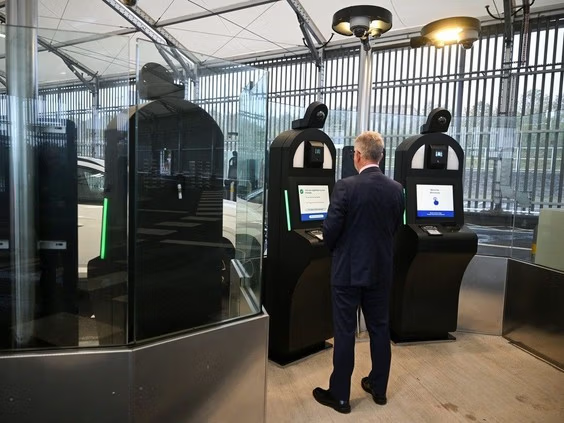
For years, the familiar thud of a passport stamp has been a cherished ritual for travelers entering Europe, a tangible mark of a journey begun. That analog tradition, however, is on borrowed time. The European Union has been painstakingly constructing a vast, digital fortress to modernize its borders—a project that has just hit another significant delay, pushing its anticipated launch into the latter half of 2025.
This isn’t just a minor scheduling conflict; it’s a revealing glimpse into the immense political, technical, and logistical challenges of building a unified, 21st-century border for a 27-nation bloc, specifically regarding the EU’s ambitious new border system. The repeated postponements of the European Entry/Exit System (EES) and the European Travel Information and Authorisation System (ETIAS) highlight the sheer complexity of harmonizing security protocols and digital infrastructure across diverse sovereign states.

At the heart of the matter are these two interconnected systems: the Entry/Exit System (EES) and the European Travel Information and Authorisation System (ETIAS). The EES is the cornerstone, an automated system designed to replace manual passport stamping. It will register non-EU travelers by collecting biometric data—specifically fingerprints and facial scans—each time they enter or leave the Schengen Area. Its sibling, ETIAS, is a pre-travel authorization program, conceptually similar to the ESTA used by the United States, requiring visitors from visa-exempt countries like Canada, the U.S., and the U.K. to apply for clearance online before they even book a flight to Europe.
The key takeaway from this latest postponement is that the future of international travel, while inevitable in its digital evolution, is proving far more intricate and challenging to implement than initially anticipated by Brussels. This delay doesn’t just push back a launch date; it signifies deeper issues within the EU’s border modernization efforts and offers critical insights into the road ahead for travelers and member states alike.
Understanding the EU’s Digital Border Initiative: EES and ETIAS Explained
The European Union’s move towards digitized borders is a strategic response to evolving security threats, increased irregular migration, and the need for more efficient management of travelers entering and exiting the Schengen Area. These systems aim to bolster external border security, prevent overstaying, and streamline legitimate travel. Understanding their individual functions is crucial to grasping the magnitude of the delay.
The Entry/Exit System (EES): A Biometric Revolution for EU Border Control
The EES represents a profound shift in how non-EU citizens will interact with Europe’s borders. Designed to automatically register travelers from outside the EU/Schengen area each time they cross an external border, EES will collect biometric data, including facial images and four fingerprints. This data will be stored in a centralized database managed by EU-LISA, the EU agency responsible for large-scale IT systems in the area of freedom, security and justice. The primary goal of EES is to accurately track the entry and exit dates of third-country nationals, making it easier to identify and prevent overstayers of the short-stay allowance (typically 90 days within any 180-day period).
The technical demands of the EES are immense. It requires the installation of new equipment—such as self-service kiosks, e-gates, and updated border guard terminals—at thousands of border crossing points across the 27 EU member states and four Schengen-associated countries (Iceland, Liechtenstein, Norway, Switzerland). This includes major international airports, bustling seaports, and numerous land border crossings. Ensuring seamless interoperability between national systems and the central EU database, along with robust data protection mechanisms, presents significant IT and logistical hurdles. For travelers, this means a potentially different, more data-intensive arrival and departure process, shifting from manual passport checks to automated biometric verification.
The European Travel Information and Authorisation System (ETIAS): Pre-screening for Enhanced Security
Complementing the EES, the European Travel Information and Authorisation System (ETIAS) is designed to pre-screen visa-exempt visitors before their journey to the Schengen Area. Modeled on systems like the U.S. ESTA or Canada’s eTA, ETIAS requires travelers from approximately 60 visa-exempt countries (including the U.S., Canada, U.K., Australia, New Zealand, Japan, etc.) to obtain online authorization prior to their trip. This authorization is not a visa but a security clearance, intended to identify potential security, irregular migration, or high epidemic risks before an individual even boards a flight or vessel to Europe.
The application process for ETIAS will be online, involving a small fee, and is expected to be straightforward for most applicants, with approvals typically granted within minutes. Once approved, an ETIAS authorization will be valid for three years or until the traveler’s passport expires, whichever comes first, allowing for multiple short stays (up to 90 days in any 180-day period) in the Schengen Area. This system provides an additional layer of security by allowing authorities to vet travelers against various EU and international security databases prior to their departure, significantly enhancing the EU’s capacity for external border management and threat detection.
The Sheer Scale of a Techno-Political Behemoth: Unpacking EU Border Modernization Challenges
The repeated delays in the launch of the EU’s digital border systems, including the EES and ETIAS, are not merely technical glitches; they underscore the staggering difficulty of orchestrating a project of this magnitude across a multi-national bloc. Harmonizing the border infrastructure, IT systems, and security protocols of dozens of sovereign nations, each with its own legacy systems, bureaucratic processes, and national priorities, is a monumental task that has tested the very fabric of EU cooperation.
The challenges are multifaceted. Firstly, the sheer geographical scope demands that every airport, seaport, and land crossing, from the bustling hubs of Frankfurt and Paris to remote border posts in Eastern Europe, must be equipped, integrated, and staffed to handle the new biometric reality. This involves significant financial investment, complex procurement processes, and extensive training for thousands of border guards. Secondly, the technical interoperability between national databases and the central EU-LISA systems is an engineering feat. Ensuring that data flows securely and accurately, maintaining data integrity, and resolving compatibility issues across diverse IT architectures is a continuous uphill battle. The “friction inherent in the EU system” often manifests as differing interpretations of regulations, varying levels of national preparedness, and competition for resources, slowing down what should ideally be a synchronized rollout.
Moreover, the political dimension adds another layer of complexity. Decisions regarding border security touch on sensitive issues of national sovereignty. While there’s a collective agreement on the need for enhanced digital borders, the practical implementation often faces resistance or delays from member states grappling with their own domestic priorities or resource constraints. This isn’t just a tech rollout; it’s a profound test of the EU’s ability to execute a bloc-wide security overhaul, reflecting the ongoing struggle between grand European vision and the practical realities of national-level implementation. Previous postponements, often attributed to the COVID-19 pandemic’s impact on travel patterns and resource allocation, or to unresolved technical issues, clearly demonstrate the persistent nature of these challenges in the journey towards fully digitized EU borders.
The Tightrope Walk Between Security and Chaos: Navigating High Stakes for Europe’s Borders
The official reason for the latest delay in the launch of the EU’s digital border systems is to ensure a “smooth, coordinated launch.” Unofficially, and perhaps more accurately, it’s a clear and pragmatic move to avoid a potential operational catastrophe. The original 2024 deadline would have risked launching an untested, complex system just months before Paris hosts the Summer Olympics—an event expected to draw millions of international visitors to Europe.
Avoiding an Olympic-Sized Operational Meltdown: The Paris 2024 Context
The timing of the previous EES/ETIAS launch window directly coincided with the run-up to the Paris 2024 Summer Olympics, an event that will dramatically surge the number of international travelers entering the Schengen Area. Launching a brand-new, complex, and unproven biometric entry system under such high-pressure conditions would have been an extraordinary gamble. The political and economic fallout from airport standstills, extensive border queues stretching for hours, and widespread logistical meltdowns during a global showcase event like the Olympics would have been immense. Such a failure would not only have caused significant inconvenience to travelers but also inflicted severe reputational damage on the EU and its member states, potentially impacting tourism and trade for years to come. The decision to delay, therefore, underscores a prioritization of operational stability and public perception over strict adherence to an aggressive timeline, reflecting lessons learned from other large-scale IT implementations that faced significant public backlash due to unforeseen technical difficulties and poor user experience.
Balancing National Security with Economic Fluidity: The Cost of a Botched Launch
This reveals the fundamental tension at the core of modern governance: the delicate balancing act between enhancing national security and maintaining economic and social fluidity. The EU is walking a tightrope. It desperately seeks the security benefits of a digitized border—the ability to accurately track overstays, identify potential threats, and combat irregular migration more effectively—yet it cannot afford the substantial political and economic price of a botched rollout. A system launch plagued by inefficiencies, technical errors, and lengthy delays would not only alienate tourists and business travelers but also disrupt crucial trade flows and create a public relations nightmare. European economies, heavily reliant on tourism and cross-border trade, simply cannot absorb such disruption. For now, the imperative of convenience—or at least the avoidance of large-scale chaos at its external borders—has won the day, reflecting a strategic decision to postpone the implementation of its advanced digital border system to mitigate high-stakes risks and ensure a more stable transition.
The Inevitable Future of Travel: Postponed, Not Cancelled
For travelers planning trips to Europe, this latest delay offers a temporary reprieve. The familiar flash of a passport and a quick stamp will remain the norm for at least another year. However, it is crucial to understand that this is a postponement, not a cancellation. The long-term trajectory of European travel and border management remains unequivocally clear. The era of casual, relatively anonymous entry into the Schengen Area is drawing to a close, and the future of international travel is one of robust pre-screening, extensive data collection, and increasingly sophisticated biometric identification.
Preparing for a Data-Intensive Travel Experience: What Travelers Need to Know
When the EES and ETIAS finally go live, they will fundamentally change the experience of crossing a European border for non-EU citizens. The process will become significantly more data-intensive for the individual. Travelers from visa-exempt countries will need to apply for ETIAS authorization online well in advance of their trip, providing personal details that will be cross-referenced against various security databases. Upon arrival and departure, the EES will collect biometric data (fingerprints and facial scans) to register entries and exits. While these systems are designed to eventually streamline passage through automated gates and kiosks, the initial period may see longer processing times as both travelers and border staff adapt to the new procedures. This grants states unprecedented visibility into the movement of people, raising important questions about data privacy, though the EU emphasizes adherence to strict GDPR regulations to protect personal information. Travelers should prepare for a more structured and transparent process, where their digital footprint becomes an integral part of their journey.
Implications for Airlines, Ports, and Member States: Leveraging the Delay
This delay, therefore, is less a change in direction for Europe’s digital border strategy and more a prolonged pause, providing critical additional time. This extended period is invaluable for airlines, port authorities, and member states to prepare for the seismic shift to come. Airlines will need to update their check-in procedures to verify ETIAS authorizations for relevant passengers, potentially refusing boarding to those without it. Border control agencies across the Schengen Area will use this time to finalize the installation of biometric equipment, train thousands of border guards on the new systems and protocols, and conduct extensive testing to ensure seamless interoperability and minimize technical glitches. Furthermore, member states can leverage this window to launch comprehensive public awareness campaigns, educating travelers about the impending changes to prevent confusion and delays once the systems are operational. The goal is to ensure that when the digital gates of Europe eventually open, they do so with maximum efficiency and minimal disruption, safeguarding both security and the vital flow of international tourism and commerce.
Read the original story at Calgary Herald.
What are your thoughts on the EU’s move towards digital borders and biometric data collection? Do you believe these new systems will enhance security or primarily create new complexities for international travel?