A Continent on Edge: What a Day of Turmoil Across Europe Tells Us About the Future
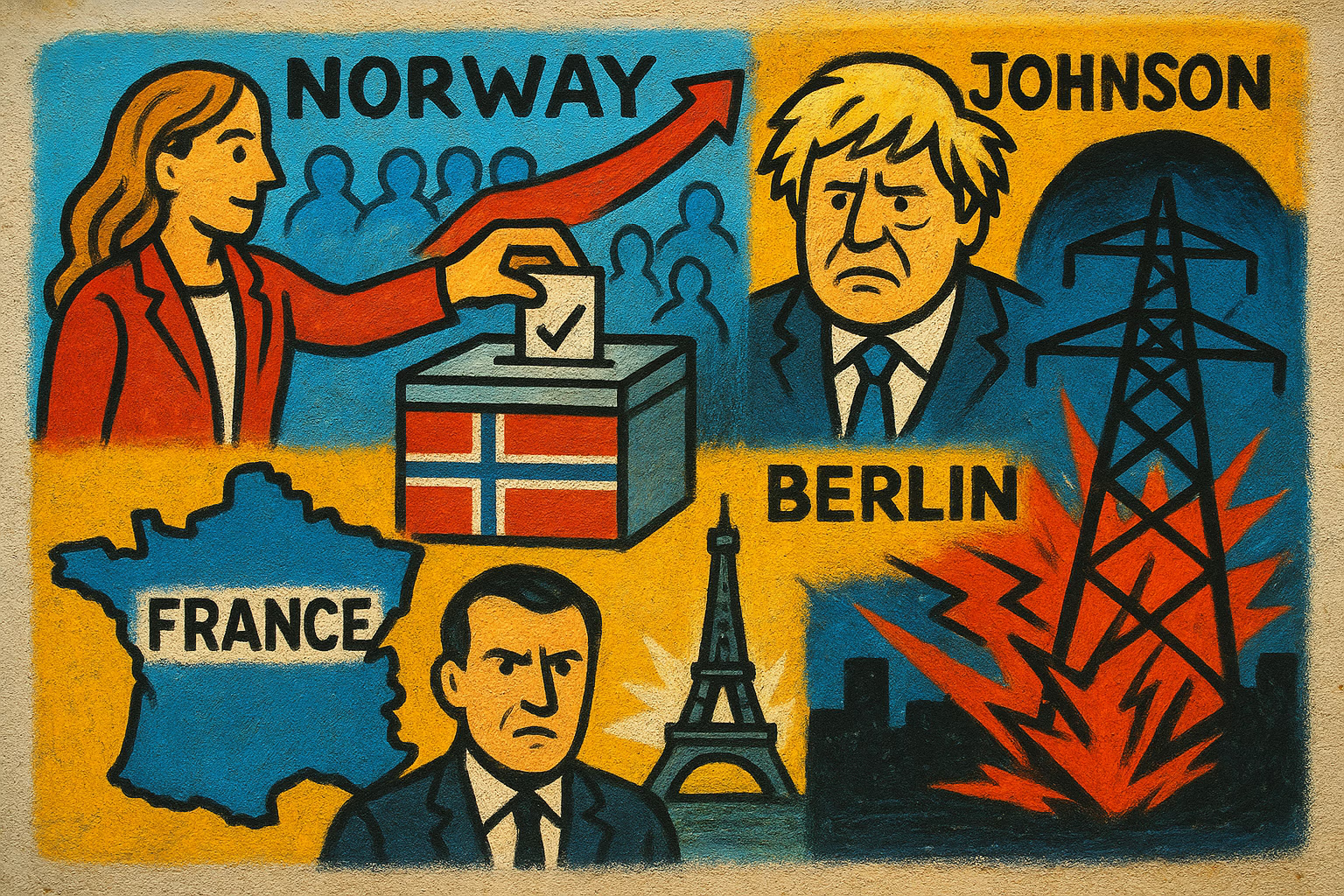
A single day’s news can sometimes tell a story far greater than the sum of its parts. Tuesday was one of those days in Europe. From a pivotal election in the tranquil fjords of Norway to the simmering streets of Paris, and from the long shadow of a former leader in London to the literal darkness of a Berlin blackout, the continent’s pressure points were laid bare. These were not isolated incidents, but interconnected signals of a Europe grappling with its identity, its stability, and its resilience in an increasingly volatile world.
This confluence of events, spanning democratic decisions, social unrest, political accountability, and infrastructural vulnerability, paints a vivid picture of a continent in flux. Each headline, seemingly distinct, contributes to a larger narrative of profound challenges and critical choices that will define Europe’s trajectory for years to come. Understanding these individual narratives is key to grasping the broader European predicament.

Norway’s Choice: Oil Wealth vs. a Greener Future
In Norway, voters faced a generational dilemma that resonates across the developed world. The nation, made fantastically wealthy by North Sea oil and gas, delivered a verdict that will shape its path for the next decade. The Norway election results were not just a choice between traditional left and right ideologies; they constituted a profound national debate about the future of energy itself, specifically the continued exploitation of lucrative fossil fuel reserves versus an accelerated transition to a sustainable, greener economy.
This wasn’t merely an environmental debate. At stake is the delicate balance between funding a generous, expansive welfare state with the vast profits from North Sea oil and gas and meeting the urgent, existential demands of climate change policy. Norway’s sovereign wealth fund, one of the largest globally, is almost entirely built on these hydrocarbon revenues, enabling world-class public services from healthcare to education. Yet, the pressure to align with global climate goals, reduce carbon emissions, and set an example for other oil-producing nations is immense. Voters grappled with how to decouple prosperity from fossil fuels without undermining the very fabric of their society.
The outcome will send ripples far beyond Oslo. For a Europe desperate to secure its energy independence, particularly in the wake of geopolitical shocks, Norway’s decisions on oil and gas exploration are critical. Its continued role as a reliable energy supplier has been vital, yet its progressive stance on climate action makes its internal debate a fascinating case study. This vote is a microcosm of the core challenge facing every modern economy: how to manage a responsible and equitable energy transition Europe-wide, ensuring that the shift to renewables doesn’t crater the prosperity that citizens have come to expect, nor leave vulnerable communities behind. Norway’s answer will be a bellwether for all nations navigating this complex path.
The global community watched closely, aware that if a nation as wealthy and environmentally conscious as Norway struggles with this transition, it highlights the immense difficulty for others. Its strategic shift, or lack thereof, could influence investment flows into new energy technologies, shape international climate agreements, and even set precedents for how resource-rich nations manage their future economic models. The implications for the global energy market and climate fight are profound, making Norway’s domestic decision a truly international moment.
France’s Fever Pitch: A Warning for the Political Establishment
Meanwhile, in France, the political temperature continues to rise. The “turmoil” reported is more than just another protest; it’s a chronic symptom of a deep and growing fracture between the government and the governed. Whether fueled by pervasive economic anxiety, resistance to Macron reforms perceived as technocratic and detached, or a general sense of disenfranchisement that has festered for years, the unrest in Paris is a stark reminder that social cohesion Europe-wide is increasingly fragile.
This is the recurring challenge for President Emmanuel Macron’s vision of a dynamic, reformed France. His ambitious agenda, often characterized by a top-down approach to modernization, aims to boost competitiveness, streamline public services, and ensure fiscal responsibility. However, this push for efficiency and change from the top is consistently meeting fierce resistance from the ground up, manifesting in widespread strikes, disruptive demonstrations, and passionate public discourse. The French penchant for direct action, rooted in a rich revolutionary history, ensures that major policy changes are rarely implemented without significant public contestation.
The key takeaway is not just about France, but about the limits of technocratic governance in an age of rampant populism France and across the continent. When political elites appear disconnected from the daily struggles of ordinary citizens, and when reforms are perceived as benefiting a select few rather than the broader population, the legitimacy of the entire system can be called into question. If the establishment cannot find a way to genuinely engage its citizens, address their legitimate concerns, and build consensus around necessary changes, the political vacuum will inevitably be filled by more extreme forces. Both the far-right and the far-left, adept at channeling public anger and frustration, stand ready in the wings to capitalize on this growing disillusionment, potentially threatening not only French stability but also the broader European project.
The French model, with its strong state and powerful unions, often serves as a bellwether for continental trends. Persistent unrest there signals a deeper challenge to democratic institutions and the capacity of mainstream parties to govern effectively in an era of heightened expectations and polarized discourse. The struggle to reconcile necessary economic reforms with maintaining social peace is a delicate balancing act that few European leaders have mastered, and France’s ongoing struggles serve as a potent warning to them all.
Britain’s Ghost of Politics Past
Across the Channel, the United Kingdom continues to be haunted by its recent political past. The ongoing Boris Johnson probe, scrutinizing the former Prime Minister’s conduct and integrity during his time in office, demonstrates that the chaotic, personality-driven era of his leadership is far from a closed chapter. This isn’t just about one man’s actions or a single scandal like “Partygate”; it’s about the lingering questions of integrity, accountability, and the very standards of public office in a post-Brexit Britain grappling with its identity.
The investigation’s future implications are twofold and significant for the nation’s political landscape. First, it serves as a constant, nagging disruption for the current Conservative government under Rishi Sunak. While Sunak seeks to stabilize the economy and present a fresh start, the shadow of Johnson’s legacy, and the continuous revelations from parliamentary inquiries, prevent a clean break from a controversial and often tumultuous period. This diverts media attention, saps political energy, and makes it harder for the government to articulate a clear vision for the future, further eroding public trust in Westminster accountability.
Second, and perhaps more fundamentally, the saga highlights the ongoing battle for the soul of the Conservative Party and, by extension, the country’s political direction. Johnson’s brand of populist conservatism, which delivered a large majority and “got Brexit done,” left deep ideological and cultural divisions within the party. The probe forces a reckoning with the standards that govern public life and the consequences of perceived rule-bending at the highest levels. It’s a debate about what kind of leadership Britain wants and expects, and whether the traditional norms of political conduct can be restored or are permanently altered.
The Johnson saga is a potent symbol of a nation still struggling to define itself after the seismic rupture of leaving the EU. Brexit, championed by Johnson, promised a new era of freedom and opportunity. Yet, years later, the UK finds itself economically challenged, politically fractured, and seemingly caught in a perpetual cycle of internal reflection and scandal. This ongoing introspection, fueled by the fallout from past leadership, prevents Britain from fully focusing on its future role on the global stage, making the quest for Conservative Party integrity an ever-present challenge.
Berlin’s Blackout: A Modern-Day Fable
Perhaps the most visceral event of the day was the Berlin blackout. In an instant, one of Europe’s most powerful and technologically advanced capitals was plunged into darkness. Homes, businesses, traffic lights, and public services ground to a halt. While the cause of the Berlin power outage remains under investigation, the event itself is a powerful, almost allegorical, metaphor for the continent’s underlying vulnerabilities. Our hyper-connected, just-in-time societies are built on complex systems that are far more fragile and interdependent than we care to admit, making European infrastructure security a paramount concern.
The immediate impact was a stark reminder of our dependence on reliable electricity. Beyond inconvenience, a sustained outage could cripple hospitals, telecommunications, water supply, and financial systems. This vulnerability is not unique to Berlin but extends across Europe, where critical infrastructure forms the backbone of modern life. The event forces a re-evaluation of assumptions about redundancy and resilience in an increasingly volatile world, bringing into sharp focus the need for robust planning against unforeseen disruptions.
Whether the cause was a mundane technical failure, a lapse in human error, or something far more sinister like a sophisticated cyberattack threat, the message is the same. In an era of heightened geopolitical tension and the pervasive threat of hybrid warfare, energy grids, communication networks, transportation systems, and other critical infrastructure are increasingly recognized as the new front lines. State-sponsored actors, criminal organizations, and even lone wolf hackers pose a constant and evolving threat to the digital and physical systems that underpin our societies.
The Berlin blackout is a jarring wake-up call, forcing a continent to ask itself a terrifyingly simple question: how resilient are we, really? It underscores the urgent need for enhanced cybersecurity measures, greater investment in grid modernization, and improved cross-border cooperation on infrastructure protection. Ensuring energy resilience Europe-wide is not just an economic imperative but a national security priority. This single event in a major capital vividly illustrates that even in highly developed nations, the foundations of modern existence can be momentarily, or even catastrophically, undermined, demanding constant vigilance and strategic foresight.
Taken together, these four stories paint a portrait of a continent at a crossroads, tested on all fronts—democratically, socially, ethically, and structurally. The choices made in the coming months, from Oslo’s energy policy to Paris’s streets and Westminster’s committee rooms, will determine whether Europe can navigate these turbulent waters or risk being overwhelmed by them. As the continent grapples with these interconnected challenges, how effectively do you believe European leaders are responding to the simultaneous demands for economic prosperity, social equity, environmental sustainability, and national security?
Read the original story at Invezz.