The Unsettled Ghost of Brexit: Farage’s Immigration Gambit Pokes a Wary Brussels
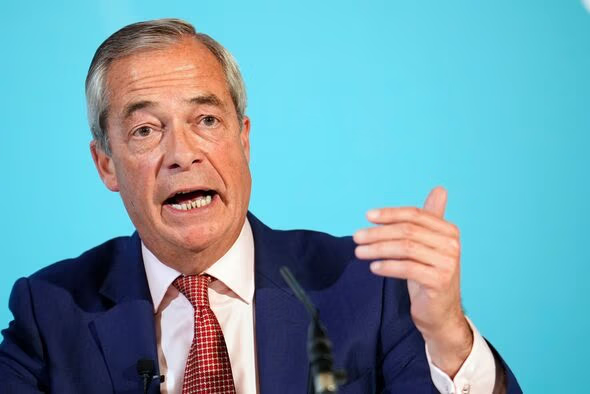
Just when it seemed the stormy seas of Brexit had calmed into a tense, but stable, new reality, the UK’s general election campaign has summoned a ghost from negotiations past. Nigel Farage, now at the helm of Reform UK, has thrown a policy grenade into the political arena, and the shrapnel has already landed in Brussels, prompting a sharp and immediate warning of “huge consequences.” This latest development underscores the enduring fragility of the post-Brexit settlement and the deep economic interdependencies that continue to bind the UK and the European Union, making any unilateral divergence a high-stakes gamble.
The proposal is classic Farage: a bold, simple, and deeply divisive plan to freeze all non-essential immigration from the European Union. For his supporters, it’s the fulfillment of a long-held promise to “take back control” of Britain’s borders in the most absolute sense, aiming to significantly reduce overall immigration figures and alleviate perceived pressures on public services. This move is presented as a definitive step towards reclaiming national sovereignty and addressing domestic concerns about infrastructure and cultural identity. However, for the EU, it’s a direct assault on a foundational pillar of the painstakingly negotiated post-Brexit Trade and Cooperation Agreement (TCA), and they are not taking this potential challenge lightly, signalling a readiness for robust economic defence.

According to a senior European diplomat, such a move by a future UK government would be seen as a flagrant violation of the TCA. The warning shot from the continent is unambiguous and carries significant weight: if the UK unilaterally tears up its commitments on the movement of people – a principle foundational to the EU’s internal market and its external agreements, even if the UK is no longer a member – the EU would feel entirely justified in suspending parts of the deal that govern the movement of goods. In short, the UK’s highly valued tariff-free access to the vast European single market, a cornerstone of its current trade relations, could be placed squarely on the chopping block. This isn’t merely a political threat; it’s a clear articulation of the economic leverage the EU possesses and its unwavering willingness to use it to protect the integrity of its treaties and market principles.
Understanding the EU’s Position: A Red Line on Discrimination
The EU’s strong reaction stems from a core tenet of its legal and economic framework: the principle of non-discrimination. While the UK is no longer a member of the single market and does not participate in its four freedoms (goods, services, capital, and people) as it once did, the Trade and Cooperation Agreement still includes various provisions that reflect these underlying principles in spirit and practice. The EU views any discriminatory measures against its citizens, especially concerning entry and residence for legitimate purposes, as an affront to its foundational values and a direct challenge to the spirit of cooperation enshrined in the TCA. This isn’t solely about economic exchange; it’s about the broader relationship, mutual respect, and the sanctity of agreements between sovereign entities.
Brussels has consistently maintained that preferential access to its market for goods and services comes with reciprocal obligations. These obligations, while not extending to full freedom of movement for people as before Brexit, still require a level playing field and non-discriminatory treatment in various areas. A blanket freeze on “non-essential” EU immigration, without clear, non-discriminatory criteria applied equally to all third countries, would fundamentally alter this dynamic and be perceived as a direct act of discrimination. The specific clauses within the TCA regarding level playing field provisions, though primarily focused on state aid, social, labour, and environmental standards, also hint at the broader principle of fair treatment and avoiding undue competitive advantages or disadvantages based on origin, which would be violated by such a policy.
What This Really Means: The Interconnectedness of the Deal
This brewing conflict reveals the central, and perhaps deliberately misunderstood, tension of the post-Brexit era. The TCA, painstakingly negotiated over many months and celebrated by both sides as a comprehensive free trade agreement, is not an à la carte menu from which the UK can pick and choose. It is, by its very design, a holistic package deal built on a delicate balance of rights and obligations. Both sides made significant concessions and accepted certain constraints to secure the benefits, primarily tariff-free, quota-free trade in goods across a vast economic bloc. To unilaterally unravel one core commitment, particularly one touching on the movement of people, is, in the EU’s view, to threaten the entire edifice of the agreement.
The EU’s position is unequivocally clear: the UK’s preferential access to its markets for goods and services is intrinsically linked to the principle of non-discrimination against EU citizens and adherence to agreed-upon frameworks. By threatening to unilaterally block EU workers through a broad freeze, a Farage-influenced government would essentially be trying to retain the economic benefits of the deal—access to a market of 450 million consumers—while discarding the commitments it finds politically inconvenient or wishes to abandon for domestic policy reasons. This “cherry-picking” approach has been a constant source of friction throughout the entire Brexit process, and the EU has consistently pushed back against it, fearing it would set a dangerous precedent for other international agreements.
The diplomat’s warning is a stark reminder from Brussels that this approach will not be tolerated. The EU is signalling that it will not hesitate to use the significant economic leverage it holds to enforce the terms of the treaty. This could manifest in several ways, each with potentially severe repercussions. The most direct would be the imposition of tariffs on UK goods, making them instantly more expensive and less competitive in the European market. This would have immediate and profound consequences for UK exporters, critical supply chains that span the Channel, and ultimately, consumer prices and jobs within the UK economy, potentially exacerbating inflationary pressures and hindering economic growth.
Beyond tariffs, the EU could also suspend cooperation in other critical areas covered by the TCA, such as security collaboration, participation in joint research programmes, or even certain aspects of transport and energy frameworks, which are all part of the integrated agreement. Such actions would send a powerful message about the inviolability of international agreements and serve as a deterrent to other third countries contemplating selective adherence to EU treaties. The credibility of the EU as a negotiating partner and a guardian of international law is also at stake from their perspective, meaning they are highly likely to adopt a firm, uncompromising stance to protect their strategic interests and the integrity of the single market.
The Future on the Line: Implications for UK Politics
While Reform UK is unlikely to form the next government, Nigel Farage’s influence on the political discourse is undeniable and potent, particularly in the lead-up to a general election. His policies are successfully dragging the political debate, especially within the Conservative Party, further to the right on emotive issues like immigration. By raising the salience of immigration control, framing it as an existential challenge, and presenting radical solutions, Farage forces mainstream parties to respond, often by adopting tougher rhetoric or proposing similar, albeit watered-down, policies. This latest EU backlash, therefore, serves as a crucial message not just to Farage and his party, but more importantly, to any future occupant of Number 10, regardless of their political stripe.
For the Conservative Party, currently facing a significant challenge from Reform UK and a potential wipeout, the temptation to adopt more hardline stances on immigration to stem the flow of votes is immense. However, this explicit EU warning makes it unequivocally clear that such domestic political manoeuvring could come at a steep and immediate economic price. A Conservative government attempting to implement a Farage-esque policy would find itself embroiled in an immediate and damaging trade dispute, potentially undoing years of efforts to stabilize the post-Brexit economy and repair relations with its closest trading partners. It highlights the difficult balance any Tory leader must strike between appeasing their right flank, particularly the ardent Brexiteer wing, and diligently protecting the nation’s broader economic interests.
For a potential Labour government under Keir Starmer, this episode is a sobering preview of the tightrope they will inevitably walk. Labour has been keen to emphasize its commitment to making Brexit work and improving relations with the EU, often stressing the need for pragmatism, stability, and closer alignment where beneficial. However, the domestic political landscape surrounding immigration remains highly charged, with significant public concern about numbers. Any future renegotiation or attempt by Labour to diverge significantly from the established agreement, particularly on sensitive issues like the movement of people or alignment with EU standards, will be scrutinised by an EU that remains highly sensitive to any backsliding or attempts to reopen settled issues without substantial and balanced reciprocal commitments.
The message from Brussels is unambiguous: the Brexit settlement, embodied by the Trade and Cooperation Agreement, is fragile, and attempts to unpick its core tenets will be met with swift and severe economic retaliation. Starmer’s government would face immense pressure to improve the UK’s economic standing, revitalize trade, and foster greater international cooperation. However, any move that could trigger a trade war with its largest trading partner would be economically disastrous and politically perilous, undermining their credibility. Labour would need to carefully navigate conflicting demands for closer alignment with Europe versus commitments to uphold the referendum result, all while dealing with an EU that is unlikely to offer concessions without significant quid pro quos and clear adherence to existing treaties.
Ultimately, this flare-up is more than just an election-season spat designed to grab headlines and rally base voters. It’s a powerful illustration of the hard constraints that now fundamentally define Britain’s relationship with its closest neighbour. The dream of absolute sovereignty, often articulated during the Brexit campaign as the ability to completely control borders and laws without external influence, is constantly crashing against the reality of international agreements, the intricate web of economic interdependence, and the necessity of maintaining robust, functional trade relationships. Nigel Farage may be igniting a new “Brexit war” with his provocative immigration proposals, but as Brussels has just made clear, it’s a war the UK economy can ill afford to fight, particularly given the current economic climate, the ongoing costs associated with exiting the EU, and the pervasive global instability.
Read the original story at Express.
What are your thoughts on the EU’s strong warning? Do you believe a future UK government would risk tariff-free access to the single market for stricter immigration controls, and what might be the long-term economic implications for Britain?