The True Cost of a “Free” TV: Are You the Customer or the Product?
In the tech world, there’s an old saying: if you’re not paying for the product, you are the product. We’ve accepted this bargain for years with our search engines and social media feeds, often implicitly. We readily trade our personal data, browsing habits, and online interactions for access to “free” communication platforms, information retrieval, and endless entertainment. This valuable data, in turn, fuels a multi-trillion dollar advertising industry, meticulously tailoring promotions to our every perceived need and desire. Now, that implicit agreement, once confined to the digital realm of our phones and computers, is breaking out of our screens and manifesting as the screen itself – directly in our living rooms – bringing a fundamental question to the forefront: are we truly the customers, or have we become the ultimate product, delivered to advertisers through new, pervasive channels?
Enter Telly, a company with a bold, almost audacious proposition: a free 55-inch 4K TV. No monthly fees, no hidden costs. Just sign up, and if you’re selected, a brand-new television arrives at your door, promising a revolution in home entertainment. The allure of a high-value piece of electronics without an upfront financial commitment is undeniably powerful, tapping into the universal desire for more for less. However, like any offer that seems too good to be true, this one comes with a significant, unmissable caveat that redefines the concept of “free” in a profoundly personal way.

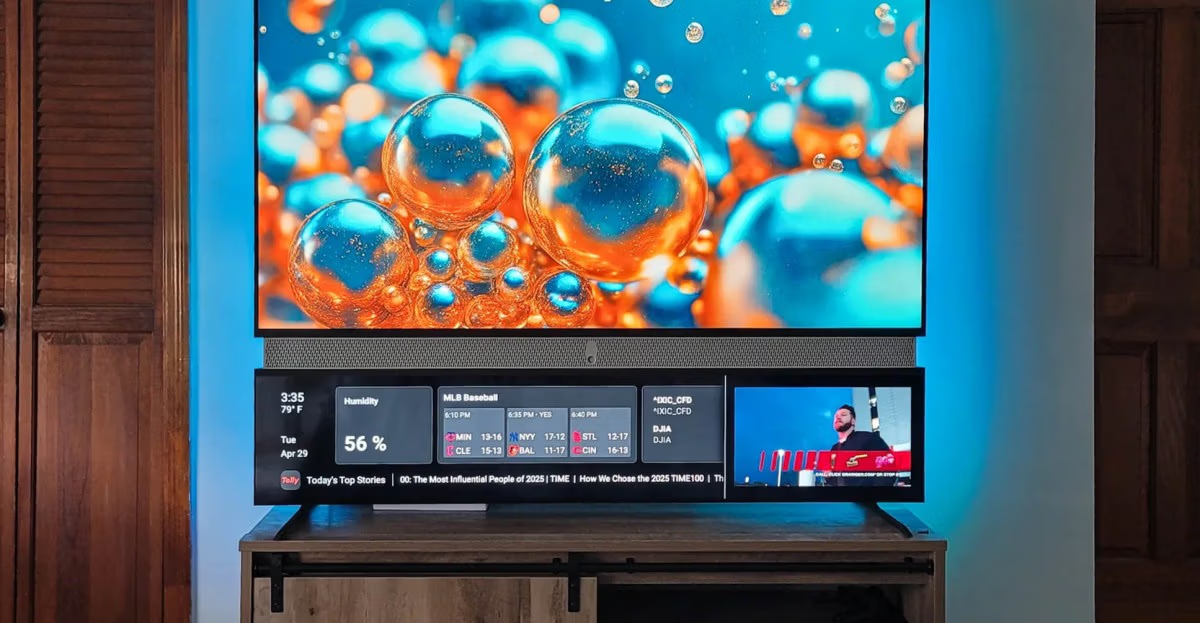
The catch, central to Telly’s disruptive model, is that it’s not just one screen. It’s two. And the second one, a smaller, auxiliary display, never, ever turns off. Based on a fascinating three-month-long hands-on from The Verge, the Telly experience is a compelling, if slightly unsettling, glimpse into a potential future we should all be paying attention to. This isn’t just about watching television; it’s about being watched, and having a constant stream of commercial content delivered directly into your most intimate spaces.
The main 4K display is, by all accounts, perfectly adequate—a “decidedly mid” TV that gets the job done for movie nights and gaming sessions. It functions as a standard smart TV, capable of streaming your favorite content from popular services like Netflix, Hulu, and Disney+. For many, its performance is sufficient for everyday viewing, making the “free” aspect even more appealing on the surface. But the real story, and the true innovation (or intrusion, depending on your perspective), is the smaller, permanent “Smart Screen” that lives below it, a constant ticker of information, personalized widgets, and, most crucially, a relentless stream of advertisements.
The Dual-Screen Dilemma: Your Living Room, Their Ad Space
This isn’t your subtle, easily-ignored banner ad tucked away at the bottom of a webpage or a brief commercial break you can mute or skip. This is a dedicated, always-on portion of your living room’s centerpiece, perpetually vying for your attention. The Telly Smart Screen is designed to be inescapable, always present, and integrated into your ambient environment. It will serve you a Domino’s ad while you’re watching a tense drama, flash sports scores during a family movie, or display the weather forecast while you’re trying to unwind after a long day. It’s the ambient computing dream, filtered through the lens of a marketing department – a constant companion that also happens to be a relentless salesperson, embedded directly into your leisure time.
Imagine settling in for a quiet evening with a gripping series, only for a vibrant advertisement for a local restaurant or a new streaming service to flash persistently below your main screen. Or trying to explain a plot point to your kids while a news ticker scrolls endlessly, distracting their gaze and shifting their focus away from the shared family experience. This integrated, continuous advertising model fundamentally alters the passive viewing experience, transforming it into an active, always-on engagement with commercial messages. It’s a bold move into the physical space of your home, blurring the traditional lines between personal entertainment and pervasive commerce in a way that goes far beyond traditional television commercials.
The Smart Screen also serves up interactive widgets like weather, sports scores, and even video calls. While these features offer some utility, they are inextricably linked to the advertising engine. Every piece of content, whether informational or recreational, serves as a soft background for the commercial messaging, conditioning users to accept constant visual stimulation, much of which is designed to elicit a purchasing impulse. This continuous low-level stream of information and ads represents a significant cognitive load that consumers may not consciously acknowledge, but which nevertheless shapes their environment and attention.
Data, Privacy, and the Telly Bargain: What Are You Really Paying With?
But here’s where it gets really interesting, and perhaps most concerning. Telly isn’t primarily a hardware company in the traditional sense; it’s an ad-tech and data company that happens to use a television as its primary delivery vehicle. The bargain for your free TV is not a one-time exchange but a continuous, long-term agreement to hand over a treasure trove of granular data about your household’s media consumption habits and beyond. This data forms the lifeblood of Telly’s business model, enabling highly targeted advertising that is far more valuable than the cost of the hardware itself.
The company meticulously tracks what you watch, when you watch it, and combines that with the demographic information you provided at sign-up (age, gender, income, household size, interests). This creates a detailed, ever-evolving profile of your household’s preferences, routines, and potential purchasing power, allowing advertisers to target you with highly personalized and incredibly effective ads. Furthermore, the terms of service even give Telly the right to collect extensive “viewing and activity information,” which could include information gathered from the TV’s built-in motion sensor (detecting presence in the room), microphone (listening for voice commands and potentially other audio cues), and camera (for features like video calls and potentially for audience measurement). This level of pervasive surveillance within your private living space raises significant privacy questions that consumers must confront head-on, weighing the convenience of a free device against the profound implications for personal autonomy and data security.
The Stark Choice: Data or Dollars
If you decide, at any point, that you’re not comfortable with this pervasive level of data collection and the constant advertising stream, Telly presents you with a stark, undeniable choice: you either send the TV back to them, or you pay Telly $500 to keep it and presumably opt out of some (though likely not all) of the data collection features and advertising. This uncompromising choice lays the true transaction bare, revealing the underlying economic model with brutal clarity. You are not receiving a gift; you are explicitly bartering. You are trading a continuous, long-term stream of your household’s invaluable data and attention for a single, mid-range piece of hardware. It’s not a one-off purchase, but a recurring payment, not in cash, but in personal information, behavioral insights, and the erosion of uninterrupted focus within your home.
This model highlights a critical shift in the consumer electronics landscape: our data, once an abstract concept tied to online activity, is now explicitly valued against tangible goods in our most personal spaces. The cost of modern convenience is increasingly measured in the currency of privacy, autonomy, and uninterrupted attention. This isn’t just about a TV; it’s about the accelerating monetization of private space and the gradual erosion of personal boundaries, transforming every moment of our lives, even within the supposed sanctuary of our homes, into a data-gathering opportunity for corporations.
The Future of “Freemium” and the Attention Economy
Telly may feel like a novelty right now, an intriguing outlier in the competitive television market, but it’s a physical manifestation of the direction the entire tech industry is heading. For years, the value exchange of our data has been abstract, happening inside servers we’ll never see, quietly powering the digital services we’ve come to depend on, from email to cloud storage. Telly makes this exchange strikingly tangible and undeniable. The price of admission to its “free” offering is a permanent, always-on ad screen in your home, a constant, physical reminder of the unseen contract you’ve entered into the moment you accepted the device.
This is the ultimate test of the “freemium” model in a physical, high-value consumer product context. Will people accept a constant, low-level stream of advertising and continuous data tracking in their physical space in exchange for a desirable product that would otherwise cost hundreds of dollars? We’ve already done it extensively with smartphones (think ad-supported apps and games that trade your data for free access) and with web browsing (where targeted ads are the norm). But a television is a more communal, central fixture of the home, typically seen as a gateway to entertainment and relaxation, not an advertising billboard embedded directly into its core functionality.
Beyond the TV: The Pervasive Reach of Ad-Supported Hardware
Telly forces us to ask uncomfortable but absolutely necessary questions about the evolving boundaries of advertising and personal privacy in an increasingly connected world. Where do we, as consumers, draw the line? Are we ready for an ad-supported smart fridge that not only tracks your inventory but also suggests brand-name products as you run low, perhaps displaying promotions directly on its screen as you open the door? Or a free smart speaker that, after answering our questions or fulfilling our commands, plays a jingle for a delivery service or a sponsored message from a related brand, turning every interaction into a potential commercial opportunity?
The implications extend to every smart device potentially entering our homes. From smart thermostats showing energy company ads to smart mirrors displaying beauty product promotions or clothing suggestions based on our reflections, the Telly model could pave the way for an environment where every “free” smart device comes with its own dedicated ad channel. This could transform our homes into highly personalized, always-on commercial hubs, where even the most mundane interactions are monetized. The undeniable convenience and innovation offered by these devices are compelling, but their unseen costs in terms of privacy, mental bandwidth, and the commodification of our attention are only now becoming clear, demanding a critical examination from all of us.
What’s Your Attention Worth?
For now, Telly is an experiment, albeit a highly visible and profoundly thought-provoking one. But it’s an experiment that sits squarely at the crossroads of hardware innovation, aggressive advertising strategies, and the ever-evolving landscape of personal privacy. It unequivocally proves that the most valuable real estate in the 21st century isn’t on a bustling city block or a prime commercial corner, but in the sliver of our collective and individual attention—that precious mental space between the show we’re watching, the task we’re performing, and the world around us. This attention, once considered a personal asset, is now demonstrably a highly sought-after, monetizable commodity.
The core question Telly presents to every consumer is profound: what’s the true cost of “free,” and what’s your undivided attention, and your household’s privacy, truly worth to you? Are we willing to trade the sanctity and quietude of our private spaces for convenience and upfront cost savings, or will this be the moment we collectively decide to draw a firmer line against the relentless march of commercial intrusion and pervasive data collection? The answer will shape not just the future of television and smart home devices, but the very nature of our connected homes and our relationship with technology itself.
What are your thoughts on Telly’s model? Would you accept a free TV with constant ads and continuous data tracking in your living room, or do you believe some spaces should remain sacred from commercial intrusion? Share your perspective in the comments below!