The Galaxy S26 Is Already Teaching Us a Lesson in Patience
Picture this: You’re at 7% battery, your ride-share is five minutes away, and you’re desperately trying to squeeze enough juice into your phone to last the journey. This common, heart-stopping scenario has become a universal modern-day anxiety. In these moments, we all dream of a sci-fi future where our devices charge in the blink of an eye, completely eradicating the fear of a dead phone. For years, the smartphone industry has been a frantic, high-stakes race towards that very future, with charging speeds emerging as a critical battleground and a key differentiator for manufacturers.
Consumers have grown accustomed to seeing year-over-year improvements in every aspect of smartphone technology, from camera sensors and display fidelity to processing power and, crucially, battery charging speeds. This relentless pursuit of faster, more efficient power delivery has pushed the boundaries of engineering, offering users unprecedented convenience. Yet, amidst this fierce competition, one major player appears to be deliberately charting its own course, seemingly content to sit this particular race out. Again.

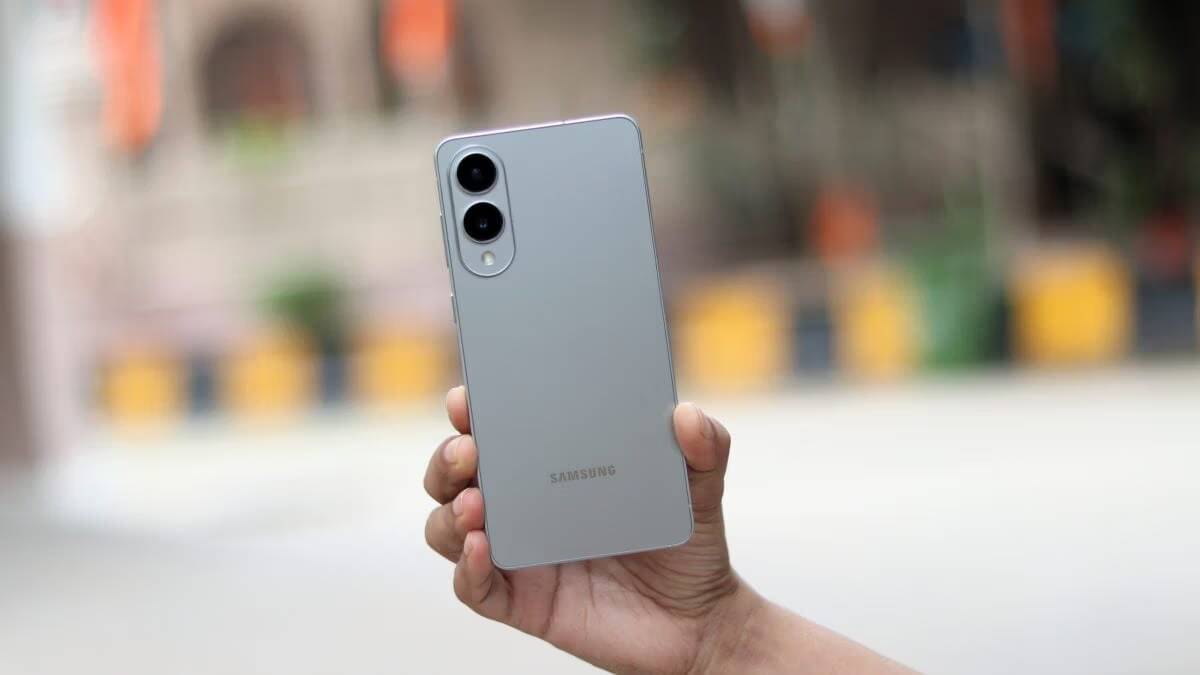
Early whispers about the highly anticipated Galaxy S26 series, a phone that’s still a distant dream on the 2026 horizon, are already starting to surface through reputable industry channels. These initial reports, often based on supply chain insights or regulatory filings, provide an intriguing glimpse into Samsung’s strategic decisions. And according to a recent report from SamMobile, a publication known for its accurate Samsung leaks, one key specification feels less like a step forward and more like a significant throwback: charging speed. The leak suggests that the top-tier S26 models, including the anticipated ‘Ultra’ or ‘Pro’ variants, will once again be saddled with a 45W charging cap. This is the very same speed we first saw introduced on the Galaxy S22 Ultra back in early 2022, marking a potential four-year stagnation in this crucial area.
For the tech-savvy, well-informed smartphone enthusiast, this news lands with a familiar, weary thud. It’s the definition of a “familiar disappointment,” echoing similar sentiments from previous Galaxy S generations where fans hoped for a significant leap in charging capabilities. This rumored decision by Samsung isn’t just a minor spec point; it represents a bold, perhaps even stubborn, stance in a market that increasingly values rapid power delivery.
The Widening Gap: Samsung’s Conservative Stance in a Fast-Paced Market
Let’s be honest and put things into perspective: 45W charging isn’t inherently “slow” by all metrics. In fact, it’s quite capable of delivering a significant charge, often enough to get you through several hours of use, in about 30 minutes. If you plug in your phone while you’re getting ready in the morning or during a quick coffee break, you’ll typically find a substantial boost in battery life. However, in the hyper-competitive, innovation-driven world of flagship smartphones, “not slow” is a universe away from “fast.” It’s a performance metric where perceptions are often shaped by the cutting edge, not the baseline.
The stark reality is that Samsung’s key competitors, particularly those originating from China such as Xiaomi, OnePlus, Realme, and OPPO, have been aggressively pursuing and achieving mind-boggling charging speeds for years now. These brands are casually tossing around 100W, 120W, and even faster charging standards, with some commercial devices already boasting 200W+ capabilities in specific regions. What this translates to for the end-user is a transformative experience: a 30-minute pit stop for a significant charge becomes a mere 10-minute splash-and-dash from zero to full. When you see a phone go from completely drained to 100% charged in the time it takes to make a cup of coffee, or even less, Samsung’s steadfast commitment to 45W starts to look less like a feature and more like a deeply ingrained philosophy—one that feels increasingly out of step with global consumer expectations and the rapid pace of mobile innovation.
This widening gap isn’t just about bragging rights on a spec sheet. It has practical implications for users who rely on their devices heavily throughout the day. Imagine being able to completely revitalize your phone during a short commute, a quick shower, or while grabbing a snack. These are conveniences that competitors routinely offer, shaping a new baseline for what “fast charging” truly means. Samsung’s decision to maintain its 45W ceiling for the Galaxy S26 therefore forces us to look beyond just the numbers and ask what this tells us about the company’s overarching vision and its priorities for the future of its flagship lineup.
The Marathon, Not the Sprint: Prioritizing Longevity Over Immediate Gratification
Samsung’s reluctance to wholeheartedly join the charging speed arms race is not born from an inability to innovate or a lack of technological prowess. Far from it. The company possesses immense R&D capabilities and has historically been a pioneer in countless areas of mobile technology. Instead, this adherence to a more conservative charging rate is a deliberate, calculated choice, deeply rooted in historical lessons and a commitment to long-term device health and user safety. The ghost of the infamous Galaxy Note 7 and its catastrophic battery woes, which led to a global recall and significant brand damage years ago, still profoundly haunts the halls of Samsung’s HQ. For them, battery safety and, just as importantly, the long-term health and reliability of the battery are absolutely paramount, overriding the immediate gratification of ultra-fast charging speeds.
The science behind this decision is clear: faster charging generates significantly more heat within the battery cells. Heat, in turn, is the mortal enemy of a lithium-ion battery. Prolonged exposure to high temperatures accelerates battery degradation, leading to reduced capacity, shorter lifespan, and ultimately, a less reliable device over time. While competing manufacturers have invested heavily in sophisticated cooling systems, multi-cell battery designs, and advanced power management integrated circuits (PMICs) to mitigate these effects, Samsung appears to be taking an even more cautious approach. By sticking to a more conservative 45W, Samsung is making a strategic bet on longevity. They’re engineering a phone designed not just to perform well on day one, but to maintain a healthier battery two or three years down the line, preserving its overall capacity and extending its useful life cycle. They are unequivocally playing the long game, prioritizing the marathon of device ownership over the sprint of a 10- or 15-minute full charge.
This philosophy extends beyond just preventing immediate issues; it aims to enhance the overall user experience throughout the device’s lifespan. A battery that degrades more slowly means consistent performance, fewer concerns about mid-day top-ups after a year of use, and potentially better resale value. It also subtly aligns with a growing global awareness for sustainability and reducing electronic waste, as users are encouraged to hold onto their devices for longer periods. Samsung’s approach implicitly asks a crucial question of consumers: do you prioritize the convenience of a lightning-fast charge that you might only need occasionally, or do you value the peace of mind and sustained performance that comes with a healthier, longer-lasting battery over multiple years? The answer to that question profoundly influences how consumers perceive “premium” in the smartphone market, and it underpins Samsung’s entire strategy for the Galaxy S26.
Redefining “Pro”: A Vision Beyond Raw Wattage
This news, if the leaks hold true, forces us to fundamentally rethink what “premium” and “pro” really mean in the context of a flagship smartphone in 2026. If Samsung is indeed holding steady on charging speeds, it’s a powerful signal that the future of the flagship phone, at least in their eyes, isn’t about chasing ever-higher raw hardware specifications like charging wattage. Instead, their immense resources and strategic focus are clearly being directed towards other, more integrated and intelligent areas of innovation.
We can confidently expect Samsung to pour its unparalleled R&D capabilities into perfecting on-device Galaxy AI, transforming the user experience with smarter, more intuitive interactions. Imagine real-time language translation during calls, advanced generative AI for photo and video editing, intelligent task automation, and truly personalized device interactions that learn and adapt to your habits. This AI-first approach positions the Galaxy S26 not just as a powerful piece of hardware, but as an incredibly intelligent companion. Simultaneously, Samsung will undoubtedly push the boundaries of computational photography even further, delivering cameras that capture breathtaking detail, excel in challenging low-light conditions, and offer unparalleled creative control through advanced processing algorithms and innovative sensor technologies. Features like the ProVisual Engine are expected to be refined, offering professional-grade results with minimal effort.
Furthermore, Samsung’s legendary display technology will continue to evolve. We can anticipate even more brilliant, power-efficient Dynamic AMOLED 2X displays with higher peak brightness levels, adaptive refresh rates for seamless scrolling, and superior color accuracy, perhaps with even further integration of Vision Booster technology for optimal outdoor visibility. These advancements aren’t just about aesthetics; they enhance every interaction with the device, from consuming media to productivity tasks. Samsung is making a clear bet that a truly “Pro” experience in the mid-2020s is defined by intelligence, creativity, visual fidelity, and robust reliability—not by how quickly you can fill the battery bar from zero to full.
While the enthusiast in all of us might sigh at the thought of another year without a major charging upgrade, this rumored move is a powerful statement. Samsung is drawing its line in the sand, confidently asserting its vision for what a cutting-edge smartphone should be. They believe that a smarter, more reliable, and longer-lasting device, one that prioritizes the user’s overall experience and the device’s health over its entire lifespan, is ultimately a better device. This holds true even if it means it spends a little more time tethered to the wall during a full charge cycle, or that users have to adapt to a slightly less immediate top-up routine.
For now, we’ll have to wait and see how these early reports materialize and how Samsung officially positions the Galaxy S26 series. But if this early report is any indication, the future of the Galaxy S series is less about outright speed and more about enduring stamina, sophisticated intelligence, and a holistic, long-term approach to smartphone ownership.
Read the original story at SamMobile.
What are your thoughts on Samsung’s approach to charging speeds versus battery longevity and advanced AI features? Which do you prioritize in your next smartphone?