The Flotilla’s Wake: How a Deadly Raid at Sea Ignited a Firestorm on Europe’s Streets
It began as a humanitarian mission on the vast expanse of the Mediterranean Sea and culminated in a geopolitical flashpoint that reverberated across continents, sending shockwaves through diplomatic channels and public consciousness alike. When Israeli naval commandos intercepted and boarded a Gaza-bound international aid flotilla, the resulting confrontation didn’t merely leave activists dead and injured; it ignited a veritable firestorm of protest that painted a vivid, angry picture of Europe’s fury and frustration. The ensuing demonstrations, erupting spontaneously and with intensity from London’s Trafalgar Square to the ancient streets of Athens, were far more than just a momentary outcry—they were a powerful, undeniable signal of a shifting international landscape, a deep-seated moral indignation, and a clear harbinger of the complex diplomatic battles that were yet to come.
The mission, dubbed the "Gaza Freedom Flotilla," comprised several civilian vessels carrying humanitarian aid and hundreds of activists from dozens of countries. Their stated goal was to break the naval blockade imposed on the Gaza Strip, drawing global attention to the dire humanitarian conditions faced by its Palestinian residents. On May 31, 2010, in international waters, Israeli forces intercepted the lead ship, the Mavi Marmara, a Turkish-flagged passenger vessel. What followed was a violent confrontation that saw ten activists killed and dozens injured. This tragic incident, widely broadcast and debated, immediately escalated a regional conflict into a global diplomatic crisis, triggering widespread condemnation and outrage, particularly across Europe.

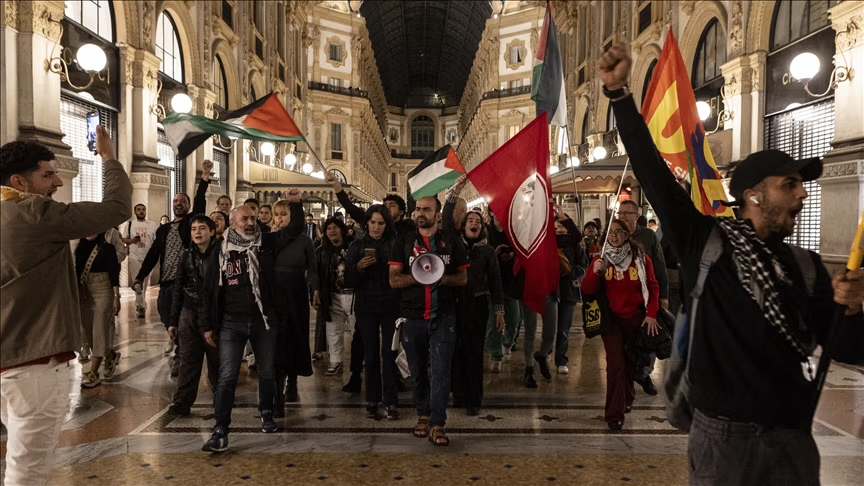
The immediate aftermath of the raid saw a visceral and remarkably coordinated eruption of anger across the European continent. In capital cities, towns, and university campuses, the Israeli-Palestinian conflict, often perceived as a distant, complex, and politically fraught issue, became intensely personal and emotionally charged. Protesters in Paris, Rome, Stockholm, Berlin, and countless other urban centers didn’t just march; they channeled a profound sense of betrayal, injustice, and moral indignation. Chants of "Free Palestine," "End the Blockade Now," and "Israel, murderer!" echoed relentlessly in front of Israeli embassies, which quickly transformed from symbols of bilateral relations into fortified bastions against public fury, reflecting the gravity of the diplomatic crisis unfolding.
The burning of Israeli flags, a potent, deeply controversial, and widely condemned act, underscored the depth and raw intensity of the rage felt by segments of the protesting populations. This was not a standard political protest driven solely by policy disagreements; it was a moral outcry against what many world leaders, international organizations, and citizens alike decried as a "disproportionate use of force" and a violation of international law. The images of dead and wounded civilians, relayed through traditional media and amplified by nascent social media platforms, fueled a public discourse that questioned the legality and ethics of the blockade and the military’s actions to enforce it. The speed and scale of the mobilization highlighted an interconnected network of solidarity that transcended national borders, signaling a powerful re-awakening of international activism around the Palestinian cause.
Key Takeaways and Future Implications from the Gaza Flotilla Raid
1. The Blockade’s Unwinnable PR War: A Catastrophe for International Image
The primary stated goal of the Israeli raid was to enforce its naval blockade of Gaza, preventing what it claimed could be weapons or dual-use materials from reaching the Hamas-controlled territory. Instead, the tactical military action achieved the precise opposite of its strategic intent: it thrust the blockade into the global spotlight, reframing it, in the eyes of millions worldwide, as an unsustainable, inhumane, and potentially illegal policy. The flotilla, initially conceived as a tool of peaceful activism and humanitarian relief, successfully transformed Israel’s military enforcement operation into an unmitigated public relations catastrophe, the repercussions of which resonated for years.
The incident stripped away layers of complex political rhetoric, presenting the situation in Gaza as a clear-cut humanitarian crisis. The visuals of aid workers being violently intercepted, combined with immediate reports of casualties, resonated deeply with an international public already sensitive to images of suffering. This event demonstrated, unequivocally, that in the modern era of instant communication and citizen journalism, military enforcement actions cannot be decoupled from the global war of narratives. The battle for hearts and minds became as crucial as any strategic maneuver. The ensuing international outcry compelled numerous governments and international bodies to scrutinize the legality and humanitarian impact of the blockade more intensely than ever before. This scrutiny led to increased pressure on Israel to ease restrictions, though the blockade itself remained in place. The future, as predicted by the fallout of this event, would indeed see more attempts to challenge the blockade not through direct military confrontation, but through sophisticated media campaigns, non-violent direct action, and sustained pressure in the court of public opinion, employing cameras, activists, and legal challenges as potent weapons.
2. The Fracturing of a Critical Alliance: Turkey and Israel at a Crossroads
The raid on the Mavi Marmara dealt a devastating, almost irreparable blow to the once-sturdy and strategically vital relationship between Israel and Turkey. Prior to 2010, the two nations shared a robust security and economic alliance, often seen as a cornerstone of regional stability and a counterbalance to other Middle Eastern powers. However, with many of the activists and, crucially, a significant number of the casualties being Turkish citizens, Ankara’s response was swift, severe, and deeply emotional. This single event dramatically set in motion a decade of unprecedented diplomatic hostility and estrangement between two regional powers, fundamentally altering the strategic calculus and geopolitical landscape of the Eastern Mediterranean and the broader Middle East.
Turkey, under the leadership of then-Prime Minister Recep Tayyip Erdoğan, condemned the raid in the strongest possible terms, recalling its ambassador from Tel Aviv, suspending all military cooperation, and demanding an apology and compensation for the victims. The public outrage in Turkey was immense, fueled by nationalist sentiment and a growing sense of solidarity with the Palestinian cause. This diplomatic freeze had far-reaching consequences, impacting regional energy projects, intelligence sharing, and military exercises. It forced both nations to re-evaluate their alliances and seek new partners. For Israel, it meant losing a key Muslim ally and a strategic partner against potential threats. For Turkey, it marked a pivot towards a more assertive, independent foreign policy, often at odds with traditional Western allies. The incident served as a stark, enduring lesson in how a single, tactical military decision, however justified by national security concerns, can have sweeping, long-term geopolitical consequences, forcing nations to choose sides, realign their interests, and redraw their diplomatic maps.
3. The Galvanization of a Global Movement: A New Era for Activism
For pro-Palestinian and human rights activists worldwide, the Gaza flotilla raid, tragic as it was, proved to be an unexpected and powerful galvanizing force. It transformed the abstract, often distant issue of the Gaza blockade and the Palestinian struggle into a tangible, deeply personal cause marked by martyrs and undeniable human cost. The widespread, passionate protests across Europe and beyond revealed not only a robust but also a highly interconnected and adaptable network of activists capable of mobilizing thousands at a moment’s notice, leveraging both traditional organizing methods and emerging digital tools.
This surge of energy didn’t dissipate after the initial outrage; instead, it solidified into a powerful, enduring movement. The incident served as a "training ground" for a new generation of advocates, imbuing them with a sense of urgency, moral clarity, and strategic purpose. It ensured that the humanitarian situation in Gaza and the broader Israeli-Palestinian conflict would remain a persistent, prominent, and often emotionally charged issue on the international agenda. This renewed vigor influenced campus politics, giving rise to more organized and effective student movements; it reshaped the missions and advocacy strategies of non-governmental organizations (NGOs), pushing for greater accountability and international protection; and it permeated parliamentary debates in various countries, compelling lawmakers to address the blockade and its implications. The raid cemented the Gaza blockade as a symbol of human rights abuses and international neglect, forever altering the landscape of advocacy and ensuring that the "battle for hearts and minds" would continue with renewed intensity and global reach for years to come.
Ultimately, the raid on the Gaza flotilla was far more than a confrontation at sea. It was a catalyst that exposed deep fault lines in international diplomacy, supercharged a global activist movement, and permanently damaged the public image and perceived legitimacy of the Gaza blockade. The anger that spilled onto Europe’s streets that day was not just a fleeting reaction; it was the beginning of a new chapter in a long, intractable conflict, one where the battle for hearts and minds, for narratives and public perception, would prove just as critical, if not more so, than any military engagement. The legacy of the Mavi Marmara continues to shape debates on international law, humanitarian aid, and the role of non-state actors in challenging state policies.
Read the original story at turks.us.
How do you think such incidents, where humanitarian missions clash with military enforcement, shape international public opinion and diplomatic relations in the long term?