The Gloves Are Off: A Media Giant Just Called Google a Content Thief, and the Future of the Web is at Stake
For over two decades, the relationship between Google and online publishers has been a delicate, often fraught, symbiosis. Publishers pour immense resources into creating valuable, authoritative content, and in return, Google, as the dominant search engine, sends them crucial traffic. This exchange, though imperfect and always evolving, formed the bedrock of the digital publishing business model, driving ad revenue, subscriptions, and audience engagement across countless websites.
But the ground beneath this old pact has been rumbling for years, with publishers increasingly feeling the squeeze from Google’s ever-changing algorithms and its push to keep users within its ecosystem. With the rapid ascent of generative AI, these tremors have finally culminated in a seismic shift. This week, we didn’t just hear another low rumble; we witnessed a full-blown earthquake, signaling a potential turning point for the entire online content landscape.

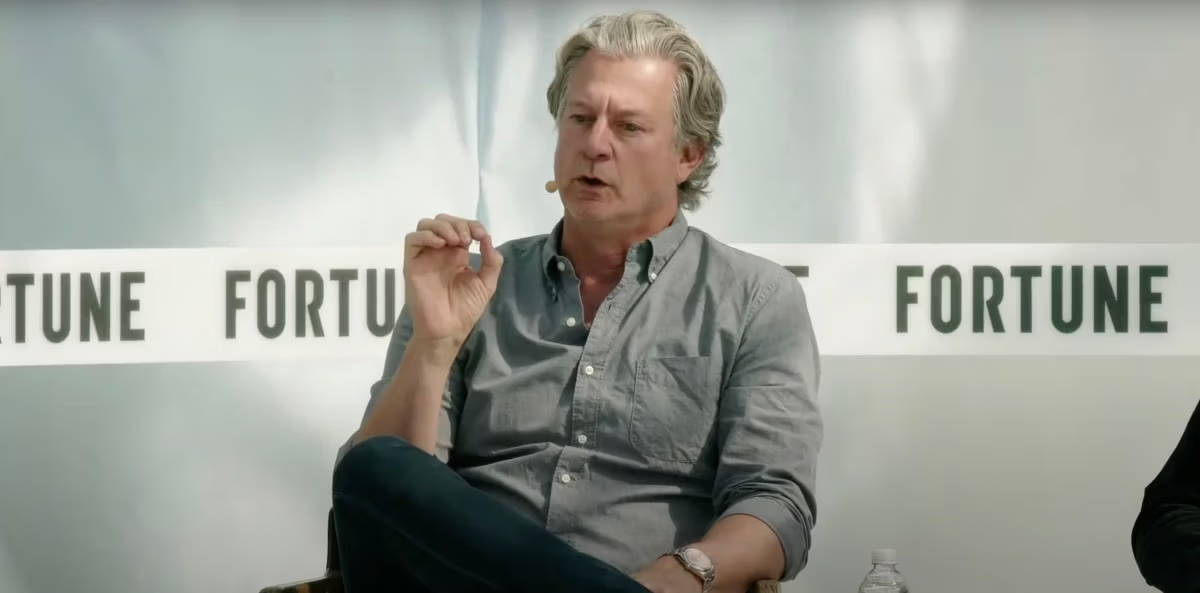
In a move that sends shockwaves through the media and tech worlds, the CEO of People magazine, a titan of the publishing industry and a cornerstone of a massive media conglomerate, has publicly labeled Google a “bad actor.” This isn’t a veiled complaint or a subtle critique; it’s a direct, unambiguous accusation that Google is outright stealing content, fundamentally undermining the creators who fuel the internet’s information supply.
This isn’t your typical, everyday complaint about an algorithm update that impacted search rankings or the perennial headaches of SEO adjustments. This is a far more serious and direct, public accusation that strikes at the very heart of Google’s new AI-powered search experience, particularly its “AI Overviews” feature. It highlights a profound disagreement over intellectual property rights and the fundamental economic model that supports quality journalism and content creation in the digital age.
The Old Deal is Dead: Google’s AI Overviews and the Erosion of Publisher Value
Let’s be clear about what’s fundamentally happening here and why it constitutes such a radical departure from the established order. For years, Google successfully positioned itself as the world’s most comprehensive librarian. When you had a question, you’d turn to Google, and it would meticulously point you to the most relevant “books”—the websites—on its vast digital shelves. The critical distinction was that you still had to “walk over” to those shelves, physically pull out the book, and read its contents yourself. That “walk” was the click—a vital, measurable interaction that directed users to the publishers’ sites, allowing them to monetize their hard work through advertising, subscriptions, and direct engagement with their audience. This click was the lifeblood of the publishing world, the transactional component of the symbiotic relationship.
Now, with the widespread rollout of AI-powered summaries and “AI Overviews” dominating the very top of search results, Google has profoundly transformed its role. It is no longer merely the librarian who points you to the book. Instead, Google has become the librarian who efficiently reads the most important paragraphs of the book for you, eloquently answers your question directly on the search results page, and then sends you on your way, often leaving the original book—the publisher’s website—unopened, unvisited, and uncompensated on the digital shelf. This shift means that the user’s information need is often satisfied without ever leaving Google, thus severing the crucial link that once drove traffic and revenue to content creators.
The implications for publishers are devastating. The publisher did all the painstaking work: the extensive reporting, the rigorous writing, the diligent fact-checking, the meticulous editing, and the significant investment in infrastructure and talent. They bore the costs and risks associated with creating original, high-quality content. Yet, under this new paradigm, they frequently get nothing in return for the value Google extracts. The symbiotic relationship, which implied mutual benefit, has demonstrably become parasitic. This is the core of the “content theft” accusation: it’s an argument that Google is systemically scraping and extracting the inherent value from publishers’ hard-earned intellectual property, repackaging it within its own ecosystem, and effectively keeping the audience, and consequently the associated ad revenue and engagement, for itself.
This new model not only bypasses the publisher’s revenue streams but also potentially dilutes their brand recognition and authority. When an AI overview presents content without a clear, compelling reason to visit the original source, the unique voice, perspective, and credibility cultivated by publishers over years are diminished. The distinction between original, vetted reporting and AI-generated synthesis becomes blurred, posing a significant challenge to the integrity of information online.
Why This Is a Tipping Point: From Grumbles to Open Rebellion
While we’ve heard persistent grumblings and growing frustration from smaller publishers and independent content creators for quite some time, this public declaration by the CEO of People magazine marks a fundamentally different and far more significant moment. People isn’t a nascent blog or a niche online publication struggling for visibility. It’s a household name, a cultural institution, and a cornerstone of a massive media conglomerate with substantial resources and influence. When a leader of this stature, representing such a formidable entity, uses language as strong and unequivocal as “bad actor,” it signals a fundamental and irreversible shift in the industry’s collective stance towards Google.
The quiet frustration, the behind-the-scenes lobbying, and the hesitant whispers among publishers have now officially boiled over into open rebellion. This public confrontation is more than just a media spat; it’s a declaration of war, setting the stage for significant repercussions across the tech and publishing sectors. This moment is particularly significant for three critical reasons that have the potential to reshape the digital landscape:
1. It Mainstreams the Complaint: Elevating the Debate Beyond Tech Circles
For too long, the intricate technicalities of search algorithms, SEO, and the economics of digital advertising have largely remained within the purview of industry insiders, tech analysts, and specialized journalists. When the CEO of People magazine, a brand synonymous with mainstream culture and broad appeal, publicly states that Google is a “bad actor” and is “stealing content,” it transforms what was once a niche tech debate into a mainstream public concern. This kind of high-profile accusation resonates far beyond the typical tech media bubble; it reaches general consumers, advertisers, and, crucially, policymakers who might not have paid attention to such issues before.
This mainstreaming of the complaint puts significant public pressure on Google. It can attract the immediate attention of regulators and lawmakers across various jurisdictions—from the Federal Trade Commission in the U.S. to the European Union’s powerful antitrust bodies. These regulatory bodies are already scrutinizing Google’s market dominance and data practices. An accusation of content theft, particularly from a widely recognized brand, provides compelling narrative fuel for investigations into anti-competitive practices, intellectual property infringements, and the potential for a monopoly over information. The weight of public opinion, combined with the potential for regulatory intervention, creates a much more challenging environment for Google to navigate than previous, more isolated complaints.
2. It Foreshadows a Legal War: Laying the Groundwork for Widespread Litigation
This public condemnation from a major publisher is highly likely to be the opening salvo in a much larger and more aggressive legal conflict. We are already witnessing publishers taking proactive steps, as evidenced by the high-profile lawsuit filed by The New York Times against OpenAI and Microsoft for alleged copyright infringement related to AI model training and output. The accusation from People magazine provides a significant boost to this burgeoning legal front, laying the moral groundwork and articulating a clear case for widespread legal challenges against Google itself.
The core of these anticipated lawsuits will center on complex issues of copyright and fair use in the age of generative AI. Publishers will argue that Google’s AI Overviews, by summarizing and essentially re-publishing their content, infringe upon their exclusive rights to reproduce and distribute their original works. Google, conversely, will likely invoke the “fair use” doctrine, arguing that its AI summaries constitute transformative use, analogous to traditional search snippets, and are essential for providing a better user experience. However, the commercial nature of Google’s AI Overviews, which aims to keep users on its platform and monetize their attention, could weaken a fair use defense. This impending legal battle will undoubtedly set precedents for how intellectual property is protected and valued in an AI-driven digital economy, with profound implications for creators across all industries.
3. It Puts a Gun to the Head of “Helpful Content”: Exposing Google’s Contradictions
For years, Google has consistently and explicitly urged creators to focus on producing “helpful, people-first content.” Its algorithms have been tuned to reward originality, depth, expertise, authoritativeness, and trustworthiness (E-E-A-T). Publishers have invested enormous resources in adhering to these guidelines, believing that doing so would lead to better visibility and sustained traffic. The irony is now blindingly clear, painfully evident, and utterly destructive to that trust. The very content that Google championed, the high-quality, meticulously researched, and human-created information, is precisely what its AI models are now voraciously feasting on, ingesting, and subsequently regurgitating—often without clear, prominent attribution or, more critically, equitable compensation.
This glaring contradiction poses an existential threat to the incentive structure of online content creation. What is the logical incentive for anyone—from a massive, resource-intensive newsroom employing hundreds of journalists to an independent blogger pouring their passion into a niche topic—to continue investing in high-quality, original content if that work is simply going to be ingested, summarized, and presented by the platform that was supposed to be its primary discovery engine, thereby bypassing the original source and its monetization opportunities? The “helpful content” mantra now rings hollow, exposed as a strategic directive that inadvertently fueled the very AI that now threatens its creators. If publishers cannot monetize their content, the well of helpful, human-created information will inevitably begin to dry up, leading to a poorer quality internet for everyone.
The Crossroads for the Open Web: Choosing a Path Forward
This isn’t merely a squabble between corporate giants over digital ad dollars; it is a profound battle for the very future of information itself, for the integrity of knowledge creation, and for the economic viability of independent voices on the internet. We are rapidly heading towards a critical juncture, a crossroads with two vastly different potential paths, each with far-reaching consequences for how we will create, access, and consume knowledge for decades to come.
Path 1: The Information Desert – A World Without Original Content
One potential path leads directly to an information desert. If the business model that underpins the creation of original, high-quality content is systematically destroyed, if publishers can no longer afford to invest in journalism, research, and expert writing, then the wellspring of reliable, human-made information will inevitably dry up. In this bleak future, generative AI models, which are inherently derivative, will be left to endlessly regurgitate, re-summarize, and potentially hallucinate from an ever-shrinking and increasingly outdated pool of existing, human-made content. This scenario would create a bizarre, distorted echo chamber—a self-referential loop where new “information” is merely a rehash of old data, progressively losing accuracy, nuance, and originality. The internet would become a vast, stagnant pool of recycled content, devoid of fresh insights, groundbreaking reporting, or diverse perspectives, ultimately serving neither users nor creators effectively.
Path 2: A New Deal – Reimagining Partnership for Sustainable Content Creation
The other path requires a fundamental “new deal”—a proactive and constructive approach that involves Google acknowledging its central role in the information ecosystem and finding innovative, equitable ways to genuinely partner with content creators. This new paradigm would move beyond mere apologies or minor tweaks, embracing a model where Google actively contributes to the sustainability of the content it leverages. This could manifest in several crucial ways:
- Equitable Licensing Deals: Google could establish comprehensive licensing agreements, directly paying publishers for the right to train its AI models on their content and to include their summaries in “AI Overviews.” This model would provide direct financial compensation for the intellectual property value Google extracts.
- Prominent and Unmissable Attribution: Beyond a tiny, easily overlooked link, Google could implement highly visible, compelling attribution that doesn’t just credit the source but actively encourages and incentivizes users to click through to the original article. This might involve richer snippets, clear calls-to-action, or even partial summaries that clearly indicate the need to visit the source for full context.
- Revenue-Sharing Models: A more direct approach could involve Google sharing a percentage of the advertising revenue generated from its AI Overviews when those summaries are demonstrably derived from a publisher’s content. This would directly tie Google’s monetization of AI to the financial health of its content partners.
- Content Creator Fund: Google could establish a substantial fund dedicated to supporting original content creation, similar to models seen in other digital platforms, ensuring a robust and diverse supply of information for its AI to draw upon.
The CEO of People magazine didn’t just voice a frustrated complaint; they drew a definitive line in the sand, challenging the prevailing power dynamics and demanding accountability from the world’s most powerful information gatekeeper. How Google chooses to respond to this mounting pressure won’t just determine its future relationship with the vast and diverse publishing world—it will profoundly shape the very fabric of how we create, discover, and consume knowledge on the internet for decades to come. The stakes couldn’t be higher for the open web and the future of quality information.
Read the original story at TechCrunch.
What are your thoughts on Google’s AI Overviews and the future of content monetization for publishers? Share your perspective in the comments below!