
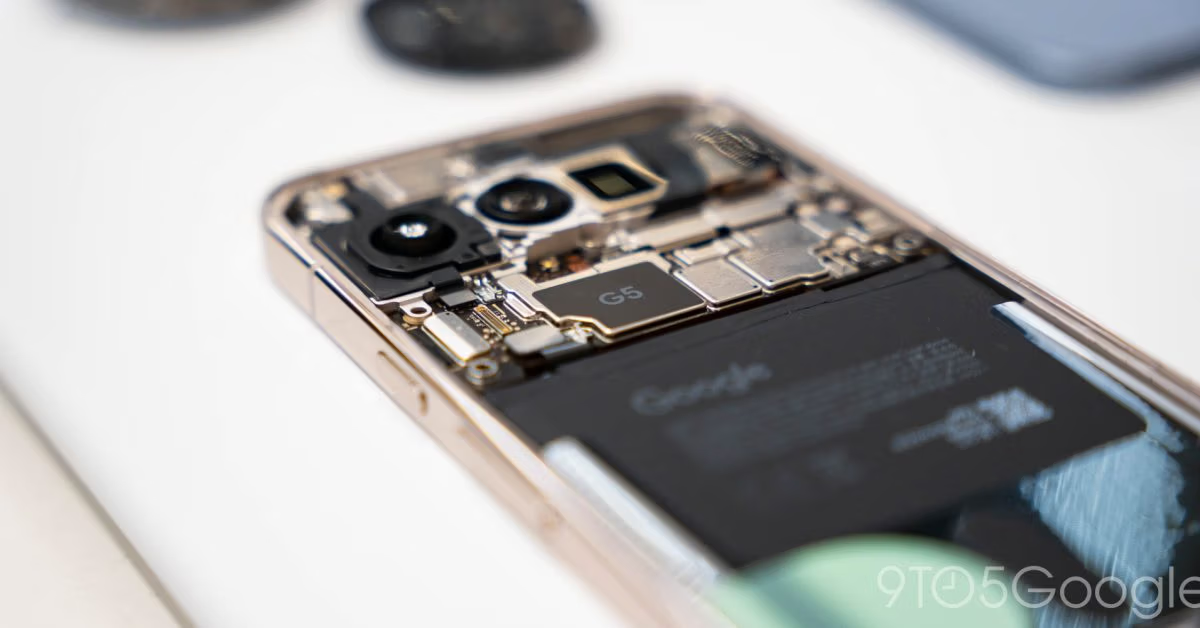
In the exhilarating, fast-paced arena of smartphones, the spotlight invariably shines on dazzling camera sensors, fluid display refresh rates, and the raw computational might of the central processing unit. These are the headline features that capture our imagination and drive sales. Yet, operating tirelessly beneath this highly visible surface, an often-overlooked but utterly crucial component works diligently to connect us to the vast global network: the modem. It is the unsung hero, the digital bridge that makes our devices truly ‘mobile’. If recent compelling reports are to be believed, Google is on the cusp of making a profound strategic shift in this critical connectivity domain, a move that holds the potential to dramatically reshape the future and elevate the user experience of its beloved Pixel smartphone line.
News recently reverberated across the tech landscape, suggesting that Google is actively engaged in rigorous testing of MediaTek modems for its upcoming Tensor G6 chip. This next-generation custom silicon is widely anticipated to be the beating heart of the Pixel 11 and likely other cutting-edge Google hardware devices slated for release in 2026. For industry analysts, seasoned tech enthusiasts, and everyday consumers who have meticulously followed Google’s ambitious journey into custom silicon and hardware development, this isn’t merely a routine supplier interchange. Instead, it signifies a potential inflection point, signalling Google’s intent to bolster the very foundation of Pixel’s mobile connectivity and optimizing every facet of its performance.

Google’s Tensor chip, since its debut, has been hailed as a significant triumph in custom silicon engineering. Its bespoke architecture excels particularly in handling demanding artificial intelligence (AI) and machine learning (ML) tasks directly on the device. This unique prowess is precisely what empowers Pixels with their distinctive, often magical, computational photography capabilities—transforming ordinary snapshots into professional-grade images—and fuels their sophisticated on-device intelligence, from real-time translation to incredibly accurate voice recognition. However, amidst these undeniable strengths, there has been a consistent, albeit sometimes whispered, thread of critique surrounding earlier Tensor generations. This feedback has frequently centered on modem performance, specifically highlighting concerns regarding signal strength, network stability, and power efficiency when compared to the gold standards set by industry leaders, particularly in challenging network environments.
Currently, Google’s Tensor chips integrate modem technology supplied by Samsung. While Samsung’s modems are certainly capable and have served Google’s devices competently, the relentless pursuit of perfection, or at least substantial and tangible improvement, is a perpetual state in the hyper-competitive smartphone market. This reported exploration of MediaTek’s advanced modem solutions is a clear indication that Google is proactively seeking to address any perceived connectivity gaps. It underscores an unwavering commitment to fine-tuning and optimizing every single facet of the Pixel experience, ensuring that its core hardware, including its critical communication components, is as robust, reliable, and advanced as its celebrated software innovations. For a flagship device, connectivity simply cannot be an afterthought.
The Quest for Unparalleled Connectivity: Elevating Pixel’s Signal and Stability
In today’s hyper-connected world, a smartphone’s modem is not merely a component; it’s the lifeline that defines its utility and user satisfaction. A high-performing modem ensures crystal-clear voice calls, uninterrupted video conferencing, blazing-fast web browsing, seamless 4K streaming, and responsive cloud gaming—all without frustrating stutters or dropouts. For Google, a company that prides itself on delivering a cohesive and intuitive user experience, any inconsistency in this foundational aspect demands rigorous attention. The recurring critiques regarding the modem performance in previous Tensor generations have therefore been a crucial catalyst for this reported strategic shift, driving Google to seek out potentially superior alternatives.
While the custom-designed Google Tensor chip has rightfully earned accolades for its pioneering advancements in AI and machine learning, powering iconic features like Magic Eraser, Face Unblur, and enhanced speech-to-text accuracy, its integrated modem (sourced from Samsung) has occasionally faced scrutiny. Users, particularly those in areas with weaker cellular infrastructure or challenging signal conditions, have sometimes reported experiences such as dropped calls, slower-than-expected data speeds compared to peers, or noticeable battery drain associated with the modem working harder to acquire and maintain a stable connection. These subtle yet impactful performance nuances, while not universally reported, suggest that there remains significant headroom for improvement in the crucial domain of mobile connectivity.
Google’s quest for “connectivity excellence” for the Pixel line is not just about incremental upgrades; it’s about eliminating potential pain points that can detract from an otherwise premium and highly intelligent smartphone experience. By rigorously exploring and testing MediaTek’s cutting-edge offerings, Google aims to equip the Tensor G6 and, consequently, the Pixel 11 with not just industry-leading AI and camera prowess, but also with best-in-class signal strength, unwavering network stability, and exceptional power efficiency. This comprehensive approach would ensure that the next-generation Pixel truly delivers a no-compromise experience, capable of standing shoulder-to-shoulder with, or even surpassing, the connectivity performance of any competitor on the market.
MediaTek’s Ascendant Journey: From Niche Player to Industry Benchmark Leader
For many years, the brand MediaTek was largely pigeonholed as a supplier of chipsets primarily aimed at the budget and mid-range segments of the smartphone market. While their offerings provided widespread accessibility to mobile technology, they rarely challenged the performance supremacy of established industry giants. However, the past half-decade has witnessed an extraordinary and profound transformation within MediaTek. The company has aggressively and successfully shed its former image, embarking on a colossal and sustained investment in research and development that has fundamentally reshaped its technological capabilities, market perception, and competitive standing on a global scale.
Their acclaimed Dimensity line of chipsets, particularly the high-end variants such as the Dimensity 9000, 9200, and their successors, stand as irrefutable evidence of this remarkable evolution. These advanced processors have not merely proven themselves competitive; in numerous independent benchmarks and extensive real-world testing, they have consistently demonstrated leadership in critical performance metrics. Key among these are exceptional power efficiency, which directly translates to longer battery life, and state-of-the-art 5G performance across a comprehensive range of bands, including both sub-6GHz and the high-speed mmWave spectrums. MediaTek’s significant R&D investments have fostered innovations in modem architecture, advanced antenna tuning, and sophisticated power management algorithms, positioning them at the forefront of mobile communication technology. This strategic focus has enabled them to gain substantial market share, even in premium smartphone categories.
Google’s reported keen interest in integrating MediaTek modems into its flagship Tensor G6 chip is far more than a mere transactional decision; it represents a powerful endorsement of MediaTek’s engineering excellence and a significant validation of its hard-earned position as a top-tier, innovation-driven component provider in the intensely competitive mobile semiconductor industry. This move unequivocally signals a notable shift in the traditional market landscape, demonstrating that truly groundbreaking innovation and leadership can now originate from multiple formidable fronts. It challenges the long-standing dominance of a few established players, fostering a more dynamic, diverse, and ultimately more innovative environment that benefits consumers globally. It’s a clear statement that MediaTek is not just a viable alternative but a genuine front-runner, fully capable of powering the most sophisticated and demanding flagship devices.
What This Means for the Future of Pixel
Should these critical evaluation tests prove successful, and Google ultimately decides to adopt MediaTek modems for its Tensor G6 chip—a decision that would impact the eagerly anticipated Pixel 11 and subsequent devices—the implications for the entire Pixel ecosystem and its growing user base would be profound and far-reaching. This strategic integration could usher in a new era of connectivity and overall performance for Google’s flagship smartphones, directly addressing some of the most consistent and pertinent user feedback over the years.
Enhanced User Experience: A New Benchmark for Pixel Connectivity
This is arguably the most tangible and exciting outcome for both current and prospective Pixel owners. A fundamentally superior modem translates directly into a noticeably elevated daily smartphone experience. Imagine consistently stronger, more reliable cellular reception, which would significantly reduce frustrating dropped calls in notoriously challenging signal areas—think bustling city centers with dense infrastructure, deep within office buildings, basements, elevators, or expansive rural landscapes. Users could anticipate faster and remarkably more reliable data speeds, whether they are downloading massive files on the go, streaming ultra-high-definition 4K video content without buffering, or engaging in latency-sensitive, graphics-intensive cloud gaming. More importantly, and a frequently requested feature, is the potential for significantly improved battery life. Modems are often one of the most power-intensive components within a smartphone, especially when forced to work harder to acquire or maintain a weak signal. A more efficient, high-performance MediaTek modem could drastically reduce this power drain, enabling the Pixel 11 to last considerably longer on a single charge, providing true all-day power. For a phone that already enjoys immense success and acclaim in software-driven areas like computational photography and on-device AI, fortifying this fundamental hardware component would solidify its position as a truly well-rounded, uncompromisingly premium device.
Deeper Vertical Integration and Strategic Control for Google
While Google designs the overarching architecture and many custom blocks of its Tensor chip, key components such as the modem have, up until now, remained distinct third-party elements integrated into the System-on-a-Chip (SoC). This reported proactive exploration of new suppliers, particularly a formidable one like MediaTek, aligns perfectly with Google’s broader, long-term strategic vision to achieve more profound control over the entire hardware-software stack of its Pixel devices. It transcends merely integrating a component; it’s about gaining the strategic flexibility to hand-pick and optimize the absolute best-in-class components available globally, irrespective of their original vendor. By meticulously selecting its modem partner, Google can achieve unparalleled precision in fine-tuning the intricate interplay between its custom Tensor silicon, the chosen modem’s advanced capabilities, and the Android operating system. This level of granular, holistic control promises more seamless performance, heightened reliability, and the potential to develop unique, tightly integrated features that might otherwise be unfeasible with less integrated or off-the-shelf solutions, ultimately paving the way for a more cohesive, efficient, and distinct Pixel ecosystem.
Increased Competition and Industry-Wide Innovation
Google’s potential pivot to MediaTek modems sends an unequivocally powerful and resonant signal throughout the entire mobile silicon industry. This bold move will undoubtedly intensify the already fierce competition among all modem manufacturers, compelling established giants like Qualcomm and Samsung, as well as emerging players, to significantly ramp up their innovation efforts. They will face renewed pressure to push the boundaries of their own modem technologies, not just in raw speed but also in efficiency and reliability. This heightened competitive environment is a tremendous windfall for consumers across all smartphone brands globally. It will likely stimulate further substantial investments in research and development across the industry, accelerate the introduction of even better-performing and more power-efficient modems, and potentially lead to more diverse, cutting-edge, and cost-effective solutions becoming available in the market. Google’s strategic decision could effectively serve as a catalyst, igniting a new wave of innovation in a component area that, despite its critical importance, has traditionally seen slower public-facing development compared to more visibly appealing elements like CPUs or GPUs.
Of course, it is crucial to temper expectations with the understanding that “testing” does not automatically translate into a “done deal.” The process of integrating a completely new modem architecture into a custom SoC like the Tensor G6 involves monumental engineering challenges, meticulous compatibility validation, complex supply chain logistics, significant cost considerations, and stringent performance benchmarks that must be unequivocally met. However, the very fact that a technology titan of Google’s immense stature is reportedly putting MediaTek’s modems through such rigorous and extensive paces for a critical future flagship product like the Pixel 11 speaks volumes about their confidence in MediaTek’s capabilities and their own strategic intent. It powerfully underscores Google’s relentless pursuit of delivering a truly no-compromise Pixel experience, one that is genuinely premium in every conceivable aspect. This bold move hints at a future where connectivity—often perceived as an overlooked but undeniably vital foundational aspect of our mobile lives—could transcend its background role and transform into a truly standout, defining feature for the next generation of Google’s highly anticipated flagship smartphones. The unsung hero, the humble yet mighty modem, might just be about to claim its rightful place center stage, fundamentally enhancing how we interact with our devices and the vast digital world around us.
Read the original story at 9to5google.com.
What are your thoughts on Google potentially integrating MediaTek modems into the Pixel 11? Do you believe improved modem performance would be the ultimate game-changer for the Pixel line, finally solidifying its position as a truly premium, all-around flagship?