Decoding Apple’s Long Game: Why iOS 26 Isn’t So Far Away After All
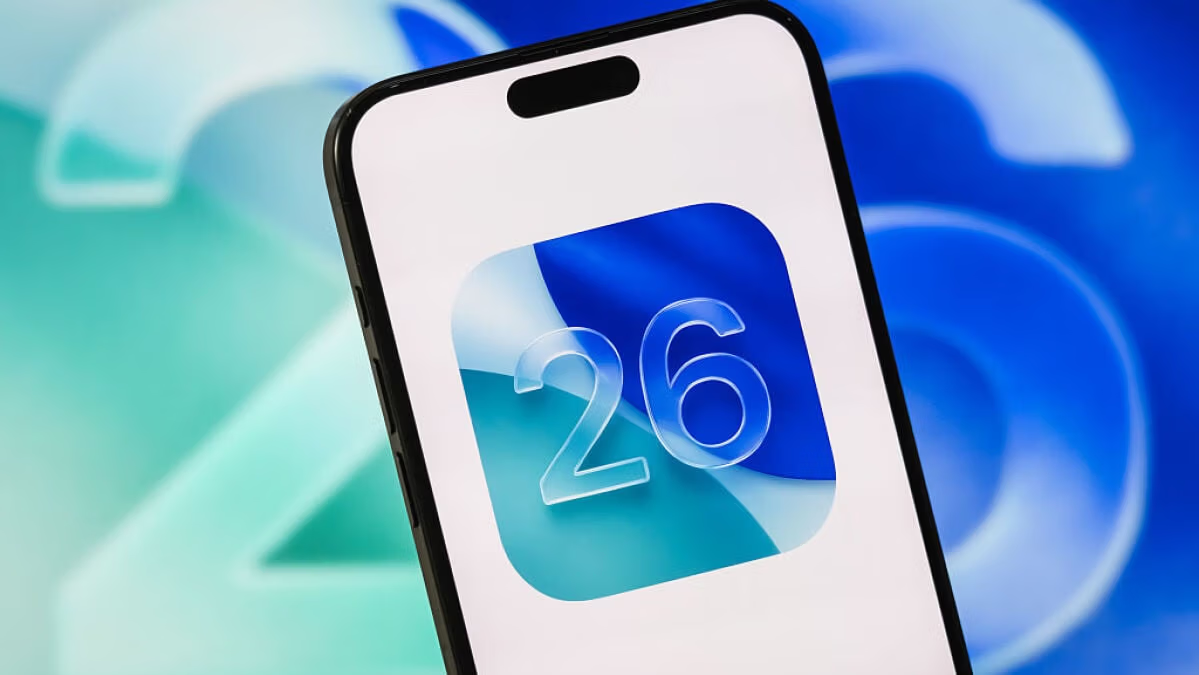
In the fast-paced world of tech, where tomorrow’s headlines often feel like ancient history, it might seem absurd to talk about something as seemingly distant as iOS 26. Yet, the conversation is already brewing, and for good reason. It’s not about predicting a specific feature three years out, but rather understanding the rhythmic hum of Apple’s well-oiled machine and the predictable cadence that allows us to peer into its long-term vision.
Apple’s annual cycle is less a frantic sprint and more a steady, deliberate march. Every June, we brace for WWDC and the unveiling of the next iOS. Every September, new iPhones arrive, perfectly calibrated to leverage that software. This unwavering consistency isn’t just a marketing strategy; it’s the bedrock of an ecosystem that thrives on predictability. This means that even if we don’t know the exact pixels or lines of code, we can anticipate the evolutionary path years in advance. This foresight isn’t idle speculation; it’s a testament to Apple’s meticulous planning and its commitment to a steady, continuous stream of innovation.

The Future is Now: AI and Spatial Computing in iOS 26
So, if iOS 26 is still a distant star, what insights can we glean today? The current tech landscape offers compelling clues. Artificial intelligence (AI), for instance, isn’t just a buzzword; it’s rapidly becoming the foundational layer of computation. By iOS 26, we can expect AI to be deeply interwoven into every aspect of the operating system – from proactive smart assistants that anticipate needs, to hyper-personalized interfaces, and even more sophisticated computational photography that goes beyond what we imagine today. We might also see elements of spatial computing, currently pioneering on the Vision Pro, begin to trickle down and integrate in more subtle, yet profound, ways into the everyday iPhone experience, offering new modes of interaction or enhanced AR capabilities that feel truly native.
The Symbiotic Relationship: iOS 26 and iPhone 17
An iOS release is never in isolation. It’s the twin sibling to a new iPhone. iOS 26 will be meticulously crafted to unlock the full potential of the iPhone 17. This synergy is Apple’s secret sauce. The hardware designers push the limits of silicon and sensors, knowing the software team will build features that leverage every transistor and pixel. Expect the iPhone 17 to house processors specifically designed for the advanced AI demands of iOS 26, perhaps new camera systems that can capture richer data for spatial applications, or even display technologies that open new avenues for user interface design. The software doesn’t just run on the hardware; it becomes its soul.
Apple’s Enduring Strategy: Why the Long Game Matters
Discussing iOS 26 isn’t about setting our calendars three years in advance. It’s about appreciating the long game Apple plays – a carefully orchestrated ballet of hardware and software development that rarely misses a beat. It’s a testament to their unwavering vision and their ability to steadily guide an entire industry. For us, the users, it means a continuous, if sometimes incremental, stream of innovation that keeps our devices fresh and capable. For developers, it provides a stable roadmap. And for the tech world at large, it’s a constant reminder that the future, while still unwritten in detail, is often foreshadowed by today’s consistent rhythms. It’s how Apple keeps us all looking forward, eagerly anticipating the next big leap, even when it’s still years away.
Read the original story at Mashable.
What groundbreaking feature or technological advancement are you most excited to see come to fruition in a future iOS release like iOS 26?