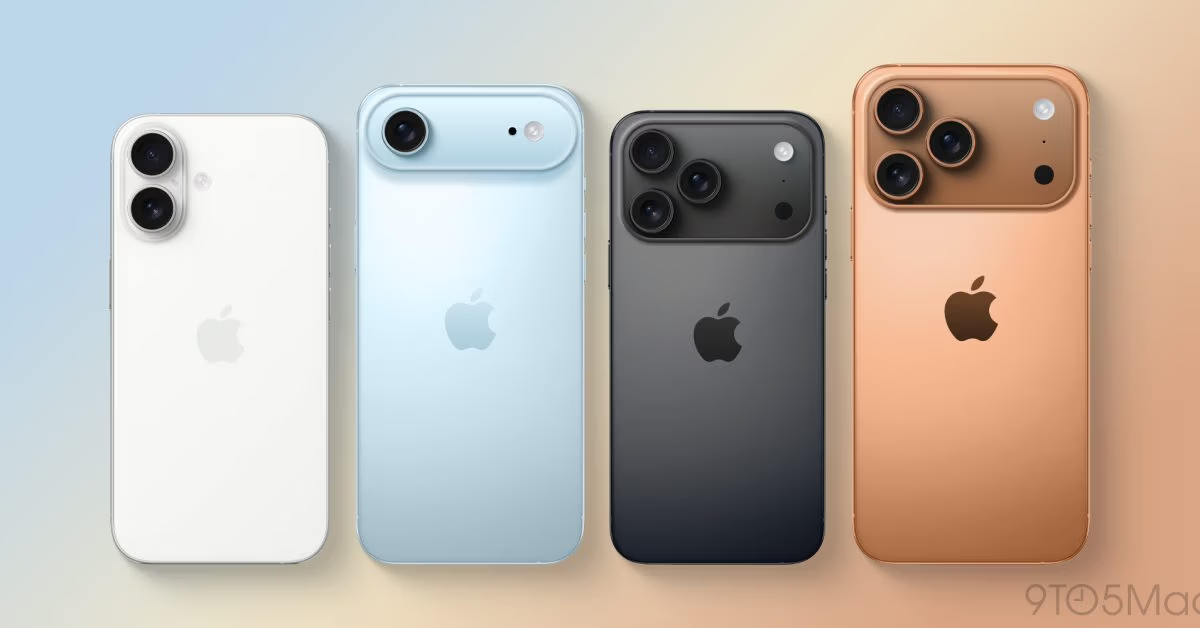
In the ceaseless quest for better smartphone endurance, every millimeter of internal space is precious. Battery life remains the holy grail for users, and manufacturers are constantly juggling power efficiency, component size, and internal layout to squeeze out an extra hour or two. This is precisely why a recent leak regarding the iPhone 17’s battery capacity has sparked significant interest, offering a fascinating glimpse into Apple’s long-term strategy and the tangible benefits of a technology that many initially viewed as merely a convenience: the eSIM.
For years, the physical SIM card tray has been a stalwart presence in our phones. Then, with the iPhone 14, Apple took a bold step in the US market, ditching the physical tray entirely in favor of an eSIM-only approach. While many debated the immediate pros and cons – greater security, easier international travel, but also potential carrier hiccups – the most compelling advantage for Apple and its users might only now be coming to light.

The latest whispers suggest that the iPhone 17 models, particularly those destined for eSIM-exclusive markets, are poised to receive a noticeable bump in battery capacity. The implication is clear: by removing the physical SIM card tray, Apple has reclaimed a small but significant internal volume. And what better way to utilize that newfound real estate than to expand the battery?
This isn’t just about a slightly bigger battery; it’s about a strategic leveraging of design choices that pays dividends years down the line. Apple is notoriously meticulous about internal design. They understand that even a fraction of a millimeter can house a more efficient antenna, a larger camera sensor, or, as we’re now seeing, a few extra milliampere-hours (mAh) of battery. The “better than expected” capacities reported by this leak underscore Apple’s commitment to optimizing every available speck of internal space.
What Does This Mean for the Future?
This leak, if accurate, signals several significant shifts:
- Accelerated eSIM Adoption: For regions where physical SIM trays still exist alongside eSIM, this news presents a powerful incentive for both carriers and consumers to embrace the digital future. When “better battery life” becomes a direct outcome of going eSIM-only, the resistance will undoubtedly wane. We could see Apple push even harder for global eSIM adoption in subsequent models, potentially leading to regional hardware divergence becoming more pronounced.
- Regional Hardware Differentiation: This is a crucial point. While iPhones generally offer a unified experience worldwide, this battery advantage means that an iPhone 17 sold in an eSIM-only market might genuinely offer superior battery endurance compared to an identical model sold in a market that still requires a physical SIM tray. This could lead to interesting debates about regional equity in hardware benefits.
- Apple’s Unseen Design Advantage: This move highlights Apple’s long game in design. Removing the SIM tray wasn’t just about streamlining; it was about laying the groundwork for future improvements. We often laud Apple for its external aesthetics, but their internal engineering brilliance is just as impactful. Every internal component is a puzzle piece, and freeing up even a tiny space allows for more critical components to flourish.
- Beyond Battery: While the immediate benefit is battery, consider the future. This freed-up space could, in theory, be allocated to other components down the line – perhaps more advanced haptic engines, larger camera modules, or even new sensors that require minimal space. It’s a testament to the fact that internal volume is one of the most valuable resources in a smartphone.
The iPhone 17’s potential battery boost for eSIM-only models is more than just a spec bump. It’s a strategic move that reinforces Apple’s vision for a simpler, more efficient, and ultimately more capable smartphone. It nudges the industry further towards a digital future and reminds us that sometimes, the most significant innovations are born from the subtle reclamation of internal space.
Read the original story at 9to5Mac.
What are your thoughts on Apple’s eSIM strategy and the potential for regional battery differences in future iPhones? Share your predictions in the comments below!