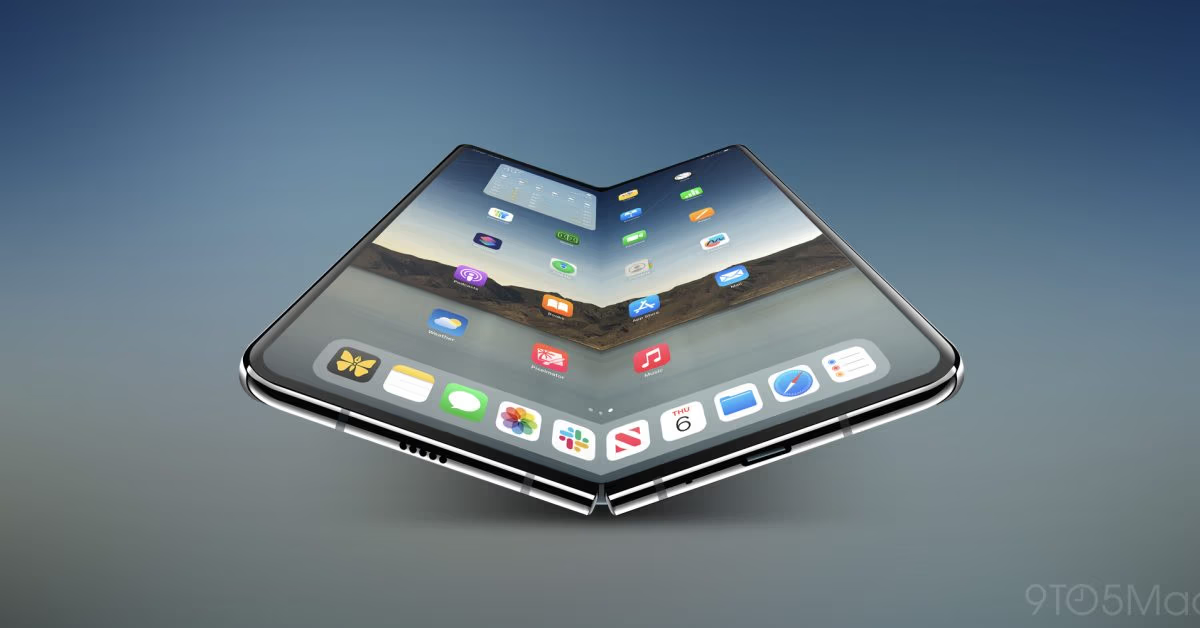
Apple’s Foldable iPhone Isn’t a ‘Fold,’ It’s an ‘Air’ – And That Changes Everything
For what feels like an eternity, the foldable iPhone has been the white whale of tech rumors—a mythical creature always on the horizon, perpetually just out of reach. While tech giants like Samsung, Google, and Motorola have bravely ventured into the flexible screen arena, defining the nascent market with their innovative yet often compromised offerings, Apple has maintained its characteristic silence, observing from the sidelines. We’ve seen countless patents hinting at their exploration of the technology, and whispers suggesting various approaches, but never a concrete product. Now, however, a new report from reputable sources suggests that Apple’s highly anticipated entry into the flexible screen arena is not only getting closer, but their strategy is classic Apple: they’re not just making a foldable device; they’re aiming to fundamentally redefine what a foldable can be.
The latest, tantalizing details circulating within the industry and reported by tech insiders suggest we could see this groundbreaking device as early as late 2025. But the most significant and telling clue isn’t about the intricacies of the hinge mechanism or the resolution of the flexible display. Instead, it’s a philosophical insight, an understanding of the product’s core identity. The foldable iPhone, according to these reports, may share its conceptual DNA with a product line that doesn’t even exist yet within the iPhone ecosystem: the “iPhone Air.”

This single detail—the potential “Air” moniker—is the critical key to unlocking and understanding Apple’s entire approach to the foldable category. It signals a strategic intent that transcends mere technical innovation and delves deep into user experience and industrial design.
It’s Not About the Fold, It’s About the Feel
To truly grasp the significance of the “Air” designation, we must first recall what that moniker has historically meant in Apple’s product universe. The original MacBook Air, unveiled with Steve Jobs famously pulling it from a manila envelope, wasn’t merely the first thin and light laptop on the market. It was a revelation that perfected the concept, making ultra-portability mainstream, desirable, and synonymous with uncompromised performance. Similarly, the iPad Air found its perfect niche by striking a delicate balance between the raw power and professional capabilities of the iPad Pro line and the extreme portability and approachability of the iPad mini. In Apple’s lexicon, “Air” implies a deliberate and unwavering prioritization of thinness, lightness, and an overall feeling of effortless integration into your daily life, all achieved without making critical compromises on performance, battery life, or durability.
This commitment to an “Air” experience is precisely where many current foldable smartphones, despite their technological marvel, often fall short. They are undeniably impressive feats of engineering, showcasing cutting-edge flexible displays and intricate hinge designs. However, they are also frequently characterized by being noticeably thick, surprisingly heavy, and often burdened by a visible and tactile crease across the display. From a user’s perspective, they can feel like a first-generation compromise, a fascinating proof of concept that hasn’t quite achieved the seamless elegance expected from a truly refined consumer device. The bulk can make them uncomfortable in a pocket, the weight can cause fatigue during extended use, and the crease, while diminishing with newer generations, remains a constant reminder of the technology at play, rather than a transparent tool.
If the new reports are to be believed, Apple is playing its typical patient game, waiting not just for the technology to mature, but until it can comprehensively solve these fundamental ergonomic and aesthetic problems that plague existing foldables. Their ultimate goal isn’t merely to produce an iPhone that can bend; it’s to engineer a foldable smartphone that doesn’t just bend, but feels impossibly thin, remarkably light, and utterly seamless in the hand. The ambition is to create a device that defies the current perception of foldables as bulky compromises, instead offering an experience that is effortlessly “Air-like,” feeling natural and premium, rather than like a brick in your pocket.
Designing for the Invisible: Apple’s Pursuit of Seamlessness
Apple’s design philosophy has always revolved around making complex technology feel intuitive and almost invisible to the user. For a foldable “iPhone Air,” this means tackling the notorious challenges of hinge bulk and screen creasing head-on. Imagine a hinge mechanism so meticulously engineered that it virtually disappears into the device’s profile when closed, contributing minimal thickness. Envision a flexible display material that is not only incredibly durable but also exhibits an almost imperceptible crease, delivering a perfectly smooth visual and tactile experience whether the device is open or closed. This level of refinement requires not just advanced materials science and manufacturing prowess but also an obsessive attention to detail that has long been Apple’s hallmark.
The pursuit of an “Air” aesthetic in a foldable also extends to weight distribution. A perfectly balanced device, even one that is slightly heavier, can feel lighter and more comfortable in the hand. Apple will likely invest heavily in custom components, optimized layouts, and perhaps even innovative battery technologies to achieve an overall weight and balance that is far superior to current market offerings. This isn’t just about shaving off grams; it’s about crafting a haptic experience that feels natural and premium, echoing the effortlessness implied by the “Air” brand.
A Clamshell with a Twist
According to the prevailing reports, Apple is strongly leaning towards a clamshell design for its initial foldable iPhone—think of it aligning more with the compact form factor of a Galaxy Z Flip rather than the book-style expansiveness of a Galaxy Z Fold. This choice makes profound strategic sense for a first-generation product entering a nascent, albeit growing, market. A clamshell is inherently a more personal, pocketable, and frankly, less intimidating form factor. It extends the familiar, beloved iPhone experience by making it even more compact when closed, rather than attempting to merge it with an iPad, which a book-style foldable often aims to do. This approach minimizes the learning curve for users and leverages existing muscle memory associated with traditional smartphones, thereby reducing friction for early adopters.
But the real design intrigue, and where Apple is expected to inject its signature innovation, comes from a rumored “wraparound” cover display. This isn’t just about placing a larger or more functional screen on the exterior; the “wraparound” concept hints at a seamless, flowing design that could radically redefine the aesthetics of a clamshell foldable. Unlike other clamshells that often feature a distinct, rectangular cover display set within a hard bezel, Apple’s rumored approach suggests a display that might curve significantly around the edges, blending almost imperceptibly into the device’s frame. This could not only eliminate harsh bezels but also create a visually striking effect, making the device appear as if it’s crafted from a single, continuous piece of glass and metal.
The Magic of the Wraparound Display
Imagine the possibilities of such a “wraparound” cover display. Notifications could dynamically flow across the curved edges, providing glanceable information without interrupting the overall aesthetic. Contextual controls, quick access widgets, and even advanced camera preview functions could be integrated in a way that feels organic and intuitive, rather than segmented. This could transform the cover display from a secondary afterthought into a primary interactive surface, offering more dynamic and edge-to-edge notifications, widgets, and potentially even unique UI interactions when the device is closed. It’s a classic Apple flourish—taking a standard feature found in competitors and polishing it, reimagining its integration, and elevating its utility until it feels entirely new and magical, pushing the boundaries of industrial design and user interface.
The engineering challenges behind such a wraparound display are substantial, involving intricate glass-bending techniques, precise display panel integration, and robust protection against everyday bumps and scratches. However, if Apple can execute this vision, it would undeniably set a new benchmark for clamshell foldables, once again proving their ability to transform advanced technology into an accessible and aesthetically pleasing user experience. This design choice underscores Apple’s commitment to visual continuity and seamless interaction, turning what could be a mere functional element into a distinctive design language.
The Future is a Fashion Statement
So, who exactly is this sophisticated and ultra-thin foldable iPhone “Air” designed for? The report strongly suggests a premium price tag, likely soaring significantly above even the already high cost of the top-tier Pro Max models of current iPhones. This isn’t a device destined to become your standard iPhone replacement anytime soon; don’t expect the “iPhone Fold” (or more fittingly, perhaps “iPhone Air Fold” or just “iPhone Air”) to achieve mass market penetration in its initial iteration.
Instead, to understand its positioning, think of it less as a typical smartphone and more like Apple’s historical “halo products.” Consider the original Apple Watch Edition, crafted from solid 18-karat gold and priced at a staggering $10,000 to $17,000. Or, more recently, the Vision Pro spatial computer, which launched as a groundbreaking, albeit expensive, new computing platform. These devices weren’t about immediate volume sales; they were about making a bold statement, showcasing Apple’s technological prowess, and establishing a new benchmark for an emerging category.
This foldable iPhone Air will be precisely that: an ultra-premium tier product. It’s designed to be a potent combination of a technology marvel and an undeniable fashion statement. It will cater to early adopters with significant disposable income, tech enthusiasts who crave the absolute cutting edge, and individuals who view their devices as extensions of their personal style and status. It will be the device for those who demand the best, the most innovative, and the most exclusive technology available.
Paving the Way: The Trickle-Down Effect
Crucially, as a halo product, the foldable iPhone Air will serve as a powerful proving ground and a technological vanguard. The advanced materials, sophisticated hinge mechanisms, groundbreaking display technologies, and refined user interface innovations developed for this premium device won’t remain exclusive forever. Historically, Apple has consistently introduced bleeding-edge features in its high-end or experimental products, allowing the technology to mature and production costs to decrease, before trickling down into more mainstream devices years later. Features like ProMotion displays, Ceramic Shield, and advanced camera capabilities first appeared in Pro models before becoming more widely available.
Therefore, Apple isn’t entering the burgeoning foldable race merely to compete on raw specifications or to simply catch up with existing players. Their strategy, as always, is to redefine the category entirely, to set an entirely new standard for design, ergonomics, and the overall user experience. If these compelling rumors hold true, the first foldable iPhone won’t just be about demonstrating what a flexible screen can do; it will be about showcasing how effortlessly and beautifully it can integrate into your life, about how it feels while doing it, and about the sheer elegance of its design. The future of the iPhone isn’t just about being flexible; it’s about being impossibly thin, undeniably light, and inherently intuitive. And for anyone who appreciates Apple’s meticulous approach to product design, that is a far more exciting and compelling proposition than just another foldable phone.
Read the original story at 9to5Mac.
What are your thoughts on Apple’s rumored “iPhone Air” approach to foldables? Do you think thinness and feel are more important than just the folding capability?