Japan’s Air Self-Defense Force Takes Flight: A Historic Global Deployment
For nearly eight decades, Japan’s post-World War II identity has been defined by a constitutionally-mandated pacifism, specifically Article 9, which renounces war and the use of force. This deeply ingrained principle has, until recently, confined Japan’s military footprint largely to its own shores and immediate self-defense. Yet, a profound transformation is now unfolding in the global security landscape, with Japan at its very heart.
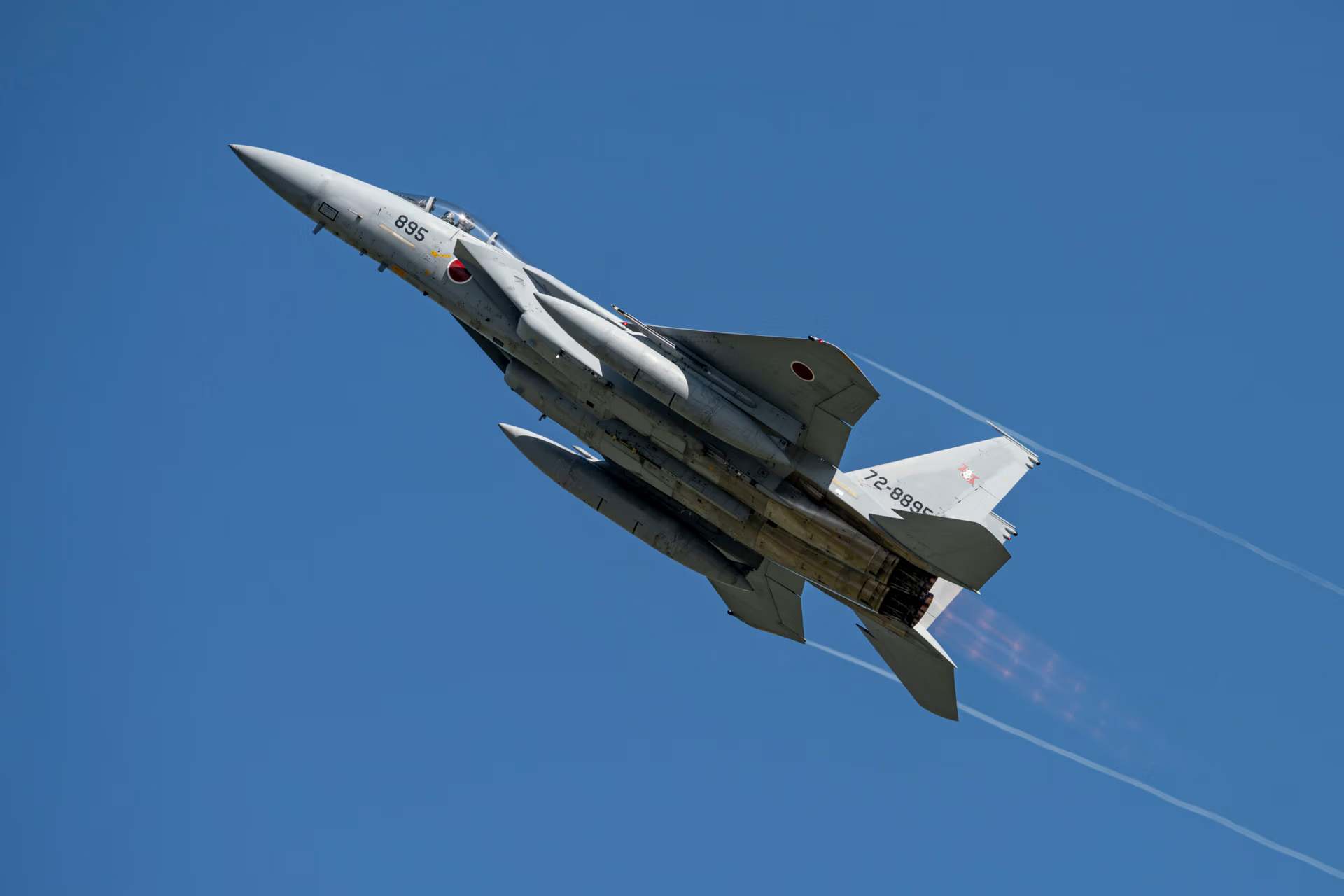
A spectacle once deemed impossible is now a tangible reality: Japanese F-15 and F-2 fighter jets, formidable symbols of the nation’s Air Self-Defense Force (ASDF), are operating thousands of miles from the Indo-Pacific, touching down on runways in Germany, Canada, and the United States. This unprecedented deployment, a central component of the sprawling “Pacific Skies 24” multinational exercise, transcends mere military logistics. It represents a seismic shift in Japan’s strategic posture and a clear redefinition of its role in a rapidly evolving global order. The sight of these aircraft, bearing the distinctive red disc insignia, soaring over distant skies is not merely an act of military cooperation; it is a powerful declaration, signaling that Japan is ready to assume a far more active, front-line role in upholding international peace and security.

This endeavor is far from a ceremonial goodwill tour. It is a meticulously planned and executed mission designed to stress-test and solidify the interoperability of allied forces across continents. The implications stretch beyond the technical details of aerial combat and joint maneuvers; they underscore a fundamental strategic realignment, born from a sobering realization shared by the world’s leading democracies: the security challenges of the Euro-Atlantic and the Indo-Pacific are no longer isolated concerns. They are, in fact, indivisibly linked, demanding a unified and robust response.
Pacific Skies 24: Forging a Global Interoperability Network
At the core of this historic deployment lies “Pacific Skies 24,” an ambitious multinational exercise designed to forge deeper military collaboration. This rigorous crucible is testing and refining the nuts and bolts of interoperability—the essential ability of diverse national militaries to operate as a single, cohesive fighting force across vast geographical and technological divides. True interoperability is the linchpin for transforming disparate forces into a formidable, unified alliance capable of responding to complex global threats.
Achieving this involves overcoming significant hurdles, from seamless communication systems like compatible data links (e.g., Link 16) that enable real-time tactical information sharing, to intricate logistical challenges such as mid-air refueling compatibility, shared maintenance protocols, and standardized spare parts. Beyond hardware, “Pacific Skies 24” aims to harmonize diverse doctrines and tactics. By flying complex simulated combat scenarios together, pilots, ground crews, and command staff learn to think, act, and react in concert, fostering mutual trust and confidence crucial for any effective military alliance.
The strategic value of this deep-seated interoperability is paramount. In an era where potential adversaries are rapidly modernizing and employing sophisticated anti-access/area-denial (A2/AD) strategies, a unified, agile response is critical. By demonstrating the ability to integrate operations seamlessly across continents, Japan and its allies send a clear message: their collective strength transcends individual capabilities, significantly enhancing deterrence against any nation contemplating aggression against democratic values and international norms.
The Indivisible Link: Connecting Euro-Atlantic and Indo-Pacific Security
While the immediate objectives of “Pacific Skies 24” focus on enhancing operational capabilities, the exercises signify a far deeper and more profound strategic realignment—a recognition that the geopolitical chessboard has fundamentally changed. A new, sobering reality has firmly taken root in the strategic capitals of the world, from Tokyo to Brussels, Washington D.C. to Ottawa: the security of the Euro-Atlantic and the Indo-Pacific are not disparate concerns, but rather two sides of the same indivisible coin. This deployment is the stark physical manifestation of that realization.
For decades, strategic thinkers often compartmentalized global threats, viewing regional instabilities through distinct lenses. However, the events of the past few years have shattered this siloed approach. Russia’s unprovoked and brutal full-scale invasion of Ukraine in February 2022 served as a stark, undeniable lesson to democratic nations worldwide. It demonstrated with chilling clarity that authoritarian aggression, if left unchecked in one region, invariably emboldens similar ambitions in another. The playbook of disinformation, territorial conquest, and disregard for international law employed by Moscow resonates deeply with the concerns many Indo-Pacific nations hold regarding Beijing’s assertive posture.
For Japan, this connection is not abstract; it is acutely felt and profoundly impactful. The prospect of a conflict over Taiwan, fueled by an increasingly assertive China, is not a distant geopolitical problem but an immediate and existential threat. Taiwan lies less than 70 miles from Japan’s Yonaguni Island, and the critical sea lanes through the Taiwan Strait are vital arteries for global trade, particularly for Japan’s resource-dependent economy. Any instability in this region would have catastrophic consequences for Japan’s security, economy, and national way of life. China’s rapid military buildup, its aggressive claims in the South China Sea, and its frequent incursions into Japanese territorial waters around the Senkaku Islands all reinforce this sense of urgency.
The message being conveyed through these extensive joint exercises is therefore unmistakable and powerful: an attack on one is the concern of all, irrespective of geographical distance. This new collective security paradigm is built on shared democratic values and a mutual understanding of the interconnected threats posed by authoritarian revisionism. It suggests a proactive, global response to challenges that were once considered regional. By actively engaging in exercises far from home, Japan is demonstrating its commitment to this broader security framework, not just as a rhetorical stance but as an operational reality. The world’s leading democracies are forging a deterrent posture that transcends traditional alliances, aiming to present a united front that complicates the calculus of potential aggressors and reinforces the rules-based international order.
A Quiet Revolution: Japan’s Evolving Defense Posture
This unprecedented deployment marks a quiet yet profound revolution within Japan itself. For decades, the nation was renowned for its economic and cultural soft power, meticulously avoiding any perception of military assertiveness due to Article 9’s strict interpretation. The notion of Japanese military aircraft participating in high-intensity exercises across the Atlantic would have been unthinkable just a few years ago.
However, the geopolitical landscape surrounding Japan has dramatically deteriorated. An increasingly assertive China, relentlessly expanding its military influence; a nuclear-armed North Korea, rapidly developing ballistic missiles; and a newly aggressive Russia, whose actions in Ukraine reverberate globally, have collectively created an urgent imperative for change. These direct and palpable threats have slowly but decisively eroded Japan’s post-war reticence towards a more robust defense stance.
Under Prime Minister Fumio Kishida’s leadership, Japan has embarked on a dramatic transformation. A landmark decision was made to double the defense budget to 2% of GDP by 2027, aligning with NATO standards and signaling serious intent. This substantial increase funds crucial modernization, including advanced stealth fighters and long-range missiles. More significantly, Japan is now developing counter-strike capabilities, a dramatic departure from its strictly defensive posture, allowing pre-emptive strikes against imminent threats.
This strategic evolution empowers Japan with greater agency and a more credible deterrent force against potential aggressors. This internal “revolution” has largely been driven by necessity, with public opinion increasingly recognizing the need for a stronger national defense. Japan is transitioning from a passive beneficiary of the international order to an active, responsible, and capable underwriter of it, signaling its readiness to maintain stability and peace both regionally and globally.
A Message in Contrails: Japan’s Hard Power Diplomacy
The deployment of Japanese fighter jets to distant allied airspaces, under the banner of “Pacific Skies 24,” is the most visible and potent manifestation of Japan’s new defense strategy—it is hard power diplomacy written in contrails. This highly tangible demonstration serves a critical dual purpose: to reassure allies of Japan’s commitment and capability, and, perhaps more significantly, to send an unmistakable deterrent message to revisionist powers in Beijing and Moscow.
To China, the message is clear and multi-faceted. As Beijing continues its aggressive expansion in the South China Sea, escalates its rhetoric regarding Taiwan, and persistently challenges Japanese administration of the Senkaku Islands, the sight of ASDF jets operating seamlessly with NATO and North American forces signals a profound shift. It underscores that any regional aggression orchestrated by China would not be met by Japan in isolation, but by a coordinated, global response from a network of highly capable democratic nations. This significantly complicates China’s strategic calculus, raising the stakes and increasing the potential costs of any military adventurism.
Similarly, to Russia, still reeling from the global fallout of its invasion of Ukraine and increasingly eyeing its strategic presence in the Indo-Pacific, Japan’s robust global engagement serves as a potent counterpoint. The deployment demonstrates that Japan’s enhanced defense posture and its deepening alliances extend far beyond theoretical statements; they are operational realities backed by state-of-the-art military capabilities. This collective show of force acts as a powerful deterrent, signaling that aggressive actions against any democratic ally could trigger a broad, internationally coordinated response, making unilateral actions far riskier.
This active projection of military capability is far more than symbolic; it lends critical credibility to Japan’s renewed commitment to international security. It moves beyond the traditional perception of Japan as a nation solely reliant on the U.S. security umbrella, repositioning it as an active and indispensable contributor to collective defense. By demonstrating its ability to operate globally, Japan is showcasing its formidable military capabilities and its unwavering resolve to uphold the rules-based international order. This is a powerful declaration that Japan’s alliances are robust, operational, and globally integrated, providing a credible deterrent against those who seek to undermine stability through force.
The New Normal: A Global Democratic Security Network Takes Shape
The journey of Japanese fighter jets to the distant skies of Europe and North America is not merely a fleeting moment in international relations; it is the leading edge of what is rapidly becoming the new normal. We are witnessing the active formation of a sophisticated, resilient global democratic security network, a tapestry of alliances and partnerships that stretches across continents and oceans, fundamentally redefining the architecture of international security.
This emerging network is distinct from historical military blocs. While formal treaties and bilateral agreements remain crucial, this new coalition is built on a deeper foundation of shared values, democratic principles, and a collective understanding of the interconnected nature of modern threats. Nations like Japan, Canada, Germany, France, and the United States recognize that challenges such as authoritarian aggression, cyber warfare, economic coercion, and climate change transcend geographical boundaries, demanding a coordinated, global response, rendering isolated defense strategies obsolete.
The implications of this shift are profound for international relations. Traditional regional security organizations, such as NATO in the Euro-Atlantic and various bilateral treaties in the Indo-Pacific, are increasingly engaging in cross-regional dialogue and cooperation. NATO’s intensified focus on the Indo-Pacific, coupled with Japan’s direct engagement with NATO members and North American allies, illustrates a strategic convergence. Initiatives like the Quad (Quadrilateral Security Dialogue involving the U.S., Japan, Australia, and India) and AUKUS (Australia, UK, U.S. security pact) are further examples of this multi-layered approach to collective security, with Japan emerging as a central pillar in this evolving framework.
The sight of Japanese jets operating seamlessly on NATO runways is no longer an anomaly to be dissected for its symbolic value; it is an operational blueprint for the future. It epitomizes an era where distance no longer guarantees safety, and where robust, integrated alliances are the ultimate currency of power and stability. This new era mandates a proactive approach to deterrence and defense, requiring nations to look beyond their immediate neighborhoods and contribute actively to global security challenges.
As this global democratic security network solidifies, it aims to create a collective deterrent against any actors seeking to unilaterally alter the international order through force or coercion. It’s a powerful affirmation that the defense of democracy, sovereignty, and the rule of law is a shared responsibility, executed through integrated capabilities and unwavering commitment. The skies over Europe and North America are now silent witnesses to this profound transformation, broadcasting a message of unity and resolve to a world in flux.
Read the original story at Atlantic Council.
What are your thoughts on Japan’s evolving role in global security, and how do you foresee these integrated alliances shaping the future of international relations?