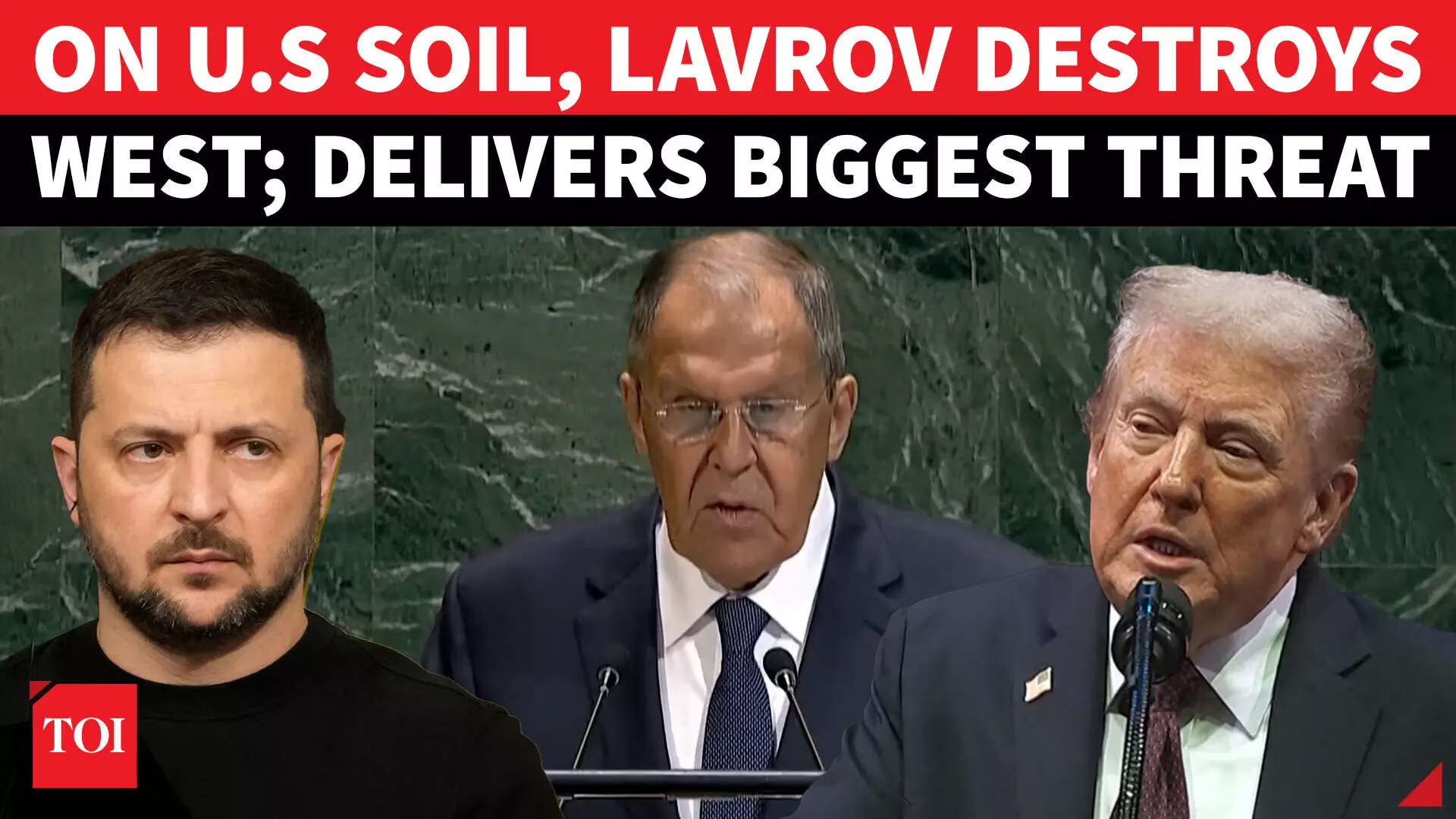
When Russian Foreign Minister Sergey Lavrov stepped up to the podium at the UN General Assembly, the world wasn’t just listening to a defense of the war in Ukraine. They were witnessing the defiant articulation of a new world order—one in which Moscow sees itself as the vanguard against a declining, yet dangerously aggressive, Western hegemon.
Lavrov’s address was less a diplomatic speech and more an unflinching broadside, a rhetorical drawing of new battle lines on the global stage. It was a carefully constructed presentation, designed not just for the immediate audience in the hall, but for a global audience, particularly those nations often referred to as the “Global South,” signaling a profound shift in Russia’s engagement with international diplomacy and its vision for future global governance. The speech resonated with historical grievances and offered a stark glimpse into the Kremlin’s hardened stance, suggesting that the era of post-Cold War cooperation, however tenuous, is definitively over.

The Irreversible Divide: Russia’s Rejection of the West
The key takeaway from Lavrov’s fiery remarks was the unequivocal finality of the divorce between Russia and the West. This wasn’t merely a critique of specific Western policies or sanctions; it was a fundamental rejection, a declaration that the two entities now stand as civilizationally distinct and ideologically incompatible. Lavrov meticulously painted a picture of a West driven by what he termed “Russophobia”—an irrational, deep-seated animosity rooted in centuries of historical encounters and rivalries—and an inherent “neocolonial desire” to subjugate sovereign nations, especially those attempting to assert independent foreign policies. He argued that this deep-seated prejudice, far from being a recent phenomenon, has permeated Western foreign policy towards Russia for decades, culminating in the present conflict in Ukraine.
In the Kremlin’s meticulously crafted narrative, the conflict in Ukraine transcends its immediate regional context. It is not just a war over territorial integrity or geopolitical influence, but rather the flashpoint of a much larger, “generational struggle.” This struggle, according to Moscow, represents the culmination of decades of broken promises and perceived betrayals, chief among them the eastward expansion of NATO. Lavrov reiterated Moscow’s long-held assertion that commitments made after the fall of the Berlin Wall—allegedly promising no NATO expansion “one inch eastward”—were systematically violated. Russia views this expansion not as a defensive alliance’s natural growth, but as an inexorable march toward its borders, an existential threat designed to encircle, weaken, and ultimately dismantle the Russian state. Lavrov underscored that this perceived encirclement, coupled with the West’s alleged support for what Moscow calls a “regime change” agenda in Kyiv dating back to the 2014 Maidan events, left Russia with no alternative but to act to protect its security interests and the rights of Russian-speaking populations within Ukraine.
This deep-seated distrust and historical grievance form the bedrock of Russia’s current foreign policy posture. Lavrov underscored that Moscow sees the West’s actions, from the imposition of sweeping sanctions to the massive military aid provided to Ukraine, as part of a continuous, hostile effort to undermine Russian sovereignty and prevent the emergence of a truly multipolar world. He argued that the West’s insistence on a unipolar world, dominated by its own values, economic models, and strategic interests, is the root cause of current global instability, framing Russia as a victim forced to respond rather than an aggressor. This framing serves not only to justify current military actions and future diplomatic postures but also to cement the ideological chasm that now separates Russia from the collective West, suggesting that their reconciliation under current conditions is virtually impossible.
The Demolition of Diplomatic Off-Ramps
This resolute framing of the conflict is crucial for understanding Russia’s future actions and its approach to any potential peace negotiations. By presenting the West as an irredeemable aggressor incapable of sincere dialogue, Lavrov effectively slammed the door on any peace formula that does not fully concede to Moscow’s core demands. He explicitly dismissed Western-backed peace initiatives, including those proposed by Ukraine’s President Zelenskyy, as not only futile but disingenuous—mere ploys, in his view, to buy time, to rearm Ukraine, or to dictate terms unfavorable to Russia without genuine consideration for Moscow’s security concerns. Such initiatives, he suggested, fail to acknowledge the fundamental shift in geopolitical realities.
For Lavrov, the only acceptable resolution is one that unequivocally recognizes Russia’s “new territorial realities.” This phrase is loaded with immense significance, implying the permanent annexation of Ukrainian territories currently occupied or claimed by Russia, including Crimea, Luhansk, Donetsk, Zaporizhzhia, and Kherson. It suggests that any negotiation must begin with an acceptance of these facts on the ground, thereby rendering discussions about Ukraine’s internationally recognized sovereignty and territorial integrity moot from Moscow’s perspective. This maximalist stance leaves virtually no room for compromise, as it directly contradicts international law and the fundamental principles upon which the UN was founded, signaling a long-term commitment to its objectives, irrespective of international condemnation or sanctions. The message is clear: Russia views these territories as irrevocably part of the Russian Federation and will not negotiate their return under any circumstances.
This is decidedly not the language of compromise, but rather the unequivocal declaration of a power that believes it can, and indeed must, outlast its adversaries. It reflects a strategic patience and a deep-seated conviction that time is on Russia’s side, especially as global geopolitical alignments continue to shift and Western unity faces increasing internal pressures. Moscow appears to be betting on the eventual fatigue of Western financial and military support for Ukraine, the erosion of Western economic stability due to sanctions blowback, and the growing influence of non-Western powers who may be more amenable to Russia’s vision of a multipolar world. Lavrov’s speech underscored that Russia views this as a zero-sum game, where its security and its desired world order can only be achieved through the direct challenging and weakening of Western hegemony and its established international frameworks.
The implications for international diplomacy are profound. With Russia rejecting universally accepted principles of territorial integrity and sovereign equality in favor of its “new realities,” the pathways for conventional diplomatic engagement become severely constrained. The concept of “negotiation” itself is redefined, shifting from a process of mutual concession to one where Russia expects its demands to be met. The message is clear: Russia is not seeking a mediated peace that restores the pre-2022 status quo; it is seeking a post-conflict settlement that legitimizes its gains and fundamentally reshapes the regional security architecture to its advantage. This uncompromising stance suggests that the conflict, in Moscow’s view, will only conclude when its strategic objectives are met, either through military success or through the international community’s eventual, albeit reluctant, acceptance of its territorial claims.
Forging a New Global Coalition: The Appeal to the Global South
Beyond the immediate conflict in Ukraine, Lavrov’s speech was a direct, calculated appeal to the “global majority”—the vast constellation of nations, primarily across Africa, Latin America, and Asia, often referred to as the Global South. These nations have largely resisted taking explicit sides in the geopolitical struggle between Russia and the West, preferring to prioritize their own national interests, economic development agendas, and non-aligned foreign policies. Lavrov masterfully positioned Russia not as an aggressor, but as a champion of a multipolar world order, a staunch defender of the UN Charter’s fundamental principle of sovereign equality for all nations, irrespective of their size or economic power.
He starkly contrasted this vision with what he described as a “Western-imposed ‘rules-based order’,” a phrase frequently employed by Moscow to undermine the legitimacy of Western-led international institutions and norms. Lavrov argued that under this so-called order, the rules are not universal or immutable but are selectively written and rewritten by Washington and its allies to suit their immediate geopolitical and economic interests. He accused the West of hypocrisy, citing historical examples such as the invasion of Iraq without UN Security Council approval, the intervention in Libya, or the imposition of unilateral sanctions on numerous countries, all while simultaneously demanding strict adherence to international law and principles when it serves their agenda. This narrative resonates powerfully with many countries in the Global South that have experienced direct or indirect intervention from Western powers.
This is Moscow’s grand strategic play: to position itself as the ideological and, increasingly, practical anchor of an alternative global coalition. This nascent coalition, according to Russia’s vision, would be united not necessarily by shared political systems or democratic ideals, but by a common, profound grievance against perceived Western dominance and a desire for greater autonomy and equity on the world stage. Lavrov underscored Russia’s commitment to strengthening forums like BRICS (Brazil, Russia, India, China, South Africa) and the Shanghai Cooperation Organization (SCO) as integral components of this emerging multipolar architecture, offering them as platforms for more equitable economic, security, and political cooperation free from Western conditionalities, aid dependencies, or human rights caveats.
By framing the conflict in Ukraine as a stand against Western neo-imperialism and a fight for genuine multilateralism, Russia seeks to resonate with the historical experiences of many Global South nations that endured colonial subjugation or post-colonial interference. The narrative is simple yet potent: Russia is fighting for the right of all nations to choose their own path, develop their own economies, and forge their own alliances, free from external coercion or the pressure of a single hegemonic power. This rhetorical strategy aims to cultivate diplomatic support, secure crucial economic partnerships (especially in energy, arms, and commodities), and foster an environment where Russia’s actions are viewed with greater understanding, if not outright endorsement, by a significant portion of the international community. It’s a long-term investment in building alternative power blocs that can collectively challenge the existing global hierarchy and create a more diversified, less Western-centric international system, ultimately aiming to dilute the power and influence of the G7 nations.
The Path Ahead: A Protracted Confrontation
Looking ahead, Lavrov’s UN General Assembly speech offers a stark and sobering preview of the diplomatic landscape for the foreseeable future. The chasm between Russia and the West is no longer merely a political disagreement over specific policies or territorial disputes; it is being framed, irrevocably, as an ideological and civilizational abyss. This fundamental divergence means that traditional diplomatic tools designed for de-escalation and compromise between states with shared foundational values are becoming increasingly ineffective, replaced by a discourse of irreconcilable differences and a zero-sum competition for global influence. The emphasis on “civilizational” differences suggests a conflict that runs deeper than political interests, touching upon distinct worldviews, historical narratives, and fundamental values.
We can, therefore, expect Russia to double down on strengthening its alliances with nations that share its anti-Western sentiments or seek strategic benefits from such partnerships. China and Iran stand out as prime examples, with Moscow intensifying economic, military-technical, and diplomatic cooperation. These partnerships are not opportunistic but represent core pillars of Russia’s strategy to build a robust counterweight to Western influence, particularly in Eurasia. Furthermore, Russia will continue to aggressively court countries in Africa, Latin America, and parts of Asia, not just with rhetoric but with tangible offers of energy deals, arms sales, security assistance, and infrastructure projects, often leveraging its historical ties from the Soviet era. These overtures are consistently made under the banner of a “more equitable global structure,” promising development and cooperation free from the perceived dictates of Western financial institutions or conditionalities often tied to human rights and democratic reforms.
For the West, the message from Lavrov is equally clear and ominous: the Kremlin is not just reacting to current events but is actively preparing for a long-term confrontation across multiple domains—geopolitical, economic, informational, and potentially military. The diplomatic off-ramps, once viewed as essential mechanisms for crisis management and de-escalation, are being systematically dismantled or rendered unusable by Russia’s maximalist demands and its outright rejection of established international norms concerning sovereignty and territorial integrity. This signifies a fundamental shift from a period of occasional friction and limited competition to an era of sustained strategic rivalry, where direct engagement on contentious issues is likely to remain minimal and unproductive, leading to prolonged global instability.
In this new paradigm, the world is being explicitly asked to choose a side, implicitly or explicitly, between the established Western-led order and Russia’s vision of a multipolar one. Lavrov’s address was not just a justification of past actions but a clear call to arms—a rhetorical one, for now—for nations to align themselves with Moscow’s vision of a global architecture that diffuses power more broadly. From Russia’s perspective, this contest has already begun, and it is a struggle not just for power or territory, but for the very future architecture of global governance and the prevailing ideological framework. The speech signals a prolonged period of instability and heightened tensions, where the pursuit of national interests will increasingly be conducted through the lens of this overarching ideological and civilizational struggle, making genuine dialogue and trust-building efforts extraordinarily challenging and raising the specter of continued proxy conflicts and diplomatic stalemates for years to come.
What are your thoughts on Lavrov’s stark pronouncements at the UN? Do you believe the world is indeed entering a new era of ideological confrontation, or is there still a viable path for diplomatic reconciliation between Russia and the West? Share your perspective in the comments below.
Read the original story at The Times Of India.