
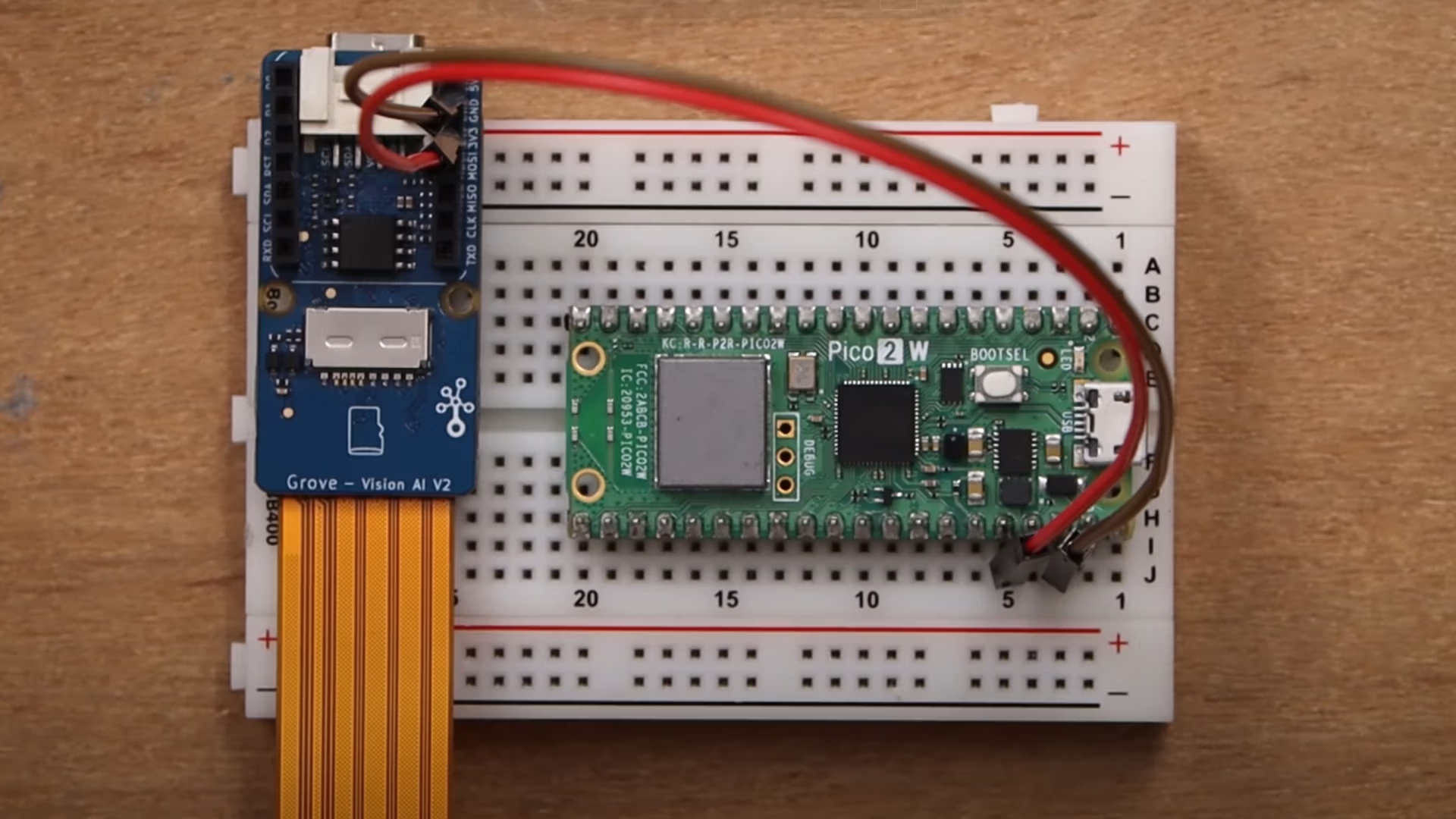
For years, the promise of ubiquitous artificial intelligence has been shadowed by a persistent challenge: power consumption. We’ve grown accustomed to the idea that powerful AI requires vast data centers, energy-hungry GPUs, and a constant connection to the cloud. But what if the most sophisticated AI tasks could run on a fraction of the power of a standard LED?
A recent breakthrough highlighted by Hackaday signals precisely such a paradigm shift, showcasing image recognition operating on an astonishing 0.35 Watts. To put that into perspective, we’re talking about power levels so low, they’re practically whispering. This isn’t just an incremental improvement; it’s a fundamental re-evaluation of where and how AI can exist.

The implications of such minuscule power consumption are profound. Imagine an AI system capable of understanding what it sees, but drawing less power than a small nightlight. This drastically low power footprint isn’t just a technical achievement; it’s a strategic enabler for an entirely new generation of smart devices. Suddenly, the constraints that have tethered advanced AI to power outlets and stable network connections begin to dissolve, paving the way for truly pervasive and sustainable intelligent systems.
The Power of Pennies: What 0.35 Watts Really Means for AI
To truly grasp the magnitude of operating complex image recognition at 0.35 Watts, consider common household electronics. A typical LED bulb consumes between 5-10 Watts. A smartphone charger, even when idle, can draw around 0.1-0.5 Watts, but actively charging or running an app like a camera uses significantly more. An average laptop easily consumes 40-60 Watts. In this context, 0.35 Watts for a sophisticated AI task is nothing short of revolutionary. It signifies an energy expenditure that is practically imperceptible in the larger power grid, opening up possibilities that were previously unimaginable for always-on intelligence, fundamentally shifting the cost-benefit analysis for AI deployment.
Historically, artificial intelligence, particularly deep learning models for computer vision, has been synonymous with immense computational power and corresponding energy demands. Training these models often involves server farms running thousands of GPUs for days or weeks, consuming megawatts of power. While the breakthrough showcased here focuses on inference – the application of a trained model – rather than training, the ability to perform complex inference at such low power levels is a monumental leap. It demonstrates that the promise of intelligent machines is no longer exclusively bound to the energy-intensive confines of massive data centers.
This remarkable power efficiency isn’t achieved by simply running simpler models or sacrificing accuracy. Instead, it’s the result of a meticulously optimized approach, spanning the entire computing stack. This includes:
- Specialized Silicon Design: Custom-designed microchips (often application-specific integrated circuits or ASICs) and highly optimized Digital Signal Processors (DSPs) are engineered from the ground up to execute AI inferencing tasks with maximum efficiency. Unlike general-purpose CPUs or GPUs, these dedicated hardware solutions eliminate unnecessary overhead, allowing for parallel processing of neural network operations with minimal energy waste. Advances in neuromorphic computing, which mimics the structure and function of the human brain, are also playing an increasing role in ultra-low-power AI.
- Highly Efficient Algorithms: Researchers are developing novel AI models that require fewer computational operations without compromising performance. Techniques like model quantization (reducing the precision of numerical calculations, e.g., from 32-bit floating point to 8-bit or even 4-bit integers) and neural network pruning (identifying and removing redundant or less critical connections and neurons) significantly reduce the memory footprint and processing demands. Knowledge distillation, where a smaller, more efficient model learns from a larger, more complex one, also contributes to creating lean, yet powerful, edge AI models.
- System-Level Integration and Software Optimization: The synergy between hardware and software is paramount. Every component, from the power delivery network to the memory architecture and the operating system’s scheduling, is meticulously designed to minimize energy waste during the AI processing pipeline. This holistic design approach ensures that every millijoule counts towards achieving the desired outcome, extending battery life and reducing operational costs dramatically.
The key takeaway here is the liberation of AI from its traditional power shackles. This isn’t about compromising on capability; it’s about optimizing the entire stack – from specialized silicon to highly efficient algorithms and seamless system integration – to perform complex inferencing with unprecedented energy efficiency. This breakthrough ushers in an era where advanced computer vision and other AI capabilities can be embedded into nearly any device, regardless of its size or power budget, fostering a new wave of truly autonomous and reactive systems that can operate independently and sustainably.
From Cloud to Edge: Decentralizing Intelligence for a Smarter World
The most immediate and profound implication of this breakthrough is the accelerated shift from cloud-centric AI to truly edge AI. For years, the dominant paradigm for deploying advanced AI has been through cloud platforms. Devices would capture raw data – images, audio, sensor readings – and transmit it over networks to powerful, centralized data centers. Here, vast GPU clusters would perform the computationally intensive AI processing, sending back insights or commands to the edge device. While effective for many applications, this architecture introduces several significant limitations that have held back the full potential of pervasive intelligence:
- Latency: The round trip for data to travel from an IoT device to the cloud, be processed, and for commands to return can introduce delays measured in milliseconds to seconds. For real-time applications like autonomous driving, robotic control, or critical industrial automation, such latency is unacceptable and can lead to safety hazards or operational inefficiencies.
- Privacy Concerns: Sending sensitive data, especially visual information, biometric data, or proprietary industrial processes, to remote servers raises substantial privacy and security questions. Users and organizations are increasingly wary of their personal or confidential data being stored, processed, and potentially vulnerable to breaches on off-device servers, leading to calls for stronger data sovereignty.
- Network Reliance and Connectivity Costs: Cloud AI is entirely dependent on a stable, high-bandwidth internet connection. In remote areas, during network outages, or in environments with limited connectivity (e.g., underground, farmlands, outer space), cloud-dependent AI simply ceases to function. Moreover, constantly streaming large volumes of data, such as high-resolution video feeds from thousands of cameras, to the cloud can incur significant bandwidth costs and consume considerable energy at the transmission point.
- Scalability and Environmental Footprint: As the number of connected devices explodes, the sheer volume of data demanding cloud processing becomes unsustainable both in terms of infrastructure expansion and the environmental impact of powering increasingly large data centers.
The ability to run sophisticated image recognition and other AI tasks on mere milliwatts fundamentally alters this equation. With on-device processing, the intelligence can reside directly on the device itself. Instead of sending raw data, the device processes the information locally, extracts relevant insights, and only transmits high-level alerts, aggregated data, or compressed results. This paradigm shift empowers devices to make instantaneous, intelligent decisions without external reliance, marking a true decentralization of AI capabilities and overcoming many of the traditional barriers to widespread AI adoption.
Hyper-Efficient IoT for Unprecedented Scale and Autonomy
Imagine a world where Internet of Things (IoT) devices are not just connected but truly intelligent, operating with unparalleled energy efficiency. Smart cameras could analyze situations locally, identifying specific objects, events, or behaviors (e.g., detecting an intruder, recognizing a package delivery, or monitoring elderly residents for falls) and only sending alerts when genuinely necessary. This drastically reduces false positives, minimizes data transmission, and leads to ultra-long battery life, potentially for years on a small coin cell. Beyond security, consider industrial sensors that monitor critical manufacturing equipment for anomalies or predict maintenance needs based on real-time visual inspection, all without needing constant data streams to the cloud. In smart agriculture, image-based AI could assess crop health, detect pests, or optimize irrigation on a per-plant basis, operating autonomously in remote fields without reliable network access. Similarly, in smart cities, low-power AI on traffic cameras could optimize flow, while environmental sensors could monitor air quality and waste levels, feeding local decision-making nodes to improve urban efficiency and sustainability.
Truly Smart Wearables: Extending Human Capabilities and Well-being
The next generation of wearables will be defined by their on-device intelligence, moving beyond simple data collection to proactive, context-aware assistance. Picture augmented reality (AR) glasses or smartwatches capable of real-time object recognition, identifying landmarks, translating foreign text on the fly, or providing contextual information about your surroundings, all without rapidly draining their tiny batteries or requiring a constant phone connection. Beyond visual tasks, these devices could perform sophisticated gesture interpretation, analyze biometric data for advanced health monitoring (e.g., continuous glucose monitoring via optical sensors, early detection of cardiac issues), or even detect subtle emotional cues in conversations, offering discreet, intelligent assistance throughout your day. The ability to process this sensitive personal data locally enhances both performance and, crucially, user trust, as private information never leaves the device.
Autonomous Systems: Resilient and Responsive in Any Environment
For applications where immediate, reliable decision-making is paramount, low-power edge AI is a transformative force. Drones could gain sophisticated visual intelligence, enabling them to navigate complex, dynamic environments, identify targets, or perform intricate inspections (e.g., inspecting wind turbines for micro-fractures, mapping disaster zones) making critical decisions in the field without the need for constant communication back to a central hub. This is vital for operations in GPS-denied or communication-limited areas. Robots in manufacturing, logistics, or even domestic settings could perceive and react to their surroundings with greater autonomy and precision, adapting to dynamic changes in real-time, improving safety and efficiency. Remote environmental monitors could track wildlife behavior, assess forest health, or monitor geological activity for extended periods, providing vital data from inaccessible locations with minimal human intervention, making them more robust and self-sufficient.
Enhanced Privacy: Building Trust in an AI-Driven World
One of the most compelling advantages of localized AI processing is the significant bolstering of user privacy and data security, addressing a critical concern in the age of pervasive surveillance. When image recognition and other forms of visual analysis happen entirely on the device, sensitive visual data—be it faces, personal spaces, proprietary industrial information, or health records—never has to leave the device. This fundamentally mitigates the risks associated with data breaches, unauthorized access on remote servers, and the potential for data misuse by third parties. For industries like healthcare, finance, or government, where data sovereignty and regulatory compliance (such as GDPR, CCPA, and HIPAA) are paramount, on-device AI offers a robust solution. It empowers users with greater control over their personal information and builds essential trust in intelligent technologies, fostering a more ethical and responsible deployment of AI across society.
The Future is Local, Sustainable, and Truly Ubiquitous
This isn’t just about building smarter gadgets; it’s about building a smarter, more sustainable world. Reducing the power requirements for AI tasks on this scale has massive environmental implications, decreasing the energy footprint of countless connected devices. The cumulative effect of billions of devices performing AI tasks on milliwatts rather than watts can lead to significant reductions in global energy consumption, lessening the burden on power grids, reducing the need for expanded data center infrastructure, and contributing significantly to a more sustainable technological future. This shift also encourages innovation in battery technology and alternative energy harvesting methods (like solar, kinetic, or thermal energy scavenging) to further extend the operational lifespan of these intelligent edge devices, pushing towards true energy independence.
Furthermore, this breakthrough paves the way for AI to permeate environments where power is scarce or intermittent, or where robust network infrastructure is simply unavailable. This opens doors for applications in developing regions, empowering local communities with AI-driven solutions for precision agriculture, remote education, telemedicine, and localized resource management. It enables truly remote sensing in challenging environments, from monitoring deep-sea ecosystems and volcanic activity to exploring the surface of Mars and beyond, where every joule of energy is precious and connectivity is a luxury. It makes sophisticated AI truly ubiquitous, integrating seamlessly into our surroundings without demanding a second thought about battery life or network availability, democratizing access to powerful intelligence.
The future envisioned by science fiction, where our environments are intelligently responsive and seamlessly integrated with technology, is becoming increasingly tangible. From smart homes that anticipate our needs to public spaces that dynamically adapt for safety, accessibility, and efficiency, low-power, on-device AI will be the invisible engine driving this transformation. This low-power image recognition breakthrough isn’t just a headline; it’s a foundational step towards a world where intelligence isn’t confined to massive, energy-guzzling data centers but intelligently distributed, always on, and effortlessly integrated into the fabric of our lives. The quiet revolution has begun, and its whisper is set to redefine our understanding of AI’s potential and its profound role in shaping our shared future.
What specific application of ultra-low-power edge AI are you most excited to see become a reality in the next decade, and how do you think it will change our daily lives?