
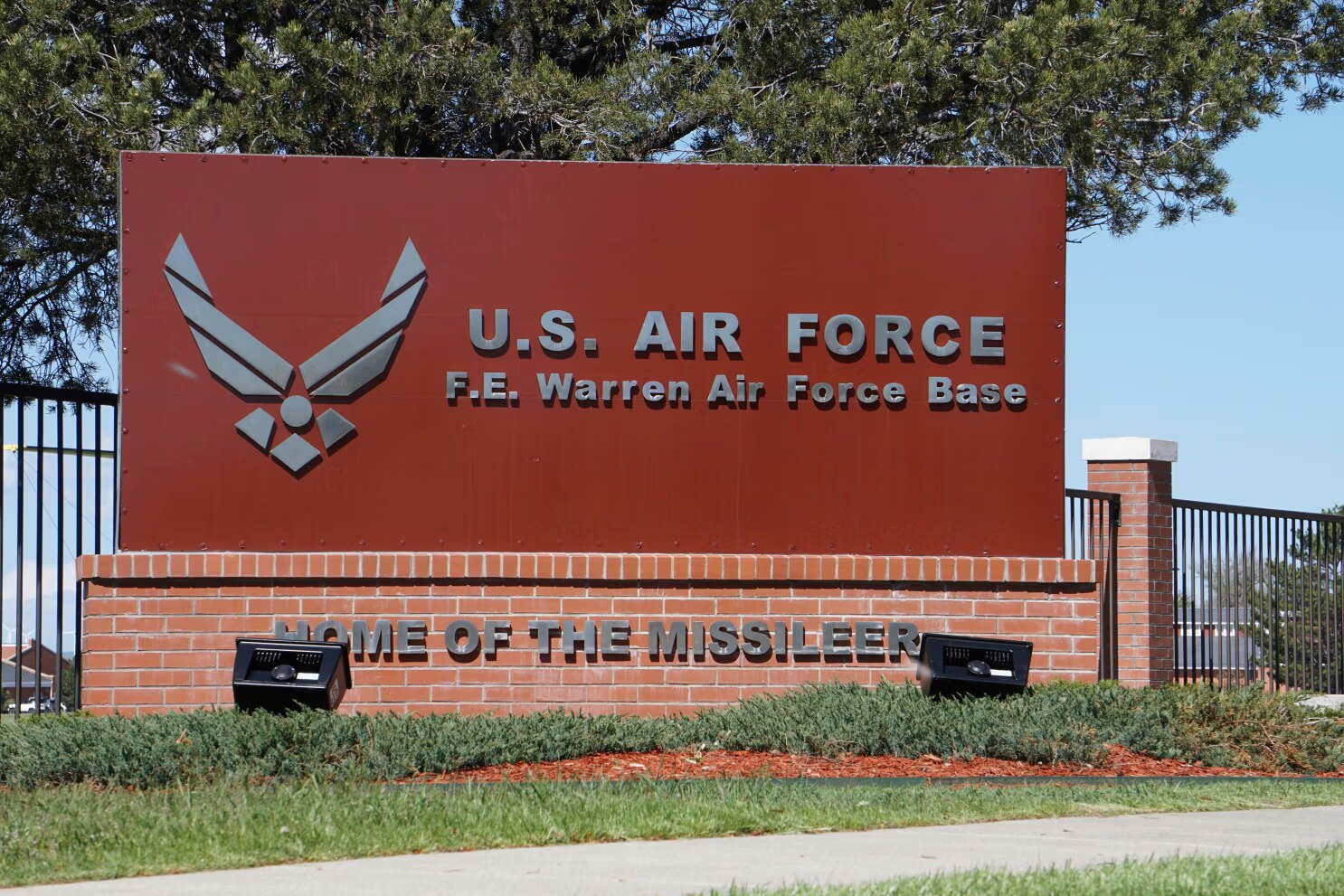
In the high-stakes world of military technology, every piece of equipment, no matter how robust or thoroughly tested, eventually meets the ultimate proving ground: human hands in real-world scenarios. This intersection was tragically highlighted by a recent incident at F.E. Warren Air Force Base, leading to an Airman’s arrest and, perhaps more significantly for the tech world and defense industry, a swift operational pause for a key military sidearm.

The news broke with the arrest of an Airman in connection with a fatal shooting. While the human tragedy and ongoing legal investigation are paramount, the immediate ripple effect within the Air Force Global Strike Command (AFGSC) sends a potent signal about the delicate balance between advanced weaponry, rigorous training, and the unwavering trust placed in both personnel and equipment. The command’s decision to temporarily halt the use of Sig Sauer’s M18 pistol for “qualifying and training purposes” for its security forces is more than just a procedural adjustment; it’s a critical moment of reconsideration, underscoring the profound impact a single event can have on the perception and deployment of critical technology.
This incident forces us to look beyond the immediate circumstances and consider the broader implications for how military hardware is developed, tested, and integrated into the complex human operational matrix. It challenges assumptions about reliability and highlights the persistent “human factor” in even the most sophisticated systems.
The M18: A Modern Mainstay Under Scrutiny
For those tracking military hardware development, the Sig Sauer M17 and its compact M18 variant represent a significant leap forward in firearm technology. These pistols famously replaced the venerable Beretta M9 as the U.S. military’s standard sidearm, a decision that followed extensive trials and promised enhanced ergonomics, modularity, and superior performance. This was not merely a minor upgrade; it was a wholesale modernization of a fundamental piece of soldier equipment, aimed at providing warfighters with a more adaptable and effective personal weapon.
The M18, in particular, embodies cutting-edge modern firearm design principles. It features a lightweight polymer frame, optics-ready slides that allow for the easy integration of red dot sights, and a focus on user adaptability through interchangeable grip modules. It’s a piece of tech designed to be an intuitive extension of the user, engineered for reliability and precision even under immense pressure and in demanding operational environments. Its adoption signified a move towards more customizable and technologically integrated personal weapons.
Yet, despite its advanced design and rigorous pre-deployment testing, this recent incident, regardless of its ultimate cause (which remains under thorough investigation), has forced a pause, a moment of profound reconsideration. It casts a spotlight not just on the weapon itself, but on the entire ecosystem of training, maintenance, and operational protocols surrounding its use within military hardware deployment.
The trust placed in such a vital piece of equipment is paramount for operational readiness and troop confidence. When that trust is momentarily shaken, even by an event whose full details are still emerging, it necessitates a systemic review to ensure the highest standards of firearm safety and operational integrity are maintained.
When “User Error” Meets Critical Performance
This isn’t the first time the M17/M18 platform has faced scrutiny regarding its performance characteristics. Earlier reports of “unintended discharges” had previously prompted discussions and internal reviews within various military branches. Consistently, Sig Sauer, the manufacturer, attributed these incidents to “user error,” emphasizing the importance of proper handling and adherence to safety procedures. A comprehensive 2020 Army safety review also concluded that there were no inherent mechanical issues with the firearm, seemingly validating the manufacturer’s stance.
This pattern, however, underscores a crucial and complex challenge inherent in the deployment of all advanced technology, especially in high-stakes environments like the military: how do you definitively separate genuine human error from potential design nuances that might inadvertently exacerbate such errors or make them more likely to occur under stress? In a civilian product, a glitch might lead to a simple recall or a software patch; in military hardware, particularly a sidearm, such a nuance, however small, can have catastrophic, life-altering consequences.
The concept of “user error” itself warrants deeper examination in military contexts. Soldiers operate under extreme psychological and physical duress, where cognitive load is high, and margins for error are razor-thin. A design feature that might be benign in a controlled range environment could become a liability during a high-stress, dynamic engagement. This is where human factors engineering becomes critically important, aiming to design systems that minimize the potential for error under all foreseeable conditions.
The AFGSC’s decision to pause training for the Sig Sauer M18, even while permitting duty carry with “additional safety procedures,” speaks volumes about their commitment to safety and operational excellence. It’s a proactive, measured response designed to reinforce safety protocols, allow for a thorough and impartial review of both the incident and the weapon’s integration, and most importantly, rebuild and sustain confidence in the equipment and the stringent protocols surrounding its use. This type of pause demonstrates a critical institutional capability to prioritize soldier welfare and system integrity above all else, even when faced with immediate operational demands.
Future Implications: Beyond the Firing Range
This tragic event, while specific to a military firearm incident, offers broader, invaluable lessons for the entire technology industry, particularly those involved in defense contracting and the development of high-reliability systems. It highlights systemic vulnerabilities and areas for improvement that extend far beyond the firing range.
1. The Unseen Variables of Adoption
Even the most rigorously tested and seemingly robust technology can encounter unforeseen challenges when integrated into complex human operations. Laboratory conditions and controlled test environments, no matter how exhaustive, can rarely fully replicate the chaotic, stressful, and unpredictable nature of real-world military deployments. The “human factor” is never truly eliminated; instead, it’s an ever-present variable that must be continuously accounted for, modeled, and mitigated. This includes understanding the cognitive load on operators, the impact of fatigue, environmental factors, and the unique psychological pressures inherent in combat or security roles. Future weapon systems must incorporate even more adaptive training and design philosophies to address these variables.
2. Reputation and Trust are Fragile
For defense contractors like Sig Sauer, a single incident, even if ultimately deemed “user error” or unrelated to mechanical failure, can create significant headwinds. The military procurement process is inherently cautious, driven by accountability and the need for unwavering confidence in equipment. Regardless of the investigation’s ultimate outcome, the public and institutional trust in the M18’s absolute reliability will undoubtedly be tested. This can affect future contracts, R&D investments, and overall market perception. Building and maintaining this trust requires not just product excellence, but also transparency, proactive communication, and a demonstrable commitment to safety and continuous improvement. The incident underscores the critical importance of a robust incident reporting mechanisms.
3. Enhanced Scrutiny for Future Deployments
This situation will almost certainly lead to even more stringent safety reviews, more comprehensive and adaptive training protocols, and perhaps new or enhanced incident reporting mechanisms for all critical military hardware. The bar for proven reliability and user-friendliness, already high, will only continue to rise. This could involve integrating advanced sensor data from training exercises, leveraging AI for predictive analysis of potential failure points, or even redesigning user interfaces to be more intuitive under extreme stress. Defense contractors will need to demonstrate not just that their technology works, but that it works flawlessly and safely within the dynamic human-machine interface of modern warfare, pushing the boundaries of operational readiness and system validation.
4. The Power of a “Pause”
The ability to quickly and decisively pause and review critical operations is a hallmark of resilient and responsible systems. The AFGSC’s immediate action demonstrates a clear commitment to safety over expediency, a valuable lesson for any industry dealing with high stakes and complex technologies. This “pause” allows for reflection, unbiased analysis, and the implementation of corrective measures without the pressure of maintaining a potentially compromised status quo. It fosters a culture of learning and continuous improvement, which is essential for adapting to new challenges and ensuring the long-term effectiveness and safety of military personnel and their equipment. This proactive approach reinforces the concept of military equipment safety as a foundational principle.
While the investigation into the tragic shooting continues, the temporary halt of the M18’s use is more than just an operational adjustment for the Air Force Global Strike Command. It’s a stark reminder that even the most advanced military technology exists within a delicate ecosystem of human trust, rigorous training, and an unwavering commitment to safety. The future of military hardware will continue to be shaped not just by innovation in materials science or digital integration, but profoundly by our collective ability to learn from every incident, big or small, that challenges its deployment and the human element at its core. This continuous feedback loop is vital for ensuring the effectiveness and security of our defense forces.
Read the original story at AP News. Updated 9:57 PM ET, February 26, 2024.
What steps do you think are most crucial for defense contractors and military branches to take to further enhance the safety and reliability of advanced weaponry in dynamic operational environments?