The Unseen Frontline: Why Moldova’s Election is a High-Stakes Battle for Europe’s Soul
In the grand theater of geopolitics, the most decisive battles are not always fought with tanks and trenches. Sometimes, they unfold in the quiet corners of the continent, through the subtle, corrosive drip of disinformation, economic pressure, and political subversion. Right now, one such battle is raging for the future of Moldova, and its outcome will send shockwaves far beyond its borders, shaping the very definition of European security and sovereignty.
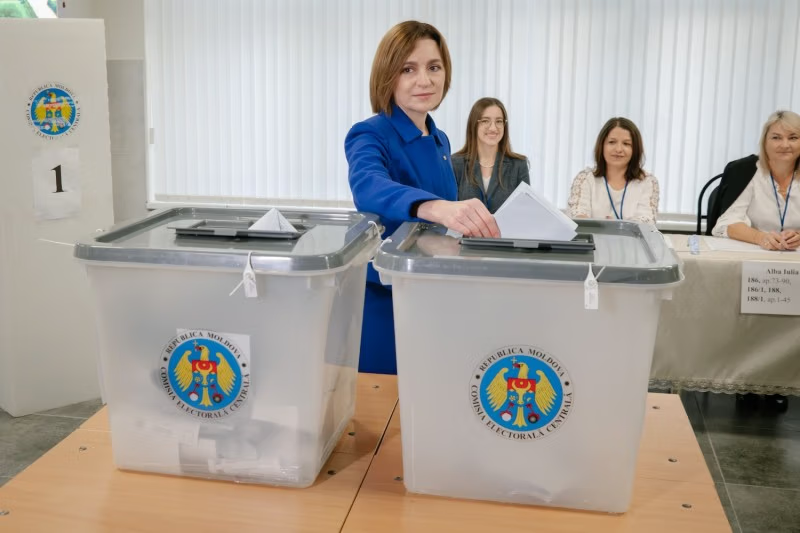
Nestled between Romania and war-torn Ukraine, this small, aspiring European nation is gearing up for an election that is less a domestic political contest and more a referendum on its destiny. On one side stands a fiercely pro-Western government, led by President Maia Sandu, that has staked its future on European integration, democratic values, and a future free from Moscow’s influence. On the other looms the long shadow of the Kremlin, which sees Moldova’s westward pivot as an unacceptable affront to its historical sphere of influence and is deploying its full hybrid warfare arsenal to halt it, often with brutal efficiency.

This is not mere speculation; it is the clear and present reality, meticulously documented by intelligence agencies and independent observers alike. Moscow’s playbook, honed over decades in various post-Soviet states and supercharged in the digital age, is on full display. It’s a multi-front assault designed to erode public trust, cripple the economy, undermine democratic institutions, and ultimately install a pliable, pro-Russian regime in Chișinău. This includes unleashing a barrage of sophisticated disinformation campaigns to sow division, weaponizing energy supplies to punish citizens and stoke discontent, and funneling illicit cash to Moscow-friendly politicians and oligarchs who promise stability at the cost of sovereignty and genuine democratic progress.
The Unfolding Hybrid War: Kremlin’s Playbook in Detail
Disinformation Campaigns and Media Manipulation
Russia’s primary weapon in Moldova is the weaponization of information. Through a sophisticated network of proxy media outlets, social media bots, and paid influencers, the Kremlin actively floods the Moldovan information space with narratives designed to discredit the pro-Western government, fuel anti-EU sentiment, and sow chaos. These campaigns often exploit existing societal vulnerabilities, such as economic anxieties or cultural divides. Common themes include portraying the European Union as corrupt and decadent, claiming Western aid comes with unbearable conditions, and accusing President Sandu’s government of betraying Moldovan national interests in favor of Brussels or Washington. False stories about impending economic collapse, threats to traditional family values, or even direct military provocations from Ukraine or Romania are routinely circulated. The goal is not necessarily to convince everyone of a specific lie, but to create an atmosphere of pervasive distrust, where citizens become cynical about all sources of information, making them more susceptible to narratives that promise simple solutions, often from Moscow-aligned figures. This erosion of trust in independent media and democratic institutions is a crucial precursor to political subversion.
Weaponizing Energy and Economic Pressure
Moldova, historically reliant on Russian energy supplies, has been particularly vulnerable to Moscow’s economic leverage. The Kremlin has repeatedly used gas prices and supply cuts as a political cudgel, especially during crucial electoral periods. By artificially inflating energy costs or threatening disruptions, Russia aims to create widespread public discontent, directly linking the hardships faced by ordinary Moldovans to the pro-European policies of their government. This economic pressure extends beyond energy. Russia has also imposed trade embargoes on Moldovan agricultural products, hindering exports and punishing farmers for their country’s political alignment. Furthermore, Moscow-linked actors have been implicated in efforts to destabilize Moldova’s financial sector, encourage capital flight, and discourage foreign investment. The cumulative effect is to weaken the state, make citizens feel the tangible costs of their Western alignment, and thus make them more amenable to a return to a Russian orbit, believing it offers a path to stability and lower living costs.
Political Subversion and Illicit Financing
A cornerstone of Russia’s hybrid strategy in Moldova is the direct support and funding of pro-Russian political parties and oligarchs. Figures like Ilan Shor, a fugitive businessman and politician, have become emblematic of this interference. Shor’s party, now banned but operating through various proxies, has allegedly received millions of dollars in illicit funds from Moscow to organize anti-government protests, bribe voters, and finance extensive propaganda campaigns. These funds are channeled through complex offshore schemes, making them difficult to trace and proving the Kremlin’s deep commitment to subverting Moldovan democracy from within. The objective is to foster political instability, fragment the pro-Western political landscape, and ultimately install a government that would reverse Moldova’s European course. By exploiting corruption, a persistent challenge in Moldova, Moscow seeks to co-opt key political and economic actors, turning them into instruments of its foreign policy, effectively outsourcing the work of destabilization to local collaborators.
Moldova’s Strategic Significance: More Than Just a Small Nation
A Critical Test of European Resolve and Credibility
The stakes could not be higher, and they extend far beyond Chișinău. First, Moldova represents a critical test of European resolve and the transformative power of its values. For years, the European Union has preached the promise of integration and the fundamental appeal of democratic governance, human rights, and the rule of law. In Moldova, a nation that has bravely chosen this path despite immense pressure, those promises are being put to the ultimate test. Moldova’s decision to apply for EU membership, accelerated by Russia’s full-scale invasion of Ukraine, was a profound act of self-determination. If Russia succeeds in derailing Moldova’s European trajectory through hybrid means, it will be a devastating blow to the EU’s credibility and a resounding victory for Vladimir Putin. It would send a chilling message to other nations in the Western Balkans, Georgia, and beyond: the path to Europe is fraught with peril that Brussels may be unable or unwilling to counter effectively. This perception of European weakness would severely undermine the EU’s foreign policy ambitions and its role as a global actor.
The Blueprint for Future Conflict: Russia’s Grey Zone Tactics
Second, the fight for Moldova is a disturbing preview of the future of conflict. Russia’s actions demonstrate that its imperial ambitions are not confined to the conventional battlefield in Ukraine. The Kremlin is waging a parallel, undeclared war to destabilize its entire periphery, perfecting a model of “grey zone” warfare that operates below the threshold of direct military confrontation but achieves strategic objectives. Success in Moldova would embolden Moscow, proving that it can achieve its geopolitical goals of creating fractured, subservient buffer states without firing a single shot on new territory. It would validate a model of interference that could be redeployed with even greater sophistication in the Balkans (e.g., Serbia, Bosnia and Herzegovina), the Caucasus, or even within the borders of vulnerable NATO and EU member states. This non-kinetic warfare—focused on information, economics, and political subversion—is harder to define, harder to deter, and harder to respond to than traditional military aggression, making Moldova a crucial proving ground for a new era of international rivalry.
Protecting Ukraine’s Flank and Regional Stability
Beyond its internal struggle, Moldova holds significant strategic importance for the broader security of Eastern Europe, particularly concerning Ukraine. Moldova shares a lengthy border with Ukraine, and a pro-Russian government in Chișinău could potentially open a new logistical route for Russian forces or enable further destabilization efforts against Ukraine from its western flank. The breakaway region of Transnistria, supported by Russian troops since the early 1990s, already presents a persistent flashpoint and a ready-made platform for Russian influence. Should Moscow consolidate its control over Moldova, it could transform Transnistria into a more active staging ground, threatening Ukraine’s southwestern regions, including the vital port city of Odesa. Such an outcome would not only complicate Ukraine’s defense but also profoundly alter the security architecture of the Black Sea region, giving Russia enhanced leverage and projection capabilities that directly threaten NATO’s eastern flank and European energy routes.
A Proactive European Response: What Needs to Be Done
Bolstering Cybersecurity Defenses
The challenge for Europe is clear and immediate. Supporting Moldova is not merely an act of solidarity; it is an act of self-preservation and a strategic imperative. This support cannot be limited to rhetoric; it demands a robust, proactive strategy. A key pillar must be providing advanced cybersecurity capabilities to Moldova. This includes equipping its government institutions and critical infrastructure with state-of-the-art defenses against digital attacks, ransomware, and espionage. Furthermore, it involves training Moldovan specialists, establishing rapid incident response teams, and fostering closer intelligence sharing between Chișinău and EU/NATO cyber agencies. Protecting electoral systems from hacking and disinformation campaigns is paramount to ensuring the integrity of the democratic process and preventing Russian digital interference from swaying the outcome.
Targeted Sanctions and Counter-Oligarch Measures
Europe must go beyond general condemnations and impose harsh, targeted sanctions on the oligarchs, politicians, and entities acting as Kremlin proxies in Moldova. This means freezing their assets held in European banks, imposing travel bans, and actively dismantling their financial networks that funnel illicit Russian money into Moldovan politics. Increased transparency in political party financing and rigorous enforcement of anti-money laundering regulations are essential. By drying up the sources of funding for pro-Russian subversive activities, Europe can significantly diminish the Kremlin’s ability to manipulate Moldovan politics. Furthermore, international cooperation is vital to track and expose the complex financial schemes used to mask these illicit transactions, holding perpetrators accountable under international law.
Economic Resilience and Sustainable Development
To counter Russia’s weaponization of energy and economic pressure, Europe must accelerate its efforts to help Moldova build genuine economic resilience. This entails significant financial and technical assistance aimed at diversifying Moldova’s energy sources, including investments in renewable energy and connecting to alternative gas and electricity grids. Supporting the development of Moldova’s agricultural sector, fostering small and medium-sized enterprises, and encouraging foreign direct investment from Western sources can reduce economic dependence on Russia and create new opportunities for Moldovan citizens. Facilitating deeper integration into the EU single market through trade agreements and administrative alignment will further strengthen Moldova’s economic ties with the West, making it less vulnerable to Russian coercion and providing tangible benefits to its population.
Strategic Communication and Counter-Disinformation
Combating the flood of Russian propaganda requires a sophisticated and sustained strategic communication effort. Europe must actively support independent Moldovan media outlets, fact-checking organizations, and civil society initiatives that promote media literacy. The EU and its member states need to amplify clear, fact-based communication about the benefits of European integration, debunking Russian myths and presenting a compelling alternative vision for Moldova’s future. This involves not only passive information dissemination but also proactive campaigns that resonate with Moldovan citizens, addressing their concerns and highlighting the concrete advantages of democratic governance and EU partnership. Engaging directly with communities, including Russian-speaking populations, to provide accurate information is crucial to countering Moscow’s divisive narratives.
Enhanced Security Cooperation (Non-Military)
While Moldova is not a NATO member, enhanced security cooperation in non-military domains is crucial. This includes intelligence sharing regarding hybrid threats, organized crime, and corruption networks. Supporting reforms within Moldova’s justice system, police force, and border management agencies will strengthen the rule of law and make the country more resilient against internal and external destabilization attempts. These efforts should be geared towards strengthening Moldova’s institutional capacity to detect, prevent, and respond to foreign interference, ensuring that its internal security is robust enough to withstand Moscow’s pressure tactics.
The battle for Moldova’s future is being fought now—in its media landscape, in its energy infrastructure, in its political institutions, and crucially, in the hearts and minds of its people. For Europe, standing on the sidelines is not an option. To watch passively as a democratic, European-aspiring nation is dragged back into a gray zone of Russian influence would be a strategic and moral failure of historic proportions. Moldova is the unseen frontline, and how the West responds will help define the security and integrity of the entire European continent for a generation to come. The resilience of Moldova today will be a testament to the strength of European values tomorrow.
Read the original story at Foreign Policy.
What specific actions do you believe European nations should prioritize to ensure Moldova’s democratic future and prevent Russia from achieving its geopolitical objectives?